


Diamond Shapes: How to Choose One for You

Almost every diamond shape guide online was written for a proposal. One stone, one still hand, one photograph.
That is no longer how most stone jewellery is bought. According to De Beers' 2025 Diamond Acquisition Study, reported by GJEPC's Solitaire magazine, 52% of diamond jewellery purchases in India are now for daily wear, against 27% in 2014. Sixty-four percent of non-bridal diamond jewellery is self-purchased. Bridal now accounts for 29% of market value, while buyers aged 18 to 28 account for 51%.
So the question has quietly changed. It used to be "which shape looks best in the box?" It is now "which shape survives a Tuesday?"
This guide answers the second question. It covers every shape you will actually be offered, what each one does on a real hand, where each one fails, and how the answers change when the stone is moissanite or cubic zirconia rather than a diamond. Shape vocabulary is shared across all three materials, which is exactly why so much shape advice gets misapplied.
A note on language before we start, because it matters: at KYMEE we set moissanite and cubic zirconia, not diamonds. The shape names below (round brilliant, oval, emerald cut, and the rest) are cutting terms used across the industry for every transparent stone. Using them does not make a stone a diamond, and we will be explicit throughout about where the material changes the answer.
Shape is not cut, and the difference is about to matter more
These two words are used interchangeably in Indian retail, and they are not the same thing.
Shape is the outline. Round, oval, pear, emerald. What you see looking down at the stone.
Cut is the quality of the faceting inside that outline: proportions, angles, how well light is returned. Two ovals of identical outline and identical weight can look completely different because one is cut well and one is not.
Here is the part almost no Indian shape guide mentions. GIA issues a cut grade only for the standard round brilliant. In GIA's own words, "Diamond cut grades are only given to round brilliant cut diamonds because they are the only cut that have standardized facets." Every other shape (fancy shapes) receives polish and symmetry grades on standard GIA reports, though select fancy stones can opt for light-performance cut grading via the supplemental GIA AGS Ideal Report.
That is the single biggest reason two fancy-shaped stones at the same price can look nothing alike.
This is changing: In June 2026, GIA announced it will launch cut grading for select fancy shapes in 2027, beginning with marquise, oval, and pear. GIA noted that nearly a third of the diamonds it received for grading in 2022 were fancy shapes, up from under a quarter previously. Until that system arrives, and it will only cover three shapes at first, judging a fancy shape is still done with your eyes and with millimetre measurements, not with a grade on a certificate.
The practical takeaway for a buyer today: for round, a report can tell you a lot. For every other shape, you have to look.
-
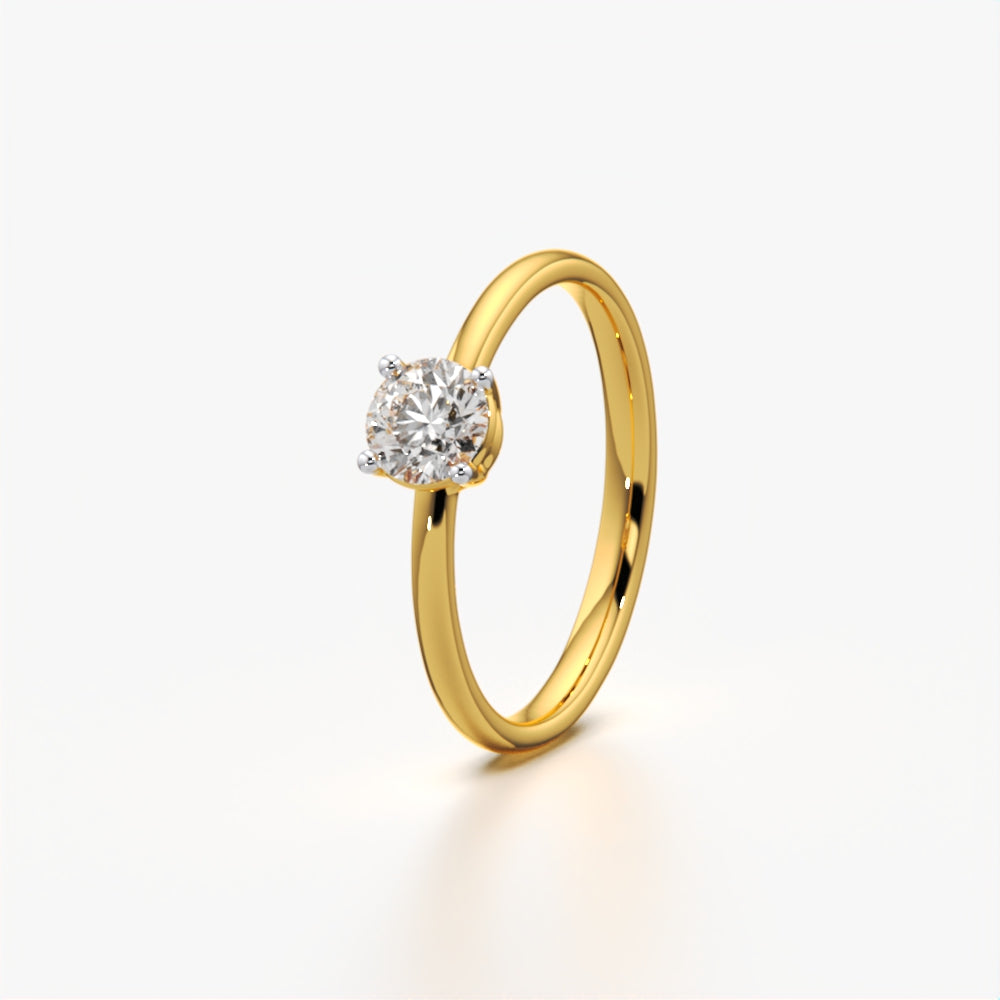
Classic Four-Prong Round Solitaire Ring
Shop Now -
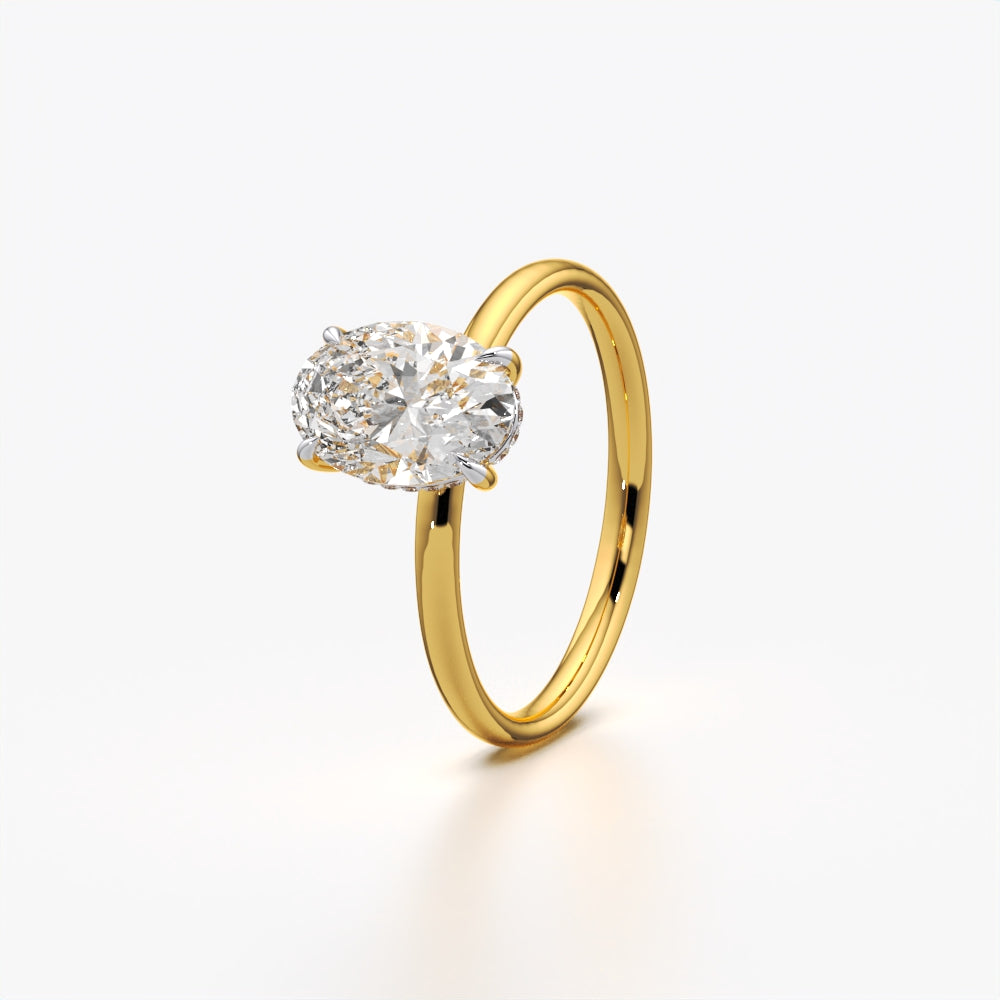
Classic Oval Solitaire Ring
Shop Now -
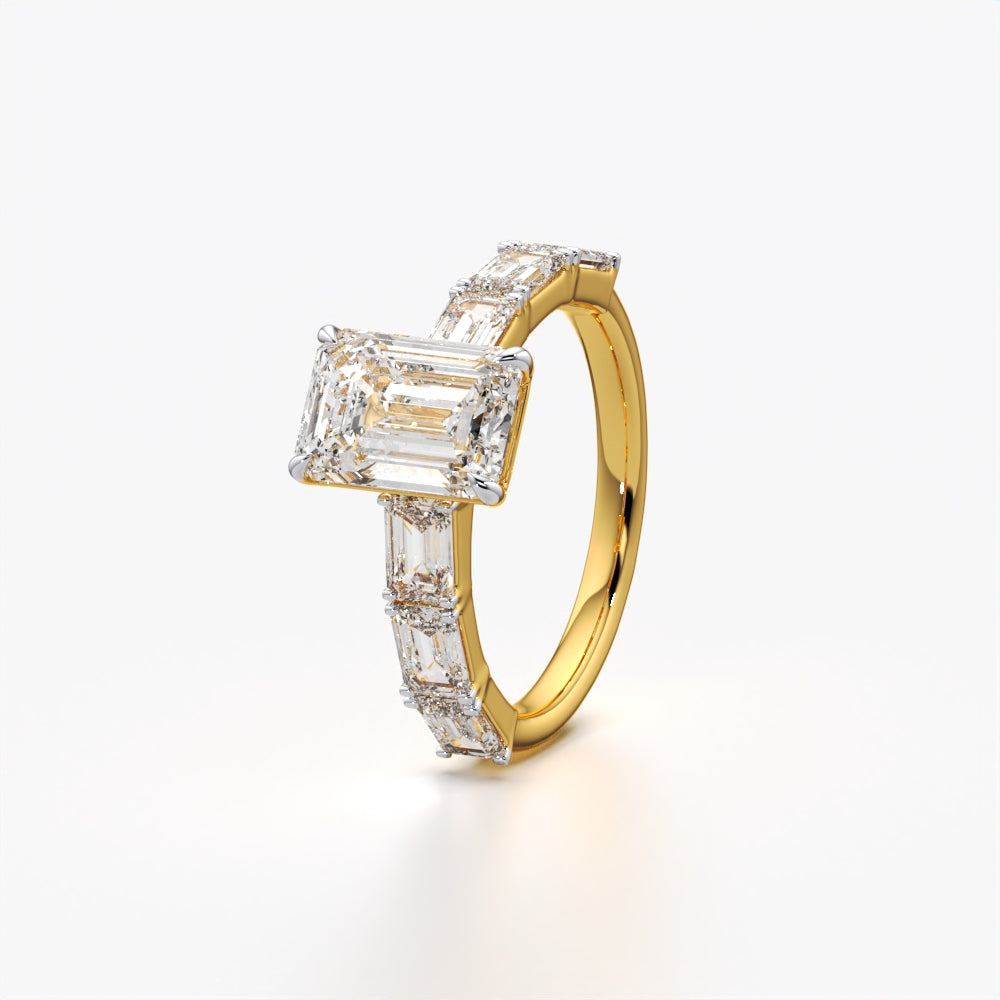
Emerald Cut Solitaire Ring with Baguette Side Stones
Shop Now -
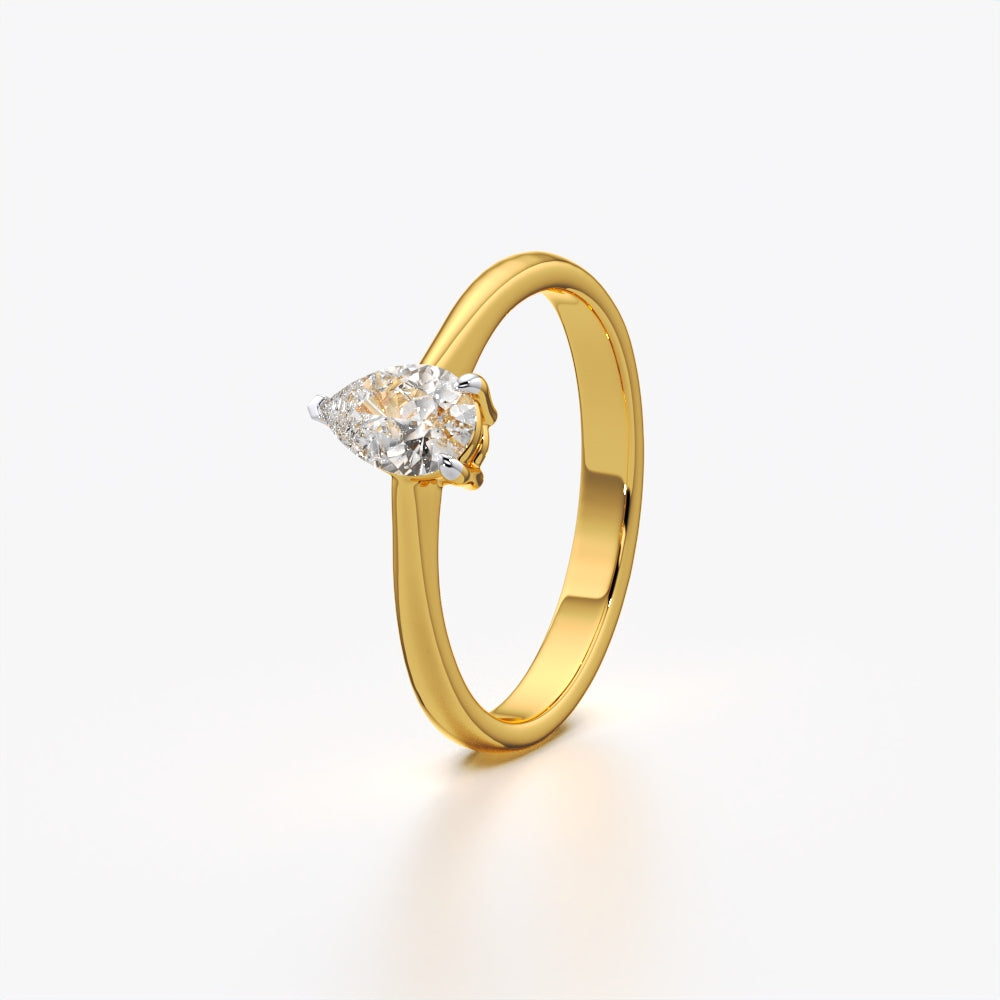
Pear Cut Classic Solitaire Ring
Shop Now
The four things your outline decides
Most guides describe shapes as personality types. Classic, bold, romantic, vintage. That framing is pleasant and tells you nothing useful.
An outline is a set of physical consequences. It decides four things at once, and they trade against each other.
- Footprint: How much of a finger the stone covers for a given weight. Elongated shapes spread. Compact shapes stack depth into invisible places.
- Perimeter risk: Points and sharp corners are where stones chip and where metal catches fabric. A curve has neither.
- Light behaviour: Many small facets create scattered sparkle. Few large facets create broad, slow flashes. This is a style decision, not a quality one.
- Stack geometry: How the outline sits against a wedding band, a stacking ring, a bangle, or a mangalsutra chain. Some shapes leave a gap. Some nest.
No shape wins all four. Round is safest and smallest per rupee. Marquise is the largest-looking and the most fragile. Emerald is the calmest and the least forgiving. Pick which two of the four you actually care about and the list shortens fast.
The bangle line: an Indian wear test no Western guide runs
Western shape guides assume a bare hand. An Indian hand very often is not bare.
The bangle line is the path a bangle, kada, or watch travels as it slides from the wrist toward the knuckle. If you wear bangles at all, even occasionally, your ring's stone spends part of every day sitting inside that path, getting bumped from the wrist side.
Run this test before you buy:
- Does the stone stand tall? High four-prong settings put the girdle of the stone right where a sliding bangle hits it. Bezel and low-profile settings clear the line.
- Does the outline end in a point that faces the wrist? A pear worn point-down and a marquise worn lengthwise both put their most fragile tip into the collision zone.
- Do exposed corners face outward? A princess cut with its corners left unprotected takes hits from both the bangle side and the outside of the hand.
Two more Indian-specific checks worth thirty seconds each:
The dupatta test: Georgette, chiffon and net catch on raised prongs and pointed tips. If you wear a dupatta most days, a bezel-set oval or a low round will save you a lot of pulled thread.
The atta test: Open-gallery settings, the ones that leave the underside of the stone exposed for light, also let dough, turmeric and haldi pack in underneath. Nothing about this ruins a piece, but it does mean an under-stone that needs cleaning weekly rather than monthly. If you cook daily and want a low-maintenance stone, favour closed-back or bezel settings, and favour shapes with a simple perimeter that a brush can actually reach.
-
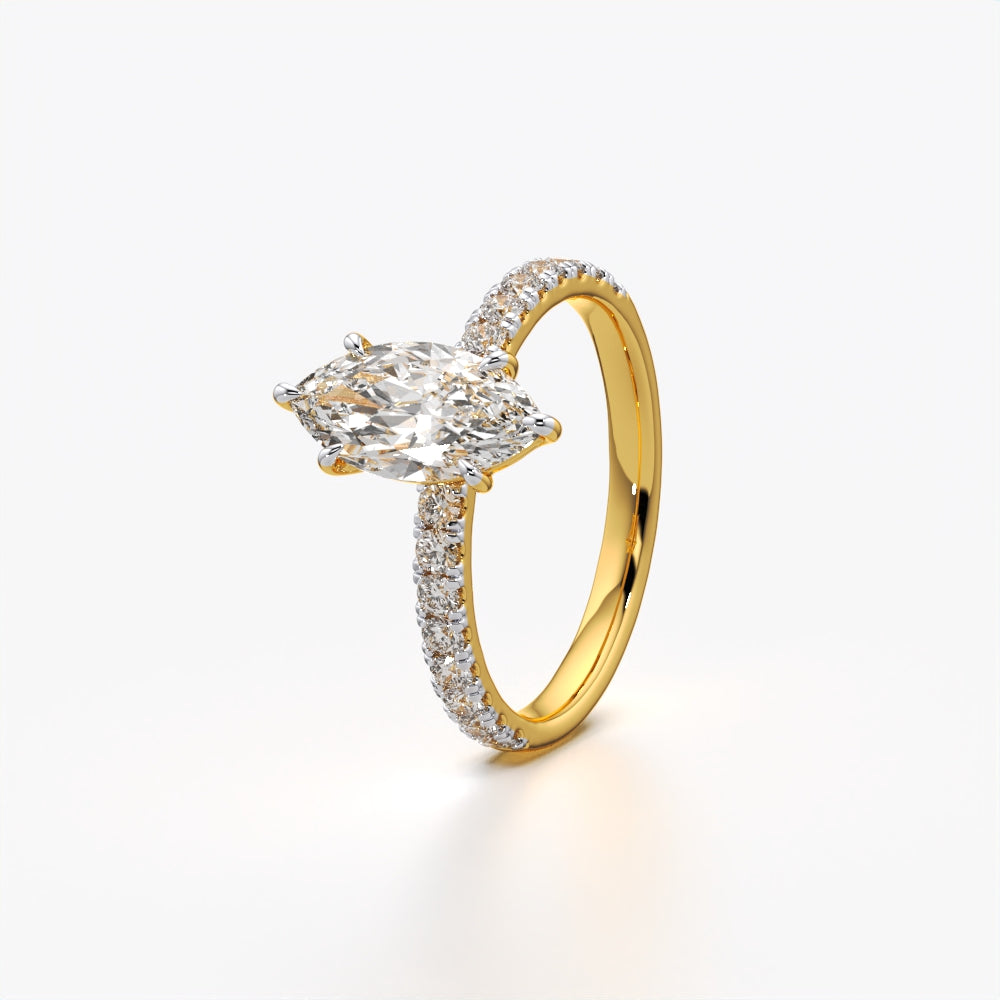
Marquise Cut Pave Solitaire Ring
Shop Now -
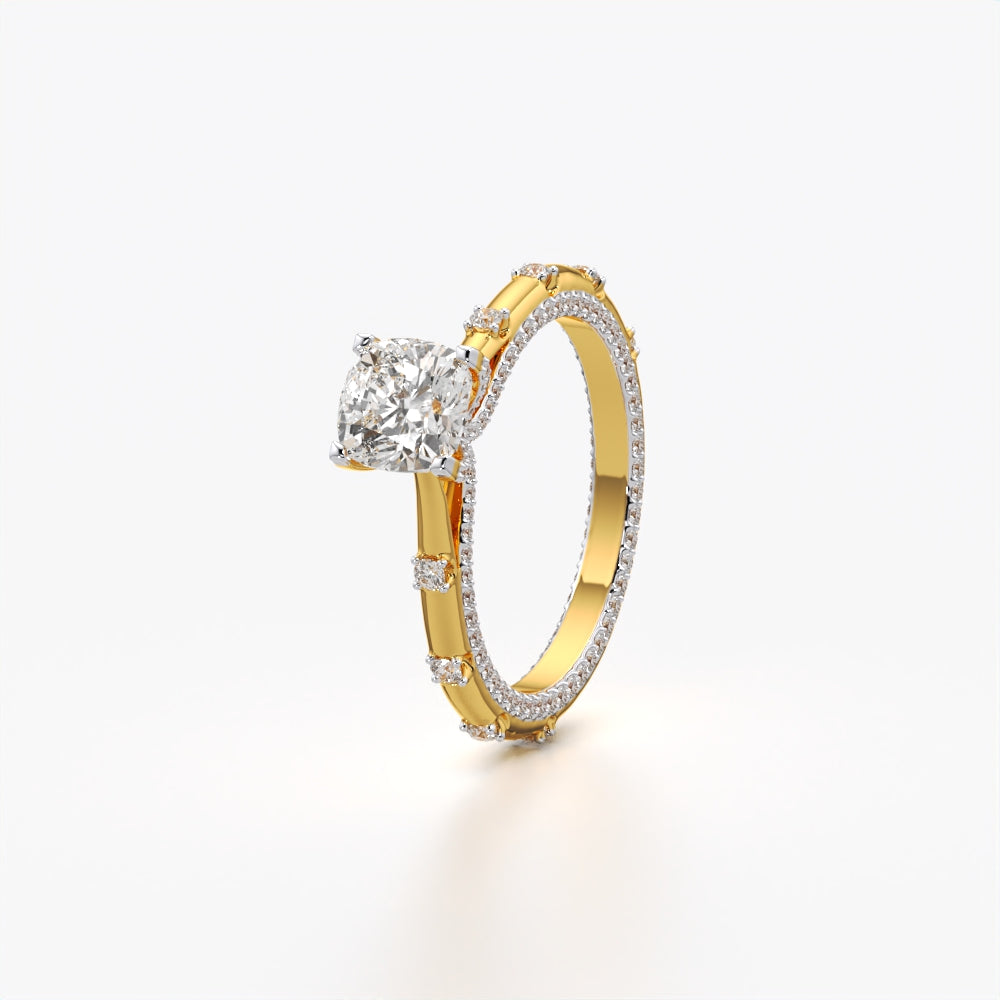
Cushion Solitaire Pave Crown Ring
Shop Now -
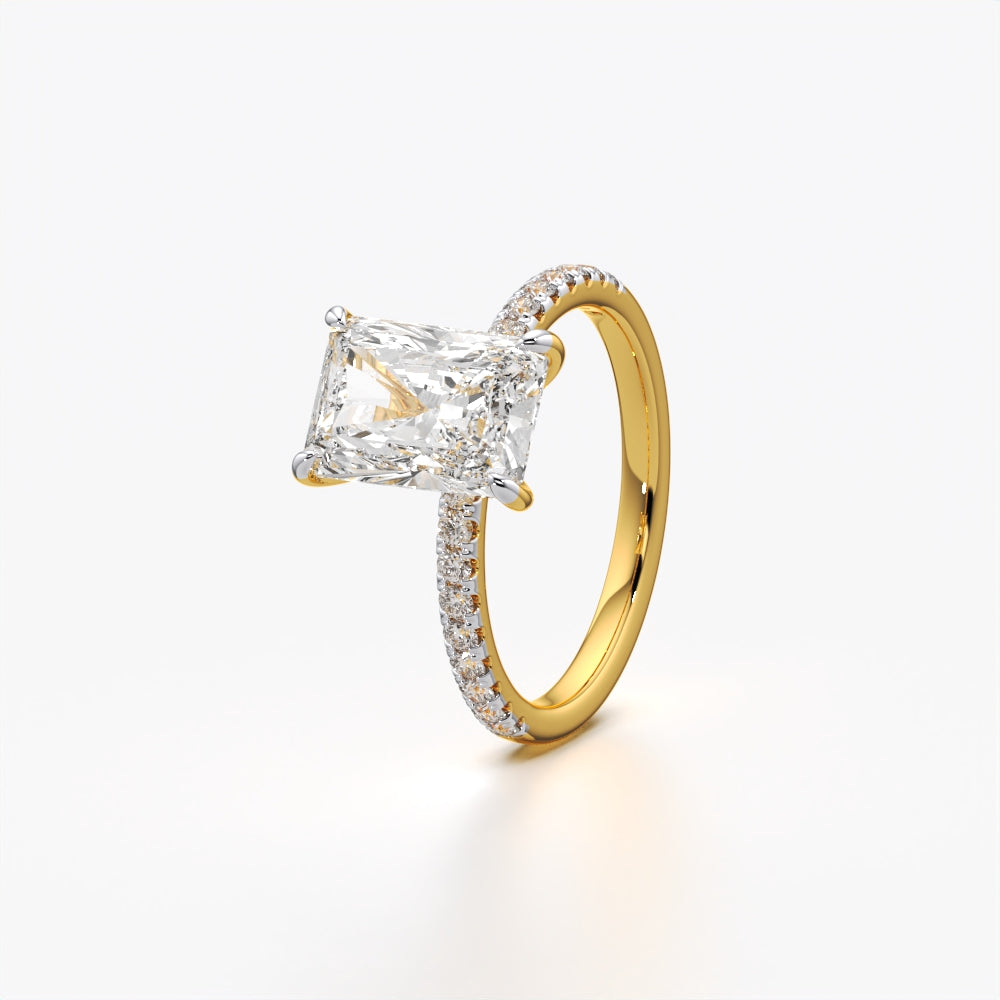
Modern Radiant Solitaire Ring
Shop Now -
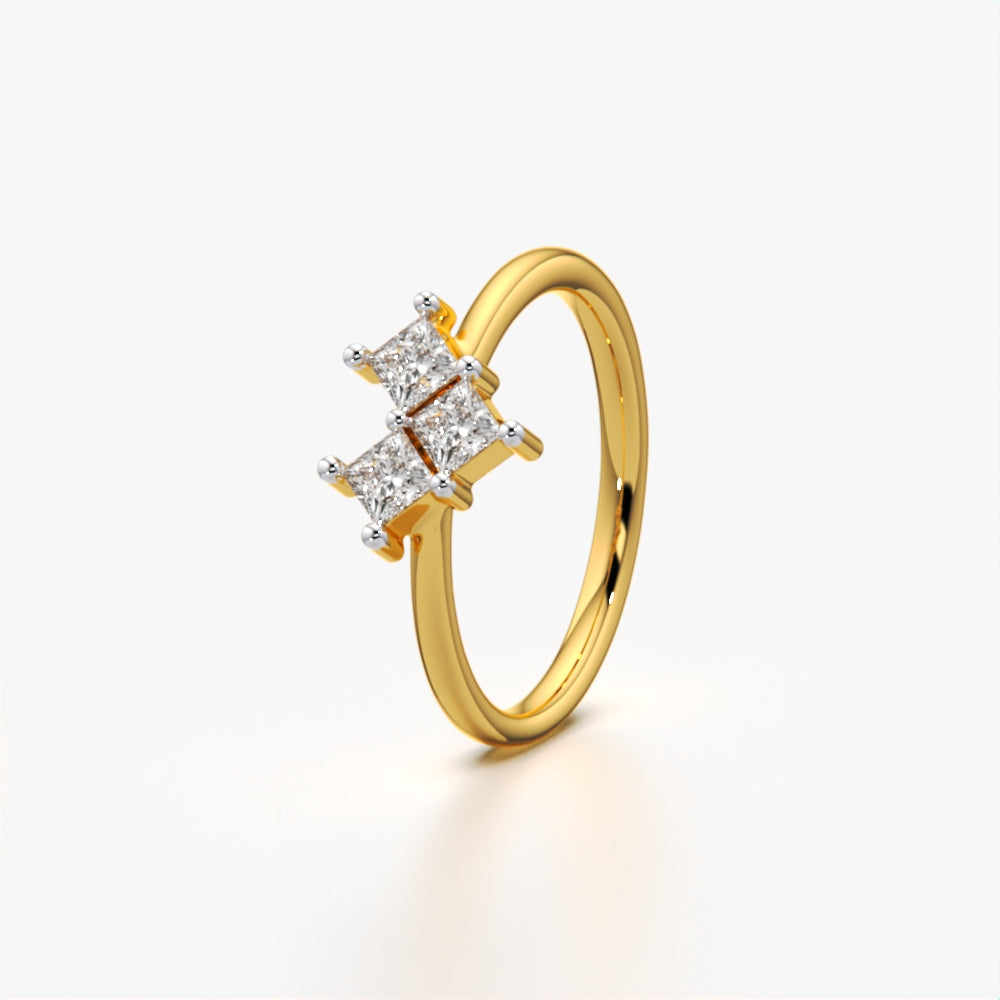
Princess Cut Cluster Staggered Ring
Shop Now
The shape tax, and why it mostly disappears in demi-fine
In diamonds, shape is a price variable. Round brilliants carry a premium widely cited by the trade at roughly 20% to 40% over fancy shapes of equal quality, and recent Rapaport market analysis places standard fancy shapes roughly 20% to 25% below rounds on average, though high-demand elongated shapes maintain a much tighter margin. The reason is yield: a round brilliant discards roughly half to 60% of the rough stone, while a princess cut can use up to 80%.
Popular fancy shapes narrow that gap. Ovals now trade at only about 10% to 15% below rounds because demand caught up. Less fashionable shapes like marquise sit well over 25% below.
Now the part that changes the decision for most readers of this page. That entire pricing logic comes from natural rough. It does not transfer cleanly to moissanite or cubic zirconia, which are grown and cut to order. At demi-fine price points, the difference between shapes is largely a function of labour and popularity, not of wasted material.
The practical consequence is liberating: if you are buying moissanite or CZ, you are not paying a meaningful premium for round, and you are not being rewarded for compromising on marquise. The budget argument for a fancy shape mostly evaporates. Which means you should choose the shape you actually want to wear, judged on the four things above, and nothing else.
The shapes, one at a time
Each shape below is judged on outline, what it does on the hand, who it genuinely suits, what to watch for, and how it behaves when the stone is moissanite or CZ rather than diamond.
Round brilliant

Outline: A circle. Fifty-eight facets in the standard arrangement.
On the hand: The smallest face-up footprint of any shape at a given weight, and the most forgiving of everything else. No corners, no points, nothing to snag.
Suits: Anyone who wears their ring constantly and does not want to think about it. First rings. Gifts where you do not know the recipient's taste. Stud earrings, where symmetry does more work than spread.
Watch for: It is the shape most likely to look smaller than expected, because you are paying weight into a deep pavilion that nobody sees. Buy by millimetre, not by carat.
In moissanite or CZ: Round is the single biggest amplifier of fire. Moissanite's dispersion is 0.104, more than twice diamond's 0.044, and a round brilliant's many small facets split that into coloured flashes. If you want maximum sparkle, this is your shape. If the "disco ball" look is not for you, this is the shape to avoid, particularly above roughly 1.5 carats equivalent. CZ sits in between, with dispersion of 0.058 to 0.066.
Browse classic solitaire rings.
Oval

Outline: An elongated ellipse. Brilliant faceting, so it sparkles like a round.
On the hand: The best-value spread in mainstream retail. At the same weight, an oval covers noticeably more finger than a round and visually lengthens the hand. Ideal length-to-width ratio runs about 1.30 to 1.50.
Suits: Buyers who want presence without going up in size. Shorter fingers, where the vertical line helps. Daily wear, because the perimeter is entirely curved.
Watch for: The bow tie. Ovals, pears and marquises can show a dark band across the centre caused by the wearer's own head and body blocking light from entering the stone. Severity is not recorded on any grading report and is judged only by eye. Contrast across the centre is normal and even attractive. A hard black bar is not. Look at the stone at arm's length under ordinary indoor light, not under a jeweller's spotlight.
Also watch the ratio. Below about 1.30, an oval starts to read as a badly cut round. Above about 1.55, it starts to look thin and shows bow tie more readily.
In moissanite or CZ: Ovals amplify fire almost as much as rounds, and the elongated shape smears coloured flashes into streaks as your hand moves. Beautiful in motion, busy in still photographs.
Cushion

Outline: A square or slightly rectangular shape with rounded corners. Historically called a pillow cut.
On the hand: Softer than a princess, warmer than a round. At 1 carat, a cushion measures around 5.5mm across, compared to 6.4 mm for a round, so it reads smaller than its weight unless you choose an elongated cushion.
Suits: Buyers who want a square silhouette without exposed corners. Vintage-leaning styling. Halo settings, which cushions carry better than almost any other shape.
Watch for: "Crushed ice" cushions, with chaotic small facets, versus "chunky" cushions, with fewer, larger facets. They look completely different, and the listing rarely tells you which you are getting. Ask for a video, not a photo.
In moissanite or CZ: Chunky cushions are one of the calmest ways to wear moissanite, producing broad, glowing flashes rather than rainbow confetti. Crushed ice cushions do the opposite. This single choice matters more than the shape name.
Princess

Outline: A square with four sharp, uncut corners. Brilliant-style faceting underneath.
On the hand: Crisp, modern, geometric. Sits flush against a straight band with no gap, which makes it one of the best shapes for a stacked wedding set.
Watch for: Those four corners are the most exposed structural points of any common square shape and chip readily if left unprotected. A princess should be set with prongs that extend directly over each corner, or bezelled. If a listing shows corners sitting naked between prongs, it is a design problem, not a style choice.
In moissanite: Moissanite's hardness of roughly 9.25 to 9.5 on the Mohs scale means corner chipping is rare with sensible settings. In CZ, this matters more. Cubic zirconia is 8 to 8.5 on Mohs, softer than either, and CZ facet edges abrade visibly over time in ways diamond edges do not. A princess in CZ is the combination most likely to look tired after a couple of years of daily wear. If you love the square look and intend to wear it every day, a cushion or an emerald cut, both of which have protected corners, will age better.
Emerald cut

Outline: A rectangle with clipped corners and long, parallel step facets.
On the hand: The most elegant and the most understated. It does not sparkle. It flashes, in broad sheets, like light on water. Ideal ratio runs about 1.30 to 1.50. It has a large open table, so it reads bigger than its weight from directly above.
Suits: Anyone who finds brilliant-cut sparkle too loud. Office and daily wear. Bezel settings, which suit its geometry.
Watch for: Step cuts hide nothing. In a diamond, that means inclusions and body colour show. The same principle applies to any stone: an emerald cut is the least forgiving outline of whatever is inside it. Also, its large flat table shows surface scratches and film more visibly than a faceted dome does, so hard water spotting is more apparent.
In moissanite: This is the key recommendation of this entire guide for anyone who has ever said moissanite looks "too sparkly." Step cuts are the most effective way to suppress rainbow fire. Long, flat facets act as mirrors and produce white flashes rather than coloured ones. An emerald cut moissanite is a completely different visual experience from a round moissanite of identical size, and it is the one most often mistaken for a diamond in ordinary light.
Asscher

Outline: A square step cut with clipped corners. Essentially a square emerald cut with a deeper, more dramatic facet arrangement.
On the hand: Architectural. Produces a distinctive "hall of mirrors" effect looking into the stone.
Suits: Art Deco styling. Buyers who want the calm of a step cut in a square footprint.
Watch for: Same as emerald. Nothing is hidden, and a small Asscher can read as merely a small square. This shape needs a bit of size to show what it does.
In moissanite: Along with emerald, the lowest-fire option available. Excellent for a quiet, expensive-looking piece.
Pear

Outline: A teardrop. Rounded at one end, pointed at the other. Ideal ratio about 1.45 to 1.75.
On the hand: One of the largest spreads per unit of weight. Worn point-up toward the nail, it visually lengthens the finger more than any shape except marquise.
Suits: Statement rings, drop pendants and earrings, where the point has a natural downward orientation and nothing to catch on.
Watch for: Two things. The point is the most vulnerable part of the stone and should always sit inside a V-prong that wraps around it. And pears show a bow tie, sometimes severely. A pear also needs strong symmetry: if the two shoulders are uneven, it reads as crooked from a metre away, and no certificate flags that.
In moissanite or CZ: In a pendant or earring, an excellent choice at any hardness. In a daily-wear ring in CZ, the point is the weakest link on the softest material. Set it with a V-prong or choose a different shape.
Marquise

Outline: A long ellipse with a point at each end. Ideal ratio: about 1.75 to 2.25 (lean toward 1.75–1.90 for better daily-wear durability against bangle bumps).
On the other hand: The champion of apparent size. A 1 carat marquise stretches to roughly 10.5mm along its length, against 6.4mm for a round of the same weight. Nothing else covers this much finger for this little weight.
Suits: Buyers who want maximum visual size for their budget. Vintage and navette-inspired designs. Accent stones in vine and cluster settings, where marquises do beautiful work.
Watch for: It is the most fragile common shape, with two exposed points rather than one, and it is the most bow-tie-prone. Both tips need V-prongs. Worn lengthwise across the finger, it also sits directly in the bangle line at both ends.
In CZ especially: A large solitaire marquise in cubic zirconia for daily wear is the highest-risk combination in this guide. As an accent stone in a pavé or vine setting, where the points are enclosed by metal, it is entirely sensible and looks lovely.
KYMEE sets marquise both ways, as solitaires and as vine accents. If you want the shape for everyday, the accent versions are the more durable choice.
Radiant

Outline: A rectangle or square with clipped corners, but with brilliant-style faceting rather than step facets.
On the other hand: The compromise shape. Emerald's silhouette, round's sparkle. Rectangular ratios run about 1.20 to 1.35; square radiants sit near 1.00 to 1.05.
Suits: Buyers torn between emerald and oval. The clipped corners make it far more durable than a princess.
Watch for: Radiants are deep. A lot of weight hides below the girdle, so face-up size can disappoint relative to the carat figure.
In moissanite: High fire, similar to round and oval. Not the shape to pick if you want restraint.
Heart

Outline: A brilliant cut with a cleft at the top and a point at the bottom. Ratio around 0.90 to 1.10.
On the hand: Unambiguous. It is a statement about sentiment, not about stone quality.
Watch for: Two vulnerable zones, the point at the base and the cleft at the top, and a shape where poor symmetry is immediately obvious to everyone. Below roughly 0.50 carat equivalent, a heart tends to read as an indistinct blob rather than a heart. Size it up or choose a different shape.
Best use: Pendants and studs rather than daily-wear rings.
Baguette

Outline: A small, elongated step-cut rectangle. Tapered baguettes narrow toward one end.
On the hand: Rarely a centre stone. Baguettes do their best work flanking a solitaire, forming a channel-set band, or creating the clean linear look in an eternity or tennis design.
Watch for: Step-cut clarity rules apply, though at baguette scale nothing is visible anyway. The real risk is the setting: channel-set baguettes can loosen and rattle over time, and a loose one is hard to notice until it falls out. Check them under a bright light every few months.
In moissanite or CZ: Excellent. At this size, fire is muted regardless of material, and the linear look reads as expensive.
Browse tennis bracelets and wedding bands.
The accent shapes: trillion, half moon, kite
You will see these in three-stone rings and side settings rather than as centres. Trillions have three points and need protection on all of them. Half moons nest beautifully against an emerald or radiant centre. Kites are having a moment in Indian demi-fine design and work well in cluster and vine settings.
Judge them by how enclosed they are by metal. Enclosed accents in any of these shapes are low-risk. Exposed points are not.
Match shape to the piece, not just to the finger
Shape advice defaults to rings. Most jewellery is not a ring.
Stud earrings: Symmetry beats spread. Round and princess dominate because a stud is seen from an angle, in motion, at a distance, where outline reads before facets do. Ovals and pears work as studs only if they are oriented consistently in both ears. Points matter less here because ears do not collide with bangles, but they do collide with hair and dupattas.
Pendants and necklaces: Elongation is your friend. Pear, marquise, and oval hang correctly and draw a vertical line. A round pendant reads as a dot. Pendant orientation also protects points: a pear hanging tip-down has its most fragile part suspended in air rather than pressed against anything.
Mangalsutra: The stone here is worn continuously, often for years without removal, against skin and fabric at the neckline. This is the strongest possible case for curved, low-set outlines: round, oval, or bezel-set cushion. Points and exposed corners are the wrong answer for a piece you are not going to take off.
Tennis bracelets and eternity bands: Round and baguette. The wrist takes more physical abuse than any other part of the body that wears jewellery, and a line of identical stones exposes any shape irregularity immediately.
Stacking rings: Straight-edged shapes nest. Princess, emerald, baguette and asscher sit flush against a plain band. Round, oval and cushion leave a visible gap unless the band is contoured.
Browse stud earrings, mangalsutra and stackable rings.
Finger shape advice, honestly assessed
The standard advice runs: elongated shapes for short fingers, compact shapes for long fingers, avoid wide shapes on wide fingers.
There is something to it. An oval or marquise genuinely does draw a vertical line that makes a short finger look longer, and a large round on a slim finger genuinely does read as top-heavy.
But two things get left out.
First, ratio outranks shape: A 1.30 oval and a 1.50 oval are different objects. If you are choosing an elongated shape for the lengthening effect, you should be asking for the length-to-width ratio, not just the shape name. Most Indian listings do not publish it. Ask.
Second, band width does more work than stone outline: A narrow band on a wider finger emphasises the contrast. A slightly wider band balances it. Changing band width is cheaper and more effective than changing shape.
And the honest caveat: this is aesthetics, not physics. GJEPC's own consumer survey found 60% of Indian buyers prioritise design over gemstone type entirely. If you love a shape, the flattery argument should not overrule you.
Six questions to answer before you choose
Work through these in order.
The answers narrow eleven shapes to two or three.
- How many days a week will this be on? Seven days points to curved outlines: round, oval, cushion, emerald. Occasion wear opens up the whole list.
- Do you wear bangles or a watch on that hand? If yes, apply the bangle line test and favour low-profile and bezel settings.
- Do you want the stone to sparkle or to glow? Brilliant cuts sparkle. Step cuts glow. In moissanite, this difference is dramatic, not subtle.
- Will it be worn with a band? If yes, straight-edged shapes nest, and curved ones need a contoured band.
- What is the millimetre measurement, not the carat weight? Especially in cubic zirconia, which is roughly 1.7 times denser than diamond, so a CZ of a given carat weight is physically smaller than a diamond of the same weight. Moissanite is slightly less dense than diamond, so it runs slightly larger. Carat is a weight unit, and it is a poor proxy for size across materials. Our stone size chart sets out the millimetre figures shape by shape.
- Is it a gift? If you are not certain of size or taste, round or oval in a bezel setting is the lowest-regret answer available.
Five mistakes that cost people money
- Buying by carat across materials: A 1 carat CZ, a 1 carat moissanite, and a 1 carat diamond are three different physical sizes. Always compare millimetres.
- Assuming a certificate covers cut on a fancy shape: It does not, and will not for eight of the eleven shapes here, even after GIA's 2027 launch. Judge fancy shapes by eye and by video.
- Ignoring the bow tie until the stone arrives: Ovals, pears, and marquises all show it to some degree. Nobody grades it. Ask for a video under normal room lighting.
- Leaving points and corners unprotected: V-prongs on pears, marquises, and hearts. Corner prongs or a bezel on princess cuts. This is a setting decision, and it is the single largest determinant of whether a pointed shape survives daily wear.
- Choosing the shape for the photograph: The stone will be photographed a handful of times and worn thousands of hours. Optimise for the second number.
Choosing your own shape
If you already know the shape you want, our solitaire rings cover round, oval, cushion, marquise, emerald cut, and pear in 18K gold vermeil over nickel-free 925 sterling silver, set with moissanite and cubic zirconia.
If you want a shape or a setting we do not currently stock, our custom creation service lets you specify the stone material and the design, and you receive a quote before anything is made.
And if you are still deciding between two shapes, the deciding question is almost always the same one: which of them would you still be happy to see on your hand on an ordinary Tuesday, three years from now?
FAQs
What is the difference between diamond shape and diamond cut?
Shape is the outline of the stone, such as round, oval, or pear. Cut is the quality of the faceting inside that outline, including proportions, angles, and light return. GIA issues an overall cut grade on standard reports only for round brilliants (which have 57 or 58 facets), as they follow standardized facet proportions. However, select fancy shapes can receive light-performance cut evaluation through the addendum GIA AGS Ideal Report ahead of GIA's full 2027 fancy cut-grade launch.
Which diamond shape looks the biggest for its weight?
Marquise, followed by pear and oval. A 1 carat marquise measures roughly 10.5mm in length against about 6.4mm across for a 1 carat round. Elongated shapes distribute their weight across the surface rather than into depth, so they cover more finger.
Which diamond shape sparkles the most?
Round brilliant, because its 58 facets are arranged specifically to maximise light return. Oval and radiant follow closely. Step cuts, meaning emerald, asscher, and baguette, produce broad white flashes rather than scattered sparkle by design.
Which diamond shape is most durable for daily wear?
Round brilliant, because it has no corners or points to chip. Oval is next, since its perimeter is entirely curved. Emerald and asscher follow, as their clipped corners are structurally protected. Marquise, pear, heart, and princess are the most vulnerable and need V-prongs or corner prongs.
Which shape is best for moissanite if you do not want too much rainbow sparkle?
Emerald cut or Asscher. Moissanite's dispersion of 0.104 is more than twice diamond's 0.044, and step cuts channel light into broad white flashes instead of splitting it into coloured sparks. Chunky cushions are a good second choice. Avoid round brilliants and crushed-ice cushions if a subtle look is the goal.
Is a fancy shape cheaper than a round?
In natural and lab-grown diamonds, yes. Round brilliants typically carry a 20% to 40% premium because cutting a round discards more of the rough stone. In moissanite and cubic zirconia, which are grown to order, the price gap between shapes is much smaller, so choose the shape you want rather than the shape that saves money.
What is the bow tie effect?
A dark band running across the centre of elongated brilliant cuts, mainly ovals, pears and marquises. It is caused by the wearer's own head and body blocking light from entering the stone. It is not recorded on any grading report and must be judged visually. Soft contrast is normal; a hard black bar is a flaw.
Which shape suits short fingers?
Elongated shapes with a length-to-width ratio above about 1.30: oval, pear, marquise, elongated cushion, and emerald. The vertical line lengthens the hand. Band width matters at least as much, and a slightly wider band balances a shorter finger better than any stone shape does.
Which shape is best for a mangalsutra?
Round, oval, or a bezel-set cushion. A mangalsutra is worn continuously, often without removal, against skin and fabric, so curved outlines and low, protected settings are the practical choice. Pointed shapes are not suited to a piece that is never taken off.
Do moissanite and cubic zirconia come in the same shapes as diamonds?
Yes. Shape names describe the cutting style and apply to any transparent stone. The material changes how the shape behaves, not what it is called. Moissanite is harder and more dispersive than cubic zirconia, which affects durability at points and corners and the intensity of coloured sparkle.