


Daily Wear Necklaces: Chosen by How They Survive Your Real Day

Most lists of daily-wear necklaces are actually lists of small necklaces. They sort by look: thin chain, tiny pendant, minimal sparkle, and stop there. That is a styling answer to what is really a durability question.
A necklace you wear to a wedding gets maybe fifteen to forty outings a year. A necklace you genuinely wear daily gets two hundred and fifty to three hundred and twenty. That is not a small difference in degree. It is a completely different engineering problem. The piece has to survive a dupatta being pulled across it forty times a day, a laptop bag strap dragging diagonally over the collarbone, sweat pooling in the hollow of the throat through a Surat summer, hair oil at the nape where the clasp sits, and the slow chemical grind of perfume, sanitiser and sunscreen.
So this list is organised differently. Each of the ten picks is matched to a specific condition of an Indian working day rather than a mood board category. Where a piece has a weakness, it is named. All ten are drawn from the KYMEE necklaces collection, which sits in the demi-fine 18K gold vermeil space, and the reasoning below applies whether you buy from there or anywhere else.
Why do most daily wear necklace lists get this wrong
Look at what currently ranks in India for this query, and a pattern appears quickly. The lists are built from aesthetic buckets: chokers, layered sets, kundan, polki, temple, chunky chains. Some are built from a material claim instead, usually lab-grown diamond or stainless steel, argued as a category rather than fitted to a person.
Neither approach tells you what you actually need to know, which is whether a specific piece will still look good in eighteen months of continuous wear.
The useful questions are physical. How far does the pendant stand off the chain, and will that lip catch on cotton? Is the stone held in prongs that can snag on a knitted sleeve, or in a closed bezel? Does the pendant sit in the hollow at the base of the throat, where sweat collects and stays, or slightly below it? Is the chain gauge proportionate to the pendant weight, or will the links slowly deform under a pendant that is too heavy for them?
Nobody is answering these. They are the whole ballgame.
-

Graduated V Chevron Necklace
Shop Now -

Interlocked Infinity and Heart Necklace
Shop Now -
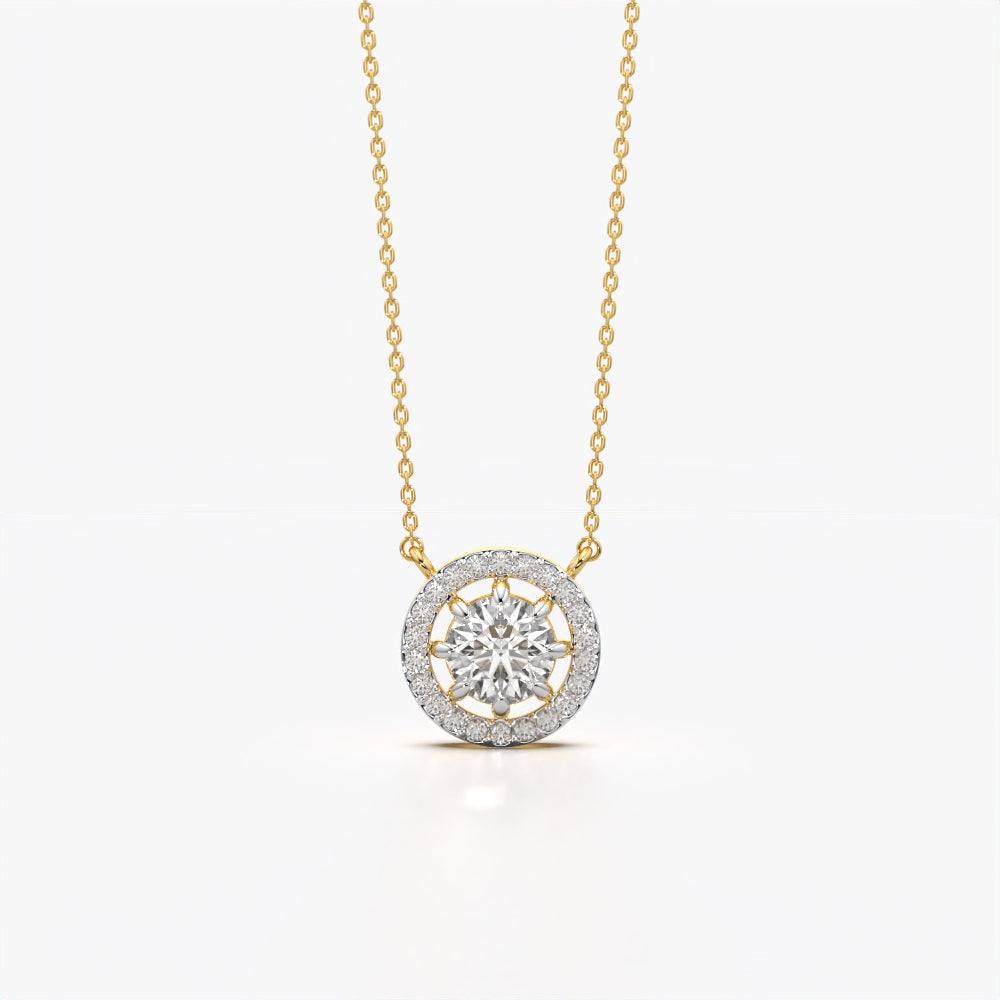
Halo Solitaire Pendant Necklace
Shop Now -
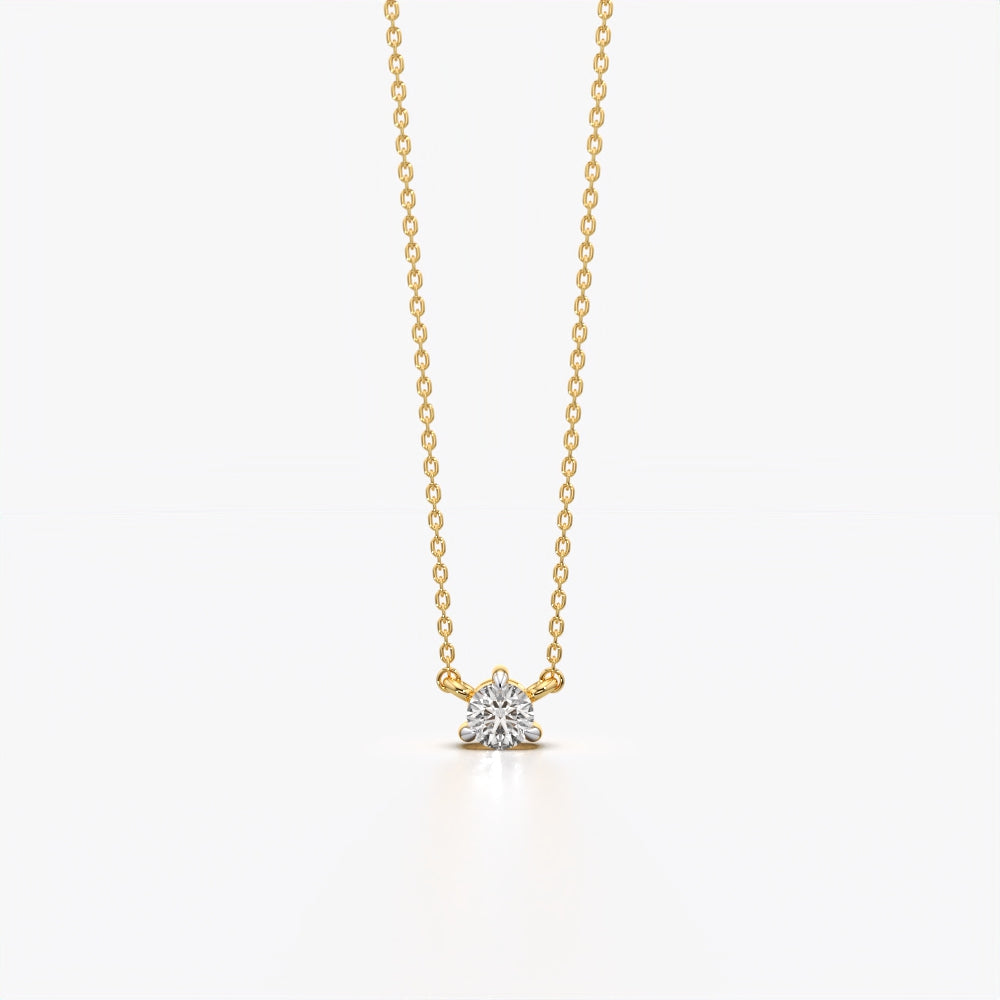
Tiny Solitaire Pendant Necklace
Shop Now
The 300-day test
Before the picks, here is the framework used to choose them. You can apply it to any necklace, from any brand.
Contact hours change with every design decision
Assume a real daily necklace is on your skin roughly sixteen hours a day, three hundred days a year. That is about four thousand eight hundred hours of contact annually. An occasion piece might see three hundred hours in the same period.
At sixteen times the exposure, small design flaws stop being cosmetic. A prong that protrudes half a millimetre too far will eventually pull a thread on a kurti. A clasp with a weak spring will open once, which is all it takes. A pendant that spins on its bail will spend half its life showing you its back.
The five friction zones of an Indian day
These are the specific places where daily-wear necklaces fail, and they rarely appear in international guidance.
The first is the drape line. A dupatta, saree pallu, or stole is repositioned dozens of times a day, and every adjustment drags fabric across whatever is sitting on your chest. Open, filigree, and high-relief pendants are the ones that catch.
The second is the strap diagonal. A sling bag, laptop bag, or seatbelt crosses from shoulder to opposite hip, and it passes directly over one side of the collarbone. Anything sitting under that line gets compressed and rubbed for the length of your commute. This is the single most underrated cause of plating wear on one side of a chain.
The third is the notch pool. The suprasternal notch, the small hollow at the base of the throat, collects sweat and holds it longer than the surrounding skin. A pendant that sits exactly there stays damp for hours. KYMEE's own jewellery care page lists water as the first of four things that dull gold vermeil fastest, alongside perfume and skincare, chemicals and cleaners, and rubbing during storage. Sitting a pendant a centimetre lower makes a real difference.
The fourth is the nape zone, where the clasp rests against the hairline. Hair oil, serum, dry shampoo, and conditioner residue all accumulate here, and this is where clasps stiffen and springs fail.
The fifth is the ritual contact zone. Haldi, kumkum, attar, agarbatti smoke, and temple ash are part of ordinary weeks in most Indian households, and they are chemically active. A pendant with recessed detailing traps residue that plain wiping will not remove.
Four design attributes that predict survival
Low relief beats high relief. The flatter a pendant sits against the skin, the less it catches on fabric and the less it swings against a strap.
Closed settings beat open ones. A bezel, or a stone set flush with its surround, has nothing for cotton to hook onto. Prongs, especially tall three-prong settings, are the most common snag points on delicate jewellery.
Fewer moving parts beat more. Every extra jump ring, extender chain, dangling charm, and articulated joint is another point that can loosen or wear.
A proportionate chain gauge beats a delicate chain under a heavy pendant. This is the failure mode people misdiagnose most often as "cheap quality" when it is really a mismatch.
What you are actually buying: a short note on material and stones
Two things worth settling before the list, because vocabulary in this category is genuinely confusing in India.
Gold vermeil is not the same as gold plated. Vermeil requires a solid 925 sterling silver base with a substantially thicker gold layer on top. KYMEE's care page and product specification panels both state at least 2.5 microns of 18K gold over sterling silver. That thickness is why vermeil survives daily wear where thin plating over brass does not. If you want the full explanation, the brand has a dedicated piece on what gold vermeil is.
On stones, be precise and expect the seller to be precise too. In this collection, moissanite appears only in mini or accent form, and larger centre stones are cubic zirconia. Neither is a diamond, and neither should be sold to you as one. Both are perfectly good daily wear choices: moissanite for its brilliance and hardness, CZ for scale at a sane price, but you should know which one you are getting. When you open any product page, scroll to the specification table rather than trusting the headline or the description, because that table is where the actual stone type is recorded. If a page tells you one thing in the title and another in the table, ask before you buy. That advice holds for any brand in this segment, not just this one.
The 10 best daily wear necklaces
Each entry names the condition it is built for, why the design survives it, and where it falls short. Prices move with promotions, so treat the bands below as orientation and check the live page.
1. Tiny Solitaire Pendant Necklace, for the piece you stop noticing

This is the default answer for a first daily necklace, and it earns it on weight rather than looks. The listed weight is roughly 2.44 grams for the whole piece, which is light enough that the chain never fights the pendant. A single round stone in a three-prong setting on a fine cable chain gives you the lowest possible visual commitment, which is exactly what you want in something worn every day for years.
It also comes in a wide spread of stone colours, which matters more than it sounds. If you already wear a mangalsutra or a religious pendant, a coloured stone version reads as deliberately different rather than competing.
Where it falls short: the three-prong setting is a primary snag risk to keep in mind on prong-set styles. Prongs are the trade-off you accept for light reaching the stone from underneath. If you wear a lot of loose-knit wool or fine chiffon, look at a bezel-set piece instead
Best for: someone building a first daily necklace who wants it to disappear into their routine.
2. Crystal Curve Bar Necklace, for the strap diagonal

A horizontal curved bar is the flattest profile in this entire collection, and flatness is the whole point. There is no pendant standing proud of the chain, so a sling bag strap or seatbelt passes over it without a pressure point. It is also the piece least likely to spin, because a bar's own geometry keeps it oriented.
The horizontal line does something useful visually, too. It widens the collarbone area slightly, which balances round and boat necklines that can otherwise look narrow.
Where it falls short: it does not layer well as a base piece, because the bar competes with anything sitting below it. Choose it as a solo everyday piece rather than the bottom of a stack.
Best for: daily commuters, anyone who carries a bag on the same shoulder every day.
3. Half-Pavé Angled Bar Necklace, for keeping sparkle out of the sweat line

The asymmetry here is functionally smart: placing pavé setting on only half the bar leaves plain polished metal across the rest of the surface, making it much easier to wipe clean of daily sweat and skincare. When worn at the proper length, it keeps detailed stone settings away from heavy pooling zones.
It has accumulated a solid review count on site, which, for a piece this understated, usually signals repeat everyday use rather than gift buying.
Where it falls short: asymmetric pieces need the chain length to be right. Too short, and the angle reads as crooked rather than intentional. Check the necklace size chart before ordering.
Best for: humid coastal and western India, or anyone whose complaint about daily jewellery is that it looks dull by evening.
4. Graduated V Chevron Necklace, for V-neck kurtis and deep necklines

This is the most reviewed necklace in the collection by a wide margin, which is worth noticing. The V shape follows the neckline rather than cutting across it, which solves the specific problem of a round pendant hanging into empty fabric space on a V-neck kurti or wrap top.
Because the stones graduate in size along the curve, the visual weight sits high and wide instead of low and central. That keeps the whole piece above the sweat line.
Where it falls short: it is neckline-specific in a way the others are not. On a high-neck kurta or a closed-collar shirt, it disappears entirely. If your daily wardrobe is mostly high necklines, skip it.
Best for: V-neck kurtis, wrap tops, scoop necks, anyone who wants one piece to carry an outfit without a pendant.
5. East West Oval Solitaire Necklace, for the pendant that will not turn around

The east-west orientation sets the oval stone sideways, preventing top-heavy vertical tipping. When combined with dual chain attachment points or a wide slide bail, it keeps the stone sitting flat against your collarbone rather than spinning or flipping over to its metal back.
It sits in the lower price band of this list while still reading as a proper solitaire piece, and the coloured stone options make it flexible across a wardrobe.
Where it falls short: an oval stone set horizontally is a slightly less traditional look, which matters if you want something that reads clearly as a classic solitaire to family. Compare against the pendant necklaces range before deciding.
Best for: anyone who has given up on a previous pendant because it kept spinning.
6. Classic Round Evil Eye Necklace, for continuous protective wear

Some necklaces are worn for meaning rather than styling, and those are the ones that genuinely never come off. That makes the durability question sharper, not softer.
A round evil eye motif is well suited to it. The design is circular and enclosed, with the stonework contained within the round rather than protruding, so there is almost nothing for fabric to catch. It is also small enough to layer under or over a mangalsutra without visual conflict, which is a real consideration for married women who already have a fixed daily piece.
Where it falls short: it is a motif piece, so it does not have the neutrality of a plain solitaire. Some workplaces and some family contexts read symbols differently. Consider the charm pendant range if you want a different symbol on the same construction logic.
Best for: continuous wear, layering alongside an existing mangalsutra or religious pendant.
7. Floating Five-Drop Station Necklace, for spreading the load

Station necklaces solve a structural problem that pendant necklaces cannot. Instead of concentrating all the weight at one point on the chain, five small stones are distributed along its length. No single link carries disproportionate stress, which means the chain holds its shape far longer.
They also sit flat by design, so nothing hangs into the notch. And they layer better than almost anything else because the stations create visual rhythm rather than a competing focal point. If the category is new to you, there is a full explainer on what a station necklace is and the whole station necklace range on site.
Where it falls short: five small stones mean five settings to keep clean. Recessed edges collect sunscreen and moisturiser residue faster than a single stone does. Budget an extra minute a week with a dry cloth.
Best for: layering, high necklines, anyone who has previously stretched a delicate chain with a heavy pendant.
8. Open Clover Outline Necklace, for a motif without the mass

An outline design gives you a recognisable shape at a fraction of the weight of a solid version, because the centre is empty. Less mass means less stress on the chain and less swing against a strap.
Clover is one of the more wearable motifs across contexts in India, reading as decorative rather than religious or occasion-specific, which is exactly what you want in something worn to work every day.
Where it falls short: this is the one entry on the list where the open construction cuts both ways. An open outline has an inner edge, and inner edges are where fine knitwear catches. It is not a snag risk on cotton, chiffon, or silk, but be conscious of it with woollens.
Best for: office wardrobes, anyone who wants personality in a daily piece without a name or initial.
9. Custom Initial Pendant Necklace, for a piece that becomes yours

Personalised pieces have the highest daily wear rates of any category, for an obvious reason. Nobody takes off a necklace with their own initial on it because it does not match an outfit.
A single letter is the right level of personalisation for daily wear, specifically. Full name necklaces are longer, heavier, and more delicate at the connecting points between letters. A single initial is compact, low-relief, and structurally simple. If you want a script instead, the Signature Script Name Necklace and the wider personalised necklaces range cover that.
Where it falls short: personalised and engraved items are typically non-returnable, here and across the industry. Get the length right the first time. Use the sizing guidance or book a video call from the product page before ordering.
Best for: gifting, and for anyone who wants one necklace they will never have to think about pairing.
10. Single Pearl Drop Pendant Necklace, with an honest caveat

A single pearl on a fine chain is genuinely beautiful for daily wear and works across formal and traditional Indian clothing in a way stones sometimes do not. It sits well with cotton sarees, linen shirts, and silk kurtas alike.
But this entry comes with a real warning, and it belongs on any honest list. Pearl is the softest material here by a wide margin, and it is porous. Perfume, hairspray, sanitiser, and sweat all affect it more than they affect metal or a hard stone, and the damage is not reversible with polishing. Vinegar and acidic cleaners will etch it permanently.
If you spray perfume on your collarbone, this is not your daily necklace. If you spray perfume on your wrists and behind your ears and put jewellery on last, it will be fine for years.
Where it falls short: Pearl is the softest material here and is organic and porous. Perfume, hairspray, sanitiser, sweat, and acidic cleaners permanently damage pearl nacre. Never place pearl jewelry in an ultrasonic cleaner or submerge it in hot steam/chemical dips, as these destroy the stone and mounting glue.
Best for: someone with a settled routine who puts jewellery on last and takes it off first.
How to choose between these ten
If you carry a bag on the same shoulder every day, prioritise flatness. The Crystal Curve Bar and the station necklace are yours.
If you wear a mangalsutra or a fixed religious pendant already, prioritise a piece that layers without competing. The evil eye, the station necklace, and the tiny solitaire all work. Browse the mangalsutra range if you are choosing both together.
If you live somewhere genuinely humid, prioritise keeping detail out of the notch. The angled bar, the chevron, and the horizontal solitaire all sit above or to one side of the pooling zone.
If your wardrobe is mostly V-necks and wrap tops, the chevron is doing work the others cannot.
If you want the piece to feel personal rather than decorative, the initial pendant and the evil eye are the two that people actually never remove.
If you have broken or stretched a chain before, go to the station necklace. Distributed weight is the fix.
If you want more than one and intend to layer, the guide on styling a pendant necklace and the layered necklaces range covers combinations properly.
The care habits that decide whether yours lasts three years or three months
None of the above matters if the piece is treated badly, and gold vermeil rewards a small amount of discipline enormously.
Put it on last and take it off first. Perfume, hairspray, moisturiser, sunscreen, and makeup should all be fully absorbed before metal touches skin. This single habit prevents most of the dulling people blame on quality.
Take it off before showering, swimming, and going to the gym. Chlorine and salt water are the fastest ways to damage a vermeil finish, and steam is not far behind.
Wipe it down at the end of the day with a soft, dry cloth, paying attention to the underside of the pendant and the clasp at the nape. Thirty seconds. This is where sweat and hair products concentrate.
Store each piece separately with the clasp fastened, laid flat or hung. Necklaces stored loose together tangle, and tangled fine chains kink permanently. Fastening the clasp before storage is the small trick most people skip.
Do not use abrasive polishing cloths or commercial jewellery dips on vermeil. They are formulated for solid metal and will cut through a plated layer. A slightly damp cloth with mild soap, dried thoroughly, is the correct approach for heavier buildup.
Rotate if you own more than one. Two necklaces worn alternately last considerably more than twice as long as one worn continuously, because the metal gets time to dry fully between wears. There is a fuller guide on storing jewellery properly if this is where your pieces are being lost.
If none of these ten is quite right
There are more than a hundred pieces in the full necklaces collection, and the sub-categories are worth browsing directly if you already know your shape: pendant necklaces, drop necklaces, coloured stone necklaces, and charm pendants.
If you have something specific in mind that does not exist off the shelf, whether that is a particular stone colour, a chain length outside the standard range, or a motif that matters to you personally, KYMEE runs a custom jewellery service where you specify the design, metal, and stone yourself. For a daily-wear piece, the two custom decisions most worth paying for are chain length and stone size, because those are the two things that determine whether it stays on.
FAQs
Can you wear a gold vermeil necklace every single day without removing it?
You can wear it every day, but you should remove it for showering, swimming, the gym, and sleeping. Vermeil is a real layer of 18K gold at 2.5 microns or more over sterling silver, which is far more durable than standard plating, but it is still a surface layer. Water, chlorine, and abrasion during sleep are the things that shorten it. Wearing it sixteen hours a day and removing it for the other eight is the pattern that gives you years of life.
What necklace length works best for daily wear in India?
Around 16 to 18 inches suits most daily wear, sitting at or just below the collarbone. Sixteen inches sits higher and works better with round and boat necklines. Eighteen inches sits slightly lower, which keeps a pendant out of the sweat hollow at the base of the throat, and pairs well with V-necks and open collars. If you layer, keep at least two inches between chains so they do not tangle.
Will a daily wear necklace turn your skin green or black?
Nickel-free sterling silver with a proper gold vermeil layer is much less likely to cause this than plated brass. Mild discolouration can still happen, and it is usually not the metal's fault. It is caused by sweat, higher skin acidity, humidity, or product buildup reacting at the surface. Keeping the piece clean and dry, and putting it on after skincare rather than before, resolves it in most cases.
Is moissanite or cubic zirconia better for a necklace worn daily?
Moissanite is significantly harder (9.5 Mohs) and holds its polish indefinitely, making it the ideal choice for high-impact center stones. Cubic Zirconia is softer (8–8.5 Mohs) and can dull over years of daily friction, but offers great visual scale at a lower cost point. Neither is a diamond, and sellers should state clearly which stone is used
How many daily wear necklaces do you actually need?
Two is the practical answer, and the reason is rotation rather than variety. Two pieces worn on alternate days each get a full day to dry out completely between wears, which meaningfully extends the plating life of both. Make one neutral, a plain solitaire or bar, and one with some character, a motif or an initial, and you have covered almost every daily context.
Can you wear a daily necklace with a mangalsutra?
Yes, and it is very common now. The trick is length separation and visual weight. Keep the daily piece shorter than the mangalsutra so they occupy different lines rather than overlapping, and keep it small enough that it reads as a companion rather than a competitor. Station necklaces and small round motifs layer best for this.
Does gold vermeil jewellery come with any resale or buyback value?
While 925 sterling silver is a precious metal with intrinsic melt value (unlike base brass fashion jewelry), the raw silver weight in a lightweight daily necklace (2–3g) is minimal. Any buyback or exchange value offered by demi-fine brands is based on brand trade-in policies rather than raw scrap metal value.
What is the single biggest mistake people make with daily-wear necklaces?
Buying for the photograph rather than for Tuesday. A piece that looks striking in a product shot is often the piece with high relief, open prongs, and detailed recesses, which are exactly the three attributes that fail under daily wear. The necklaces that last are almost always the ones that looked slightly plain online.
Which necklace is best for daily use for ladies?
A lightweight pendant or station necklace on a proportionate chain, in a material that tolerates sweat and humidity. Solid gold and 18K gold vermeil over sterling silver are the two that hold up. A length of 16 to 18 inches suits most.
Are gold vermeil necklaces good for everyday wear?
Yes, provided the gold layer is at least 2.5 microns over a sterling silver base, which is what the vermeil standard requires. They are considerably more durable than gold plated jewellery over brass, and hypoallergenic when the silver is nickel-free.
What type of necklace never goes out of style?
A plain fine chain, a single-stone solitaire pendant, and a small symbolic motif such as an initial or a protective symbol. These three have been continuously worn for decades and are not tied to a trend cycle.
How do you stop your necklace chain from tangling?
Fasten the clasp before storing; store each necklace separately rather than in a shared pouch, and lay it flat or hang it rather than dropping it in a box. Most permanent kinks happen in storage, not while being worn.
Which necklace length is best for a saree?
For a modern or minimal saree, an 18-inch pendant sits well against the blouse without competing with the pallu. For heavier traditional sarees, jewellery choice usually shifts to occasion pieces rather than daily wear.
Can you wear a necklace to sleep?
It is better not to. Sleeping in a fine chain is one of the most common causes of kinks and broken links, because the chain twists against a pillow for eight hours. It also traps sweat against the skin overnight.
What is the difference between gold plated and gold vermeil?
Gold plated usually means a thin gold layer over a base metal such as brass, often under one micron. Gold vermeil requires a solid 925 sterling silver base and a gold layer of at least 2.5 microns. The difference in longevity is substantial.
Which necklace is best for office wear?
Low relief, minimal movement, and a single focal point. A bar necklace, a small solitaire pendant, or a station necklace all read as professional without drawing attention during meetings.