


Best Daily Wear Rings for Women: Chosen by How They Behave, Not How They Look

There is a particular kind of disappointment that comes about three weeks after buying an everyday ring. It looked perfect in the photo. It felt fine in the first hour. And now it is snagging your dupatta, collecting atta in its crevices, spinning loose by evening, and living in a bowl on the dressing table because putting it on has become a decision instead of a habit.
That gap between "beautiful ring" and "ring I actually wear" is not about taste. It is about physics.
Almost every daily wear ring guide online sorts rings by appearance: minimalist bands, solitaires, kundan, pearls, stacked looks. That is a useful way to browse. It is a poor way to predict whether a ring will still be on your finger in month four. This guide sorts differently. Every ring below is assessed on how it behaves against fabric, hair, dough, sanitiser, water, and a finger that quietly changes size between morning and night.
Why most daily wear ring lists get it wrong
A ring worn once a month only has to be pretty. A ring worn 300 days a year has to survive a genuinely hostile environment.
Go and read what women actually say about their everyday rings rather than what jewellery brands say about them, and the complaints are remarkably consistent. On long-running jewellery community threads, women with prong-set rings describe losing strands of hair to the setting, picking sweater fuzz out of the prongs constantly, and habitually rotating the stone to the inside of the palm before pulling on a sleeve. One woman described ruining pairs of stockings so reliably that she now removes the ring entirely before putting them on.
Cooking threads add another layer. Home cooks routinely take rings off before anything "hands in": kneading, mixing, shaping. In an Indian kitchen, that is not an occasional event. Atta gets kneaded most days, and a raised setting with open channels underneath is very good at holding onto it.
Then there is the quiet one nobody writes about. Your fingers are not a fixed size. They are smaller on a cool morning and larger after a salty lunch, a long flight, a humid August afternoon, or a day mostly spent standing. A ring sized to feel snug at 8am can feel tight at 6pm. A ring sized comfortably at 6pm will spin all morning.
None of this shows up in a product photograph. All of it decides whether you keep wearing the thing.
-
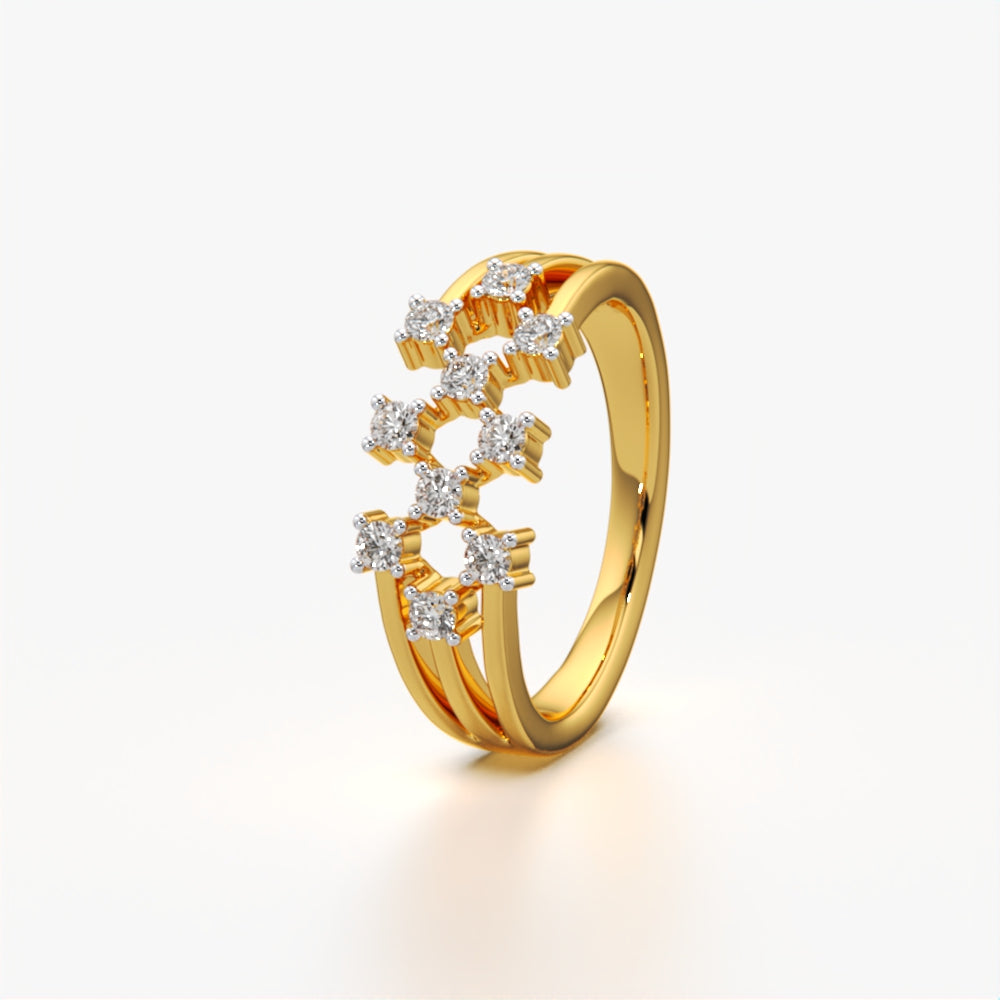
Stardust Stack Ring
Shop Now -
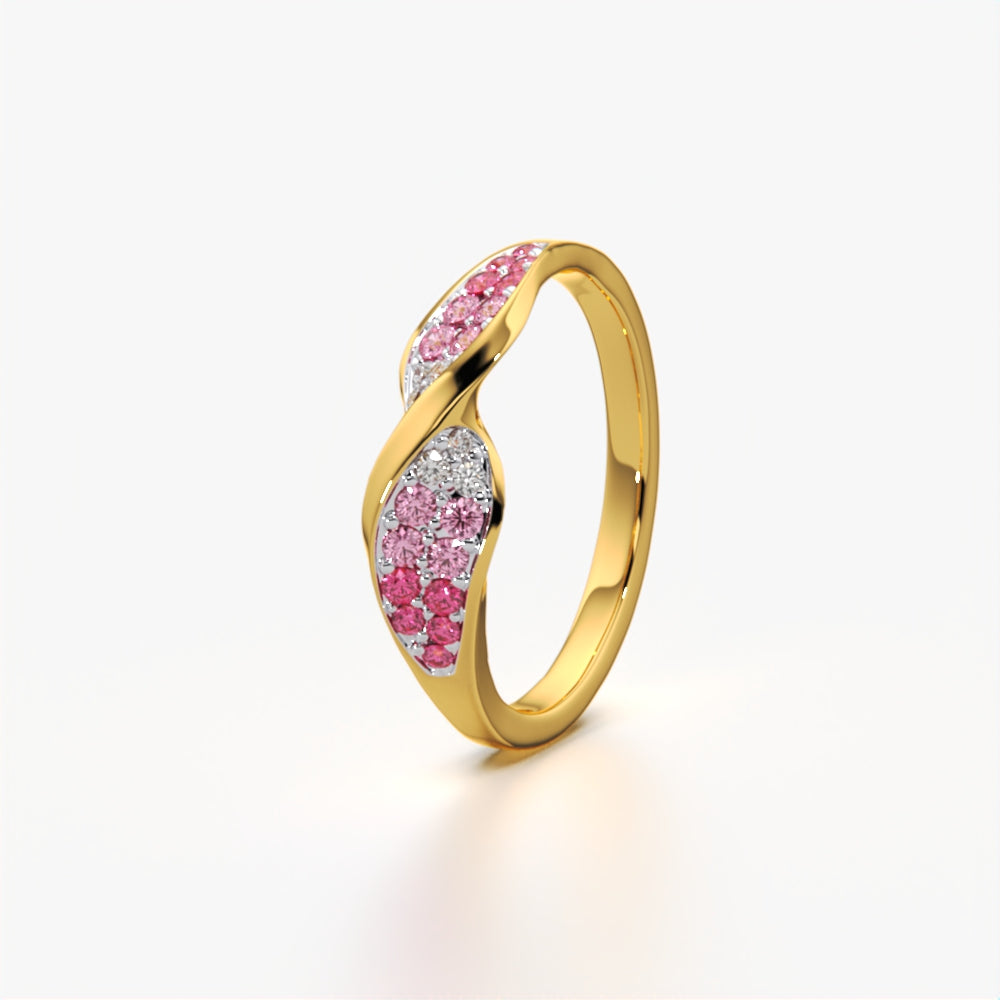
Pink Petal Twist Ring
Shop Now -
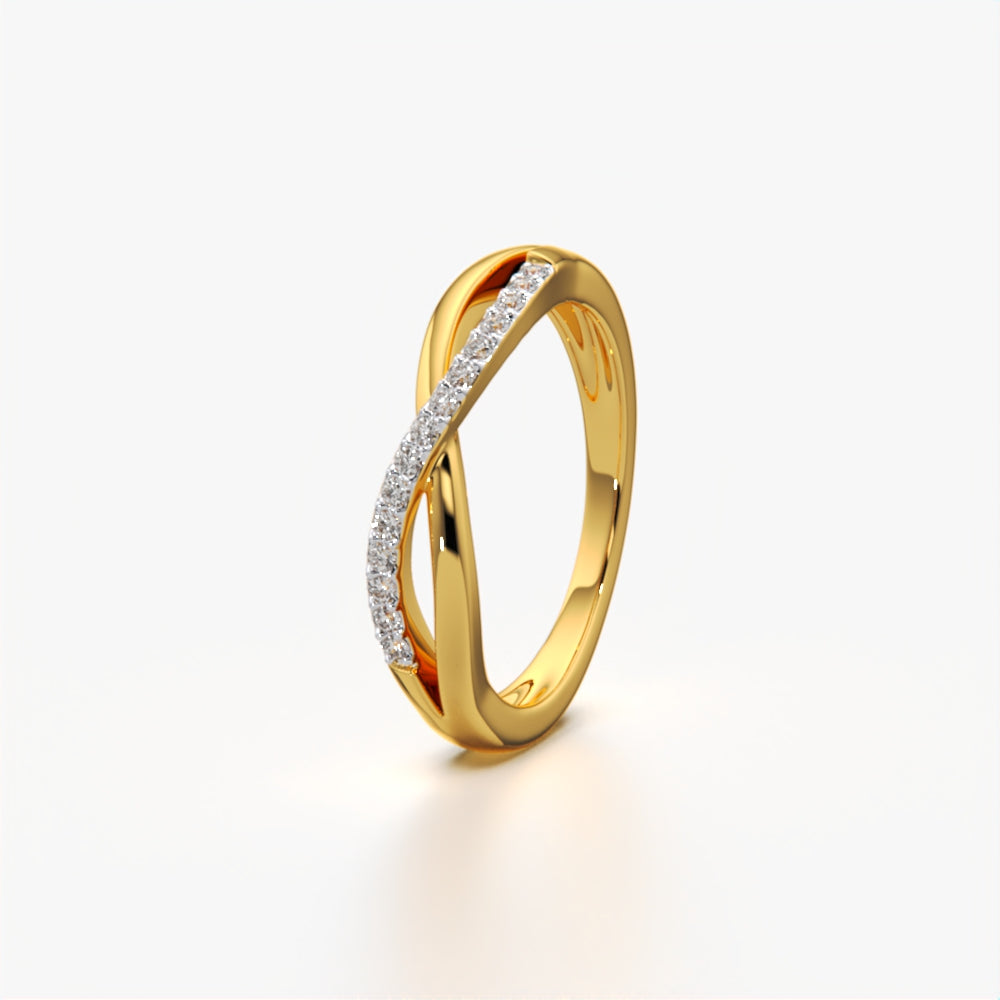
Moissanite Infinity Twist Crossover Band Ring
Shop Now -
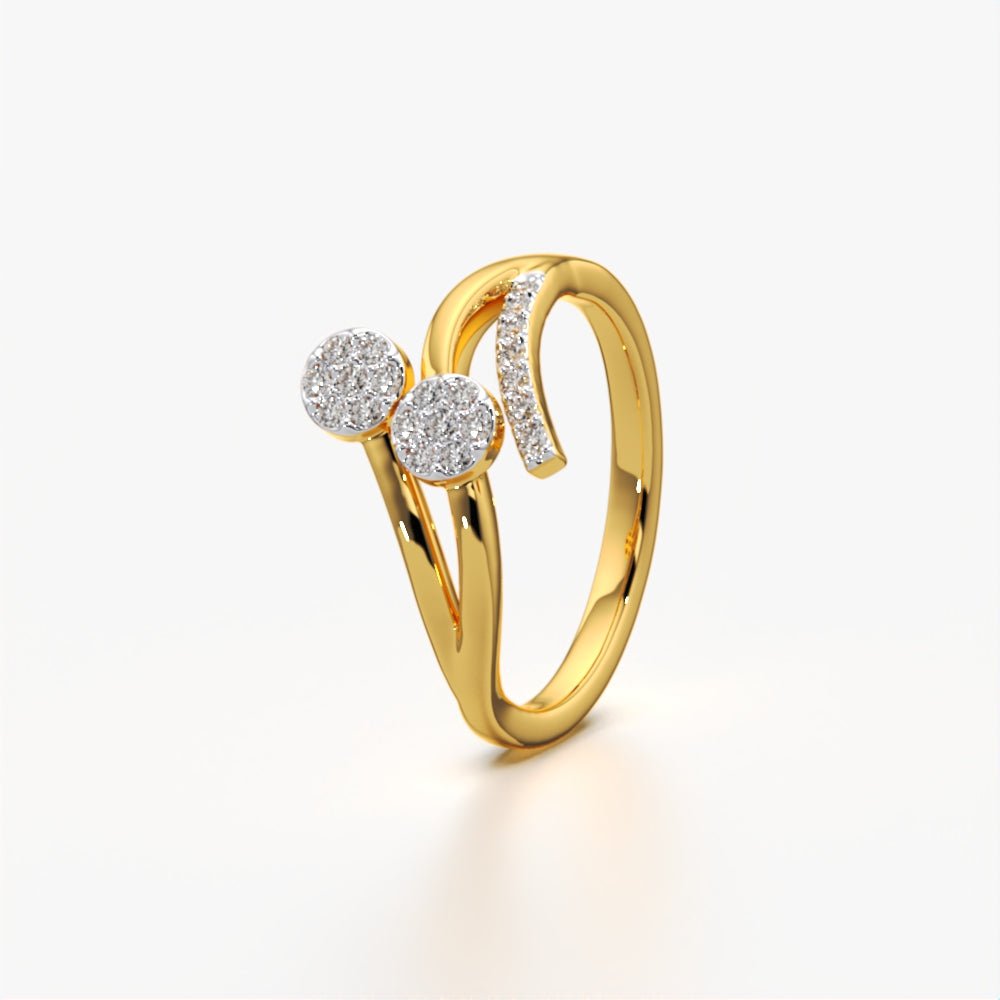
Twin Cluster Bypass Ring
Shop Now
The three-second tests that predict whether a ring survives daily wear
You can apply these to any ring, from any brand, using nothing but the product photo and your own hand.
Test one: the drag test
Look at the ring from the side, not the top. Ask a single question: Does anything sit meaningfully above the line of the band?
Every millimetre a stone or prong rises above the band is a millimetre available to catch on knit fabric, hair, a handbag lining, a bedsheet, or a child's clothing. This is why the same stone in a bezel or tension setting behaves completely differently from that stone in a tall four-prong basket. It is also why baguette and emerald cuts, which have flat tops rather than pointed crowns, tend to be the calmest cuts for continuous wear.
A low profile does mean no sparkle. It means the sparkle is arranged laterally instead of vertically.
Test two: the palm test
Turn the ring over in your mind and look at the underside, the part that faces your palm and touches your other fingers.
A full eternity band puts stones all the way around, which means stones sit against your palm and against the adjacent fingers all day. It looks magnificent. It is also the setting most likely to feel abrasive when you grip a steering wheel, carry bags, or hold a phone for an hour. Half-eternity bands solve this precisely: sparkle on the visible half, smooth metal on the working half.
If you type, cook, drive, or carry anything for a living, the underside matters more than the top.
Test three: the gap test
Look for open channels, deep galleries, and prong baskets with space underneath the stone.
These are where residue lives. Soap film, hand cream, sanitiser, turmeric, and dough all migrate into the gaps under a raised setting and then dry there. This is the single biggest reason everyday rings look dull after two months, while the owner insists she has not done anything to them. The metal is fine. The gaps are full.
Closed-back settings, bezels, pave set flush into the band, and sculptural metalwork with no under-stone cavity all resist this. Open baskets do not.
The fourth factor nobody mentions: your finger changes size
This one deserves its own paragraph because it causes more abandoned rings than snagging and dullness combined.
Finger circumference varies throughout the day and across a season. Heat, humidity, salt, standing, exercise, hormonal cycles, and long-haul travel all shift it. In most of India, that variation is larger than in temperate climates simply because the humidity swing between February and August is enormous.
Two design features handle this gracefully. Open shank rings, where the band does not fully close, have a small amount of natural give and sit comfortably across a wider range. And rings with a thin, even band profile slide more forgivingly than thick, heavily contoured bands, which grip and then refuse to move.
If you know your fingers swell noticeably, this factor should outrank aesthetics in your decision.
A note on metal: why 18K gold vermeil sits where it does
Daily wear in India has an awkward metal problem. Traditional 22K gold is beautiful and culturally loved but soft enough to deform under everyday pressure, and at current gold prices, a 22K everyday ring is a serious purchase to expose to dough, detergent, and door handles. At the other end, ordinary gold-plated fashion jewellery uses a very thin gold flash over brass or a similar base metal, and it does not survive continuous contact with skin, sweat, and water for long.
Gold vermeil sits between them, and the definition is specific rather than marketing language. To be vermeil, the base must be sterling silver, not brass, and the gold layer must be meaningfully thick rather than a flash. KYMEE builds to 18K gold at 2.5 micron (5x stronger) thickness over 925 sterling silver, which its product pages state directly in the metal specification, and the sterling silver base is what makes the pieces workable for people who react to nickel.
This matters practically in two ways. Because the base is silver rather than brass, the failure mode of a worn vermeil ring is a gold layer thinning to reveal silver underneath, not a brass ring turning your finger green. And because the gold is layered rather than solid, the honest framing is that vermeil is durable for daily wear, not indestructible. Plating wears. How fast depends almost entirely on habits, which the care section below covers.
If you want the full technical comparison, KYMEE's explainer on gold vermeil goes deeper into microns and layer construction than is useful here, and the anti-tarnish jewellery guide covers why some finishes hold up better than others.
A note on stones: what you are actually buying
This section exists because the Indian demi-fine category is genuinely murky about it, and you deserve a straight answer before you spend money.
The stones in this price bracket are not mined diamonds. They are simulants and lab-created stones, and the two you will encounter most are moissanite and cubic zirconia.
Moissanite is silicon carbide. It is hard, it has a polish, and it has higher dispersion than diamond, which means it throws more coloured fire rather than more white brilliance. In practice, small moissanite accents read as crisp, lively sparkle and hold up well to daily knocks.
Cubic zirconia is softer and more prone to surface abrasion over years of contact, which is why a CZ centre stone in a ring worn continuously will typically lose a little crispness before the metal shows any wear.
In KYMEE's rings, moissanite is used in mini and accent form, and cubic zirconia is used for larger centre stones. Neither is a diamond, and neither should be sold to you as one. If a listing anywhere in this category uses "diamond" loosely in a title or an image name, treat the specification table as the truth and the title as marketing.
The practical implication for daily wear: a design built from many small moissanite accents set flush will generally age better through continuous wear than a design built around one large soft centre stone standing proud of the band. That is reflected in how the list below is ordered.
The 10 best daily wear rings, mapped to how you use your hands
All ten are drawn from KYMEE's daily wear rings collection, and all are 18K gold over 925 sterling silver. Prices are as listed at the time of writing and are worth re-checking, since this category runs frequent offers.
1. Stardust Stack Ring

Best for: the stacked look without the stacking problems
Stacking three separate rings looks wonderful and behaves badly. Individual bands rotate out of alignment during the day, rub against each other, and wear at the contact points, creating three separate gaps for residue to collect in.
This ring solves that structurally. Three slim bands are fused into a single piece, scattered with tiny moissanite in a soft zigzag rather than lined up in a row. The visual result is a stack. The physical result is one continuous object that cannot misalign, cannot self-abrade, and has no inter-ring gaps.
Light enough that most wearers stop noticing it, which is the actual test for a daily ring.
2. Baguette Row Half Eternity Ring

Best for: the lowest snag profile in the list
If you only apply one of the three tests, apply the drag test to this ring and see what happens.
Baguette-cut stones are rectangular with flat tops. They have no pointed crown and no raised culet, which means a row of baguettes set into a band creates something close to a continuous flat plane. There is very little for fabric to catch on because there is very little standing above the band line.
Combine that with the half-eternity construction, which leaves the palm-side half as smooth, unbroken metal, and you have a ring engineered for people who use their hands constantly. Typing, driving, carrying, holding a phone for hours: none of it involves stones pressing into your palm.
This is the ring to consider if you have previously given up on stone-set rings because they kept catching.
3. Crossover Tension Solitaire Ring

Best for: solitaire sparkle without the solitaire prongs
Most women who want an everyday solitaire are quietly asking for something the classic four-prong basket cannot give them: a centre stone that does not sit up on a tall claw setting.
A crossover tension design holds the stone within the sweep of the band itself rather than lifting it above the band on prongs. The stone sits lower, the metal wraps rather than claws, and the whole silhouette stays closer to the finger. You lose a little of the floating, elevated look. You gain a ring you can pull a sleeve over without thinking.
If a solitaire is specifically what you want, KYMEE's guide to wearing a solitaire ring covers setting choices in more detail, and the full solitaire rings collection has the higher-profile options if you decide you want the classic look after all.
4. Moissanite Infinity Twist Crossover Band Ring

Best for: continuous surface, no single high point
A twist design distributes both metal and stones along a curve rather than concentrating them at one raised point. There is no peak. Nothing rises dramatically above anything else, so there is no obvious catch point anywhere on the ring.
Twists also carry a practical advantage for hands that are not perfectly symmetrical, which is most hands. The diagonal line reads as movement and tends to be more forgiving on shorter or wider fingers than a hard horizontal band, which visually cuts the finger across.
The infinity motif carries its own meaning, and if you are weighing this against an eternity band for symbolic reasons, the infinity versus eternity comparison sets out the difference properly.
5. Tiny Daisy Solitaire Ring

Best for: the smallest footprint and the lowest entry price here
This is the least expensive ring in the collection and also the smallest in physical footprint, which is not a coincidence. Less material means less to catch, less residue to collect, and less to notice.
A four-petal flower setting around a small centre stone does something clever. The petals surround the stone rather than clawing over it, so the metal is doing the protecting rather than four thin prongs. The result is more visual interest than a plain bezel with less exposure than a prong basket.
This is the sensible first vermeil ring. If you have never worn a stone-set ring daily and are not sure you will like it.
6. Pave Knot Ring

Best for: rounded sculptural form with nothing sharp on it
A knot is a genuinely good shape for everyday wear, and the reason is geometric. A knot has no edges and no points. Every surface curves back into another surface. Even with pavers set into it, the overall topography stays rounded rather than faceted, so fabric slides across rather than catching in.
Knot rings also solve a common styling problem. They read as designed and intentional without reading as formal, which means they work with a kurta on a weekday and with anything else on a Saturday. That versatility is why they end up worn more than more beautiful, more specific rings.
If you like the shape, the Love Knot Ring and the Dainty Bow Knot Ring are variations on the same principle.
7. Olive Leaf Bypass Ring

Best for: fingers that swell
This is the specialist pick, and it is on the list because of the fourth factor above.
A bypass design has the two ends of the band pass alongside each other instead of joining into a closed circle. That open construction gives a small amount of natural give, which means the ring accommodates a wider range of finger circumferences than a rigid closed band. On a humid August day when your usual ring feels tight, a bypass ring usually still feels fine.
The leaf motif also lies along the finger rather than across it, which keeps the profile low and lengthens the visual line of the hand.
If you have ever bought a ring that fit perfectly in the shop and became uncomfortable by evening, this construction is the answer to that specific problem.
8. Twin Cluster Bypass Ring

Best for: presence without a single vulnerable centre stone
There is a real trade-off between wanting a ring to be noticed and wanting it to survive. A single large centre stone gives presence but concentrates all the risk in one place: one stone to loosen, one setting to fail, one high point to catch.
A cluster distributes that. Several smaller stones grouped together produce a comparable amount of visible sparkle across a similar surface area, while each individual stone sits lower and carries less structural load. If one accent ever needs attention, it is a far smaller repair than a compromised centre setting.
Combined with the bypass shank, this is the ring for someone who wants their everyday ring to be visible without accepting solitaire-level fragility.
9. Open Heart Pavé Half Band Ring

Best for: symbolism with a smooth working half
Heart motifs are among the most searched jewellery shapes in India, and most heart rings are built badly for daily wear, with a raised solid heart that catches on everything.
An open heart is the better construction. The outline is drawn in metal rather than filled, which keeps the piece light, and the pave sits within the outline rather than on top of it. The half-band construction leaves the palm side clear.
The result is a recognisable, meaningful shape that behaves like a plain band from the perspective of your other fingers.
10. Pave Butterfly Ring

Best for: a motif that stays flat
Butterfly wings are, usefully, flat. A butterfly motif set with pave produces a broad, low plane of stones rather than a peak, which means it reads as a decorative, noticeable ring while behaving like a low-profile one.
This is the ring for someone who finds bands and solitaires too anonymous but does not want to accept a cocktail ring's practical penalties. It has personality, and it passes the drag test.
Worth noting: broad flat motifs do collect a little more surface residue than narrow bands simply because there is more surface. A weekly wipe handles it.
Quick comparison: which ring for which day
If your day involves a lot of kneading, washing, and kitchen work, prioritise the closed, gap-free designs: the Tiny Daisy Solitaire, the Pave Knot Ring, and the Open Heart Pavé Half Band.
If you type or work at a desk for six or more hours, prioritise the smooth-underside designs: the Baguette Row Half Eternity Ring and the Open Heart Pavé Half Band.
If you commute in crowds, carry bags, or handle a child's clothing constantly, prioritise the lowest profiles: the Baguette Row Half Eternity Ring, the Crossover Tension Solitaire, and the Stardust Stack Ring.
If your fingers change size noticeably, prioritise the open shanks: the Olive Leaf Bypass Ring and the Twin Cluster Bypass Ring.
If you want to be seen wearing it, the Twin Cluster Bypass Ring and the Pave Butterfly Ring give the most visual presence per rupee without accepting solitaire fragility.
Getting the size right when your fingers change throughout the day
Sizing is where more everyday rings fail than at any design stage, and the standard advice is incomplete.
The usual instruction is to measure at the end of the day when fingers are warm, which is on KYMEE's own size chart and is sound as far as it goes. But for a ring you intend never to take off, the better approach is to measure twice: once on a cool morning and once on a hot evening after being on your feet. If those two measurements land on different sizes, take the larger and choose an open shank design that can accommodate the gap.
Two India-specific notes. First, if you are sizing between February and April, expect to need slightly more room by July. Sizing at the coolest, driest point of the year and buying snug is a common mistake. Second, Indian ring sizing runs on its own numbering, and KYMEE's chart maps Indian sizes 5 to 20 against diameter in millimetres and against US sizing, so a ring bought internationally will not translate directly.
The practical route: measure at home using the step-by-step ring sizing guide, which covers the string method and the existing-ring method, and then use the video call booking on any product page if you want a person to sanity-check it before ordering. That second step is worth the fifteen minutes, because resizing after purchase is a chargeable service rather than a free exchange.
What does daily wear actually do to a vermeil ring, and how to slow it down
Vermeil holds up genuinely well to daily wear. It does not hold up to daily chemistry. Almost all premature wear traces back to a handful of avoidable contacts, and the difference between a ring that looks new at eighteen months and one that looks tired at six is habit, not luck.
The five-second habit that matters most
Put the ring on last, after everything else.
Perfume, deodorant, hand cream, sunscreen, hairspray, and setting spray are all harder on a gold layer than water is. If the ring goes on before them, it takes a direct hit every single morning. If it goes on after they have dried, it takes almost none. This one change does more for the lifespan of a vermeil ring than any polishing routine.
The mirror habit: take it off first, before washing up, before kneading, before applying mehendi or oil.
Monsoon and humidity
Sustained high humidity accelerates tarnishing of the sterling silver base wherever the gold layer is thinnest, typically at the inner band where friction is highest. During monsoon months, store rings in a closed pouch or box rather than an open dish, and consider a silica sachet in the jewellery box. Air exposure in a humid room is the problem, not the rain itself.
Hard water and borewell water
Much of urban and peri-urban India runs on hard or borewell water with high dissolved mineral content. That mineral load leaves a fine film on metal that dulls the finish and, over time, builds into a visible haze in any crevice.
The fix is unglamorous: dry the ring properly rather than letting it air dry, because the film is deposited as water evaporates. A soft, dry cloth after any significant water contact prevents most of it.
Haldi, kumkum, and festival days
Turmeric stains, kumkum is abrasive in fine powder form, and both migrate into settings and stay there. Attar and traditional oils are also harder on plating than modern alcohol-based perfumes.
For haldi ceremonies, puja, and Karva Chauth preparations, take the ring off. It is a one-day inconvenience that prevents a permanent problem. KYMEE's jewellery care page covers cleaning specifics; the short version is warm water, a drop of mild soap, a soft cloth, and never an ultrasonic cleaner.
For what it is worth on the risk side: KYMEE lists a buyback programme on its policy pages, which does provide a route if a heavily worn ring eventually needs refreshing. Check the current terms on the policy page directly rather than relying on any summary, including this one, since the specifics have varied across the site.
Styles to avoid if you genuinely never take your ring off
This is the section that most brand-published lists omit, and it is the most useful one.
Tall four-prong and six-prong solitaires: Beautiful, and the single worst performer against fabric. Every community thread about snagging is dominated by them. Fine as an occasion ring. Frustrating as a permanent one.
Full eternity bands: Stones against the palm and against adjacent fingers all day. They also cannot be resized, which is a serious problem given how much finger size shifts. Choose half eternity for daily wear and save full eternity for occasions.
Large soft centre stones: A big cubic zirconia centre standing proud of the band takes years of micro-abrasion in exactly the spot you look at most. Smaller, harder, flush-set stones age better.
Open galleries and deep baskets: Anything with visible empty space beneath the stone is a residue trap. This is the design feature most responsible for rings looking dull despite no actual wear.
Anything adjustable that relies on bending: Repeated flexing fatigues metal and, on a plated piece, cracks the gold layer at the bend point. Open shank rings with fixed geometry are fine. Rings you physically squeeze to fit are not.
Heavy contoured bands if your fingers swell: Thick shaped bands grip. When a finger swells around a thick band, it becomes genuinely difficult to remove, which is a safety issue as well as a comfort issue.
When none of the ten fit: the custom route
Sometimes the constraint is specific enough that no stock ring solves it. You want a particular stone shape in a particular setting height. You need to match an existing heirloom band. You want an initial or a date on something you will wear every day.
KYMEE runs a custom jewellery service where you specify the design and stone yourself. For daily wear specifically, the useful custom brief is not "make it bigger" but "make it lower": a bezel instead of prongs, a closed back instead of an open gallery, a half eternity instead of a full one. Those three changes turn most occasion designs into viable everyday ones.
If it is engraving or initials you want rather than a full custom build, the personalised rings collection is the faster route.
FAQs
Can you really wear gold vermeil rings every day?
Yes, with the caveat that it is a plated finish and plating wears. The 2.5 micron 18K gold layer over sterling silver is substantially thicker than standard gold plating and is built for continuous contact with skin. What shortens its life is chemistry rather than wear: perfume, sanitiser, cleaning products, and chlorinated water. A ring worn daily but kept away from those will hold its finish for years. A ring worn daily through swimming, dishwashing, and a full skincare routine will not.
Will a gold vermeil ring turn your finger green or black?
Green discolouration comes from copper in base metals like brass, and vermeil uses sterling silver rather than brass as its base, so the classic green stain is not the failure mode here. What can happen on any silver-based jewellery is a faint dark mark, usually where the gold layer has thinned at a friction point, and the silver underneath has reacted with sweat or humidity. It wipes off skin easily. If it is happening early and consistently, that indicates plating wear rather than a metal allergy.
Is moissanite or cubic zirconia better for a ring worn every day?
Moissanite, clearly, for anything you wear continuously. It is significantly harder, resists surface scratching much better, and keeps its polish. Cubic zirconia is softer and will develop fine surface abrasion over years of daily contact, which reads as a gradual loss of crispness rather than obvious damage. This is why designs built from small moissanite accents set flush into the band tend to be the better long-term daily wear choice than designs built around one large cubic zirconia centre stone.
Can you wear your ring while cooking or making roti?
You can, but you will regret it with the wrong design. Anything with prongs or an open gallery will pack with atta and take real effort to clean. Even flat pave collects a film from oil and dough. The practical approach is to keep a small dish near the kitchen and make removal automatic, or choose one of the closed, gap-free designs above and accept a weekly wipe. Turmeric in particular should never meet a plated ring.
How many rings should you wear for daily wear?
One or two per hand is the comfortable ceiling for genuine everyday wear. Beyond that, you start getting metal-on-metal contact between rings, which accelerates wear on the plating at the contact points, and you start noticing them, which is the beginning of the end for a daily ring. If you want the look of more, a fused multi-band design gives you the visual without the friction.
What if your ring size falls between two numbers?
Take the larger size and choose a design with an open shank or a thinner band. A slightly loose ring on a cool morning is an annoyance. A ring that becomes too tight to remove on a hot evening is a genuine problem, and finger swelling in Indian summer is not marginal. If you are between sizes on a closed band design, size up rather than down.
Which finger should you wear a daily ring on?
There is no rule that constrains you, and the answer is mostly practical. The index finger takes the most incidental contact and is the harshest position for a stone-set ring. The middle finger is the most visible and the most stable. The ring finger carries the most cultural meaning. The little finger is the gentlest position for anything delicate.
Can these rings be resized?
Plain and lightly set bands can generally be resized. Full eternity bands cannot, because there is no un-stoned section to work with. Bypass and open shank designs have some natural tolerance, but resizing them changes the geometry. This is the practical argument for getting the size right the first time, using the home measurement methods and, if you are unsure, the video call.
Which ring is best for daily use?
A low-profile design with a smooth underside and no open gallery beneath the stone. Setting construction matters more than stone size or price.
Is gold vermeil good for everyday wear?
Yes, better than standard gold plating because of the thicker gold layer and sterling silver base, and more practical than 22K gold because it resists deformation. It is a plated finish, so it wears, and the wear rate depends almost entirely on chemical exposure.
Can you wear a ring 24 hours a day?
Physically, yes, but remove it for cooking, cleaning, swimming, and gym work, and take it off overnight occasionally so the finger underneath dries out properly. Continuous, unbroken wear traps moisture against the skin.
Which is better, silver or gold vermeil, for daily wear?
Plain sterling silver will not fade because there is no layer to lose, but it tarnishes and needs regular polishing. Gold vermeil keeps a gold appearance with far less upkeep, but the layer is finite. If you want low maintenance, vermeil. If you want an indefinite lifespan and do not mind polishing, silver.
Do daily wear rings need to be insured?
At this price point, generally not. The rational protection is the brand's own plating warranty and buyback route rather than a separate insurance product.