


Top Heart Ring Designs: How to Pick One You Will Actually Wear

Most "best heart ring" lists in India are photo galleries. You scroll, you like three, you buy one, and six weeks later it is sitting in a drawer because it catches on your dupatta every single day.
That is the gap this guide is trying to close.
A heart ring is not one thing. It is at least three different structural ideas wearing the same symbol, and each of those behaves completely differently on a real hand doing real work. Sorting them by how they are built, rather than by how they photograph, is the fastest way to buy one that survives past the first month.
Below are ten heart ring designs worth knowing, grouped by where the heart actually sits in the design. For each one, you get what it is, how it wears, who it suits, and what to check before you pay. Where a design exists in KYMEE's 18K gold vermeil rings, it is named and linked. Where it does not, that is said plainly, along with the route to get it made.
First, the two ideas that make this list useful
The three heart positions
Every heart ring puts the heart in one of three places. Knowing which one you are looking at tells you most of what you need to know about price, comfort, and wearability before you read a single spec.
Position 1: the heart as a pattern. The heart is engraved, cut out, or repeated as small motifs along the band. The band's outline stays a plain circle. Lowest profile, highest daily wearability.
Position 2: the heart as the stone. A heart-shaped stone sits on top of an ordinary band, usually prong-set or surrounded by a halo. The heart is a visible object with height. Mid to high profile.
Position 3: the heart as the silhouette. The metal itself forms the heart, often as an open or wrapping band. The ring's own outline is the heart. Sculptural and the most variable in terms of fit.
-
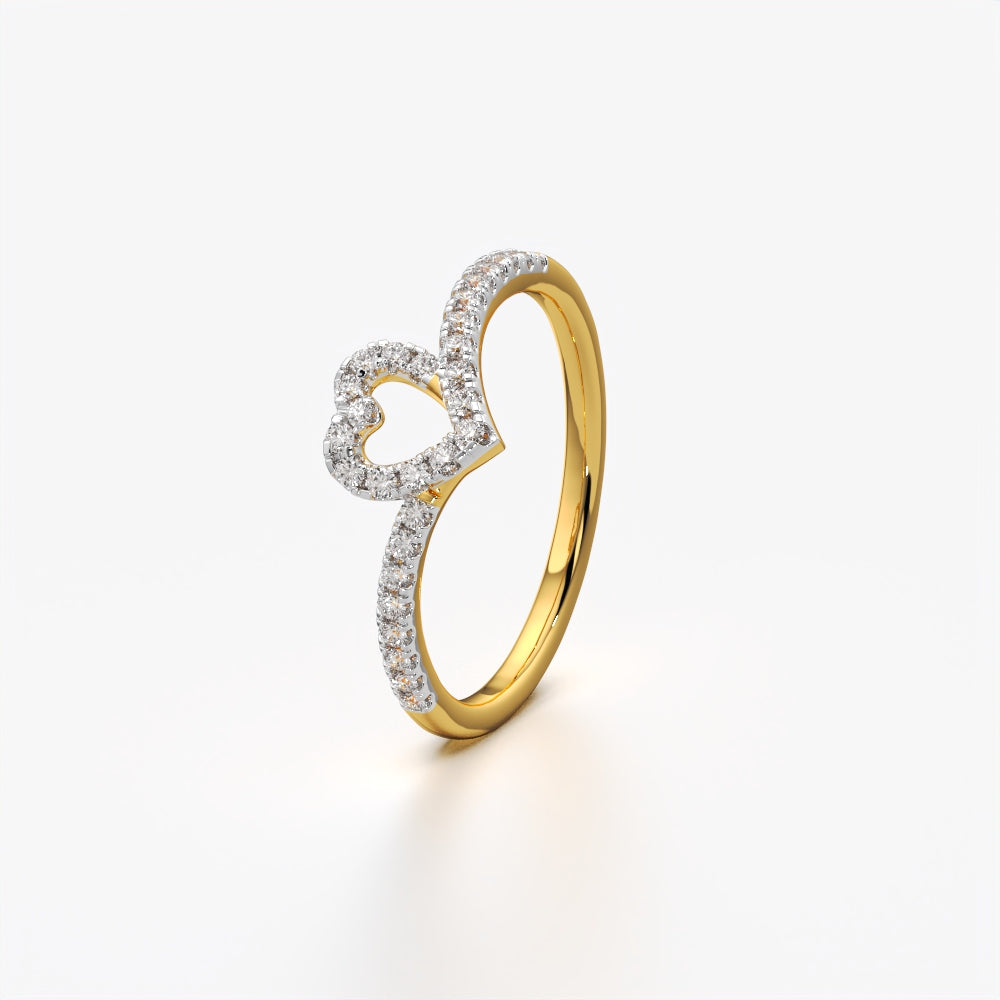
Open Heart Outline Ring with Pave Band
Shop Now -
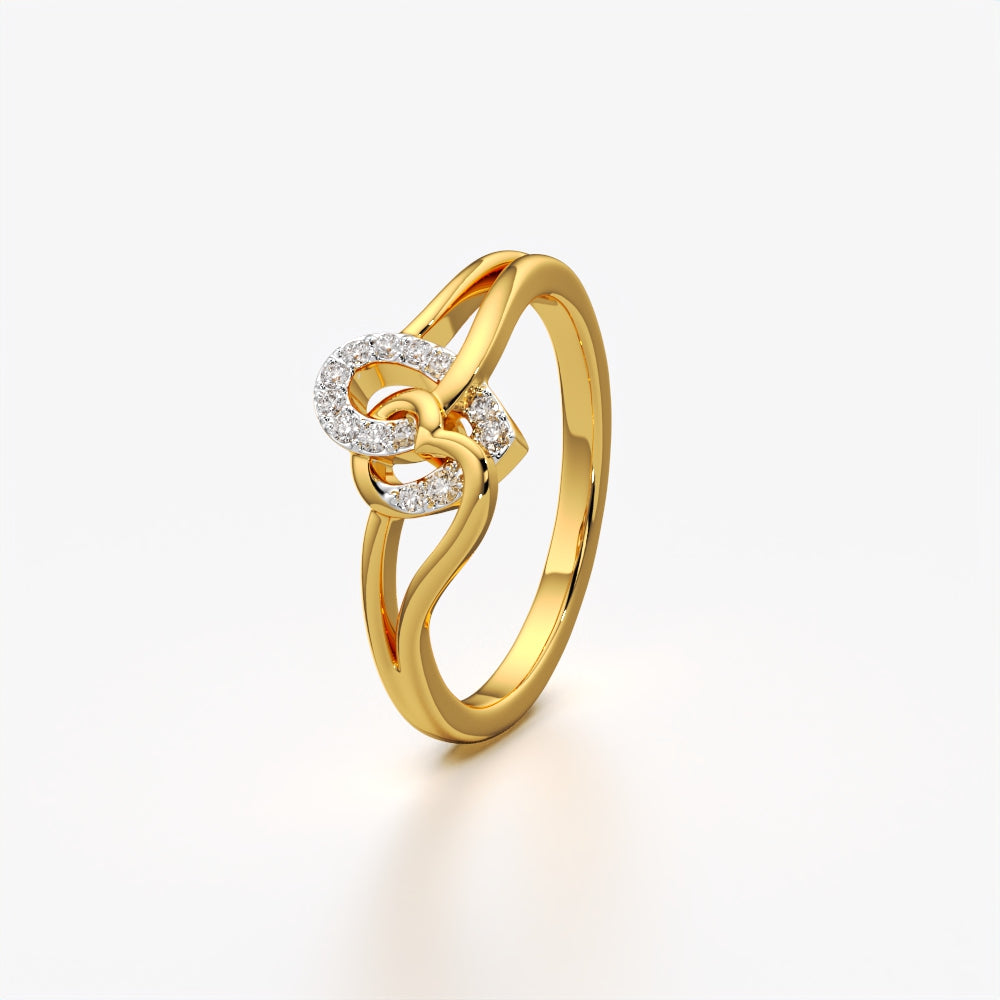
Interlocked Hearts Ring
Shop Now -
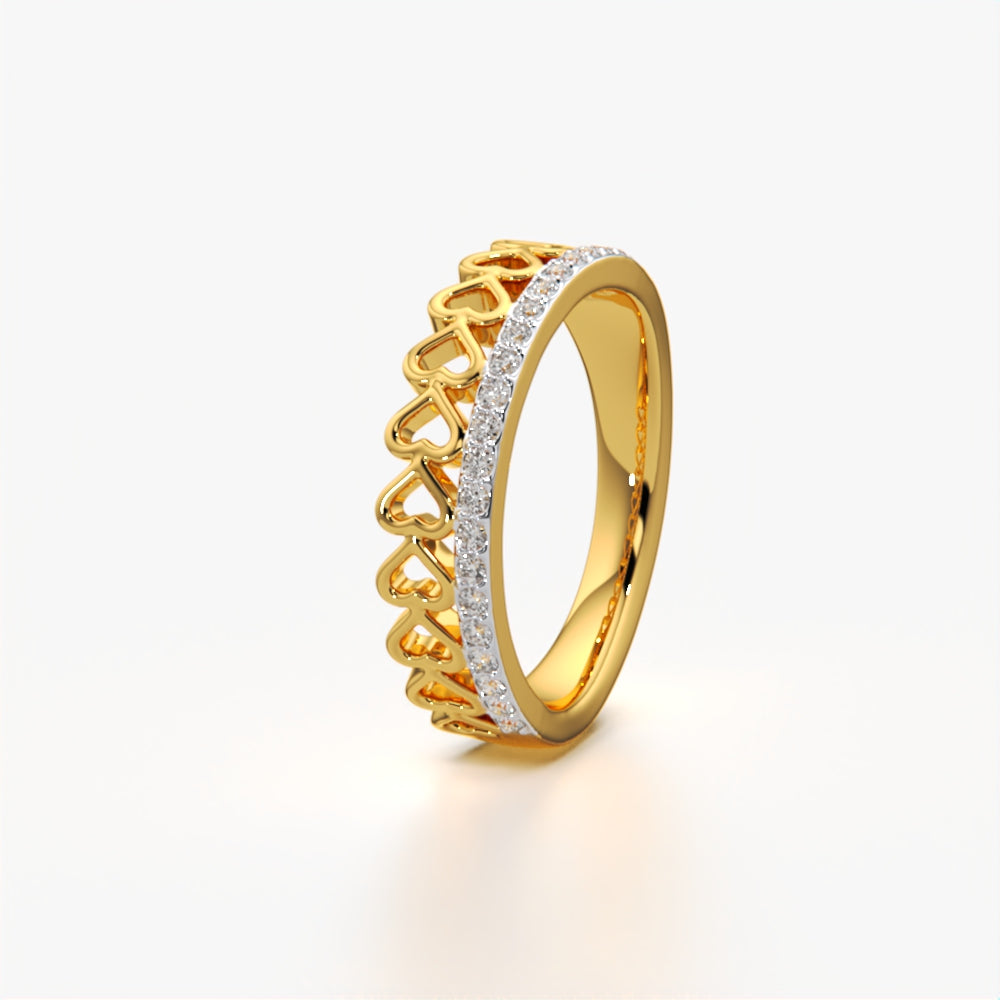
Heart Cut-Out Band
Shop Now -
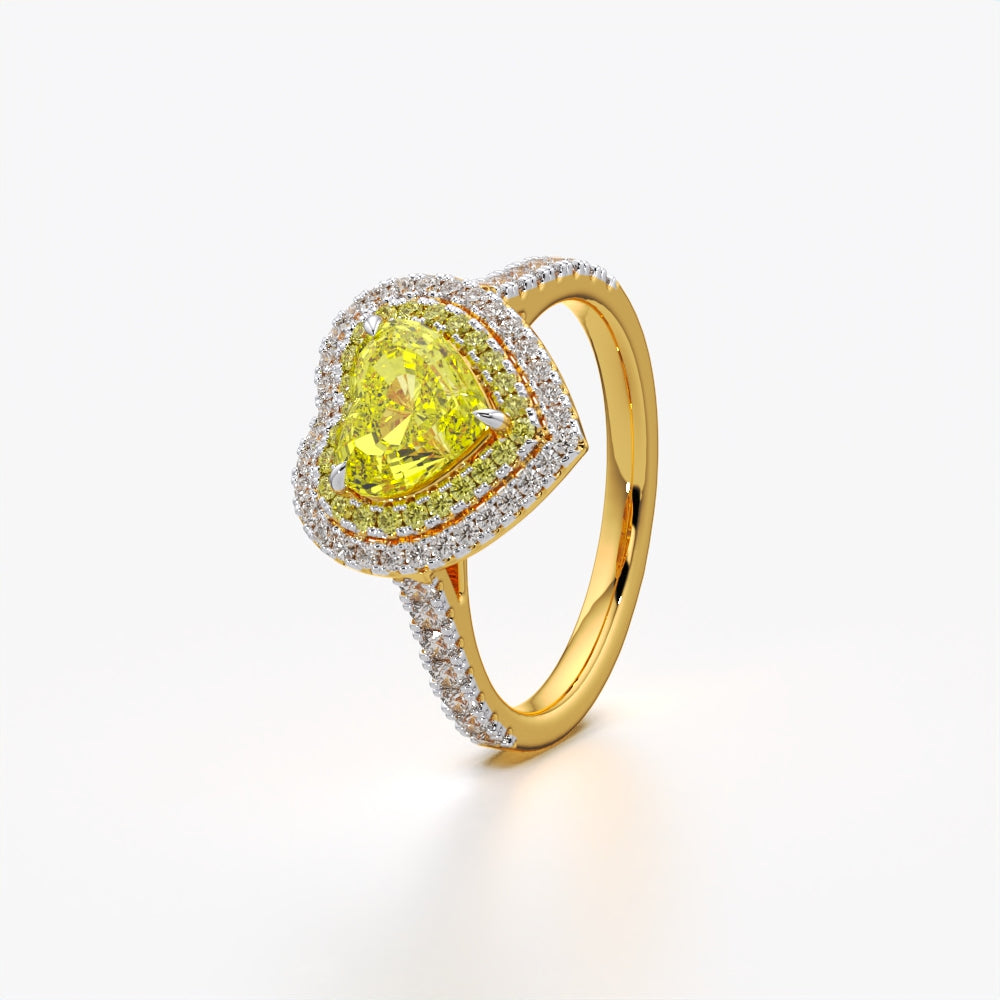
Heart Cut Double Halo Statement Ring
Shop Now
The apex test
Every heart has a pointed bottom tip. Call it the apex. It is the single detail that decides whether a heart ring is a joy or a nuisance, and almost nobody mentions it when they sell you one.
Here is the test. Look at the product photo from the side, not the top.
Ask two questions:
- Does the apex stick out past the edge of the band? If yes, it is a hook. It will find chiffon, net dupattas, woollen shawls, hair, and the lining of your handbag.
- Is the apex pointing along the finger or across it? An apex that points down the length of your finger slides past fabric. One that points sideways, across the finger, presents an edge to everything your hand brushes.
This is not a fringe concern. Jewellers who design for daily wear make the same point about stone geometry: shapes with sharp tips or corners are naturally more prone to snagging, and even set low, the pointed geometry still exists, whereas stones with softer outlines are generally more forgiving for everyday wear. A heart is a soft curve on top and a point at the bottom. The curve is the reason you want it. The point is the reason you check the side profile.
Rings that pass the apex test can be worn like a plain band. Rings that fail it are still worth owning. You just wear them the way you wear a good pair of heels, deliberately and not on laundry day.
Position 1: The heart as a pattern
Lowest profile, best for daily wear, easiest to gift.
1. The heart-and-stone half eternity band

What it is: A slim band with small polished hearts alternating with tiny round stones across the front half. The hearts are flat against the band, integrated into the metal rather than sitting on top of it. The back half of the band stays plain.
How it wears: This is the design that passes the apex test outright, because there is no protruding apex to catch anything. Nothing rises above the band's surface. It stacks cleanly, tucks under a watch strap, and does not interfere with typing.
Who it suits: Anyone buying their first heart ring, anyone who wears rings on the hand that does the most work, and anyone who wants the symbol without the announcement. It is also the safest gift, because half eternity bands read as jewellery rather than as a statement about the relationship.
Check before buying: Half eternity means the stones and motifs cover roughly the front half only. That is deliberate and good. It keeps the underside smooth against the adjacent finger and makes future resizing possible, because a jeweller can work on the plain section. A full eternity version cannot be resized in the same way.
2. The heart cut-out band

What it is: The heart appears as negative space. The band is pierced or shaped so that a heart-shaped void reads against the skin underneath, often paired with a second band or a line of pavé to frame it.
How it wears: The most quietly clever design on this list. The heart is unmistakable at conversation distance and almost invisible in a photograph taken from three feet away. Because the heart is a hole rather than a bump, the outer surface stays smooth. Apex test: passes.
Who it suits: Women who work in conservative offices, hospitals, courtrooms, or classrooms, where a visible heart motif can read as too casual. Also anyone who dislikes the sweetness of a solid heart but likes the idea of it.
Check before buying: Cut-outs collect. Hand cream, foundation, turmeric, atta, and soap residue all lodge in the void and dull the finish faster than a solid band would. This is a design that genuinely needs the weekly soft-cloth wipe described in KYMEE's jewellery care guide, not just the occasional one.
3. The full heart eternity band
What it is: Hearts repeating all the way around the band, with no plain section.
How it wears: Beautiful, and the most committing choice on this list in a practical sense. Continuous patterning around the full circumference means the ring cannot be resized later without breaking the pattern. Your finger size in December is not your finger size in May, and it is definitely not your finger size after a monsoon week of water retention.
Who it suits: Someone who already owns rings, knows their size precisely on the specific finger, and wants a milestone piece. It is a poor first heart ring and a poor surprise gift.
Check before buying: Ask two questions. Can it be resized at all? And is the pattern the same all the way round, or does it thin out at the back? Full eternity bands that keep full detail on the palm side press into the adjacent finger.
In KYMEE's range: Not currently stocked as a heart design. If this is the one you want, it is a natural fit for a Customised Piece, where you can specify a repeating heart pattern and a comfort-fit interior. Bring your exact Indian ring size, measured on the finger you will actually wear it on.
Position 2: The heart as the stone
Where the heart becomes a visible object. Higher profile, more occasion-weighted, more colour available.
4. The coloured heart halo

What it is: A heart-shaped centre stone in a strong colour, ringed by a halo of tiny clear stones. The halo does two jobs. It makes the centre look larger, and, crucially, it wraps the apex in metal and small stones so the point is no longer exposed.
How it wears: Better than people expect. The halo is a bumper. It rounds off the apex and softens the hardest edge of the heart silhouette, which is why halo settings are one of the more forgiving ways to wear a pointed stone shape. The profile is still raised, so it is a ring you take off before kneading dough or before a gym session, but it is not a snagging problem in ordinary use.
Who it suits: Anyone who wants colour. This matters more in India than most global guides acknowledge, because a clear stone disappears against gold in daylight, while a red or pink centre reads instantly against a saree, a kurta or a lehenga. It is the single best-value festive ring category.
Check before buying: Look at how the halo meets the apex. A halo that stops short of the point leaves the sharpest part exposed and defeats the purpose. Also check the setting height in the side profile photo.
5. The crowned heart

What it is: A heart-shaped stone with a crown or tiara motif arching above it. Descended from the Claddagh, which pairs a heart with a crown and two hands, but usually simplified into heart plus crown.
How it wears: More jewellery than the halo, and more of a talking point. The crown adds visual height above the heart, so the whole setting reads taller. Apex test: check carefully, because a crowned heart usually orients the apex downward along the finger, which is the better direction, but the crown itself adds a new upper edge.
Who it suits: People who like their jewellery to mean something specific, and people drawn to the regal, slightly vintage register. It also carries an actual code, which is the fun part.
The orientation code: The Claddagh tradition assigns meaning to how you wear it. Per Claddagh specialists, worn on the left ring finger with the heart facing outward, the wearer is indicating engagement; on the left hand with the heart facing inward, it means married; on the right hand facing outward, it signals the heart is still open, and on the right hand facing inward, it conveys the heart is taken. Very few people in India will read the code off your hand, which arguably makes it better. It becomes a private signal rather than a public one.
Check before buying: Crowns have small repeated peaks. Ask whether those peaks are rounded or squared at the tips. Rounded peaks behave; squared ones catch on knitwear.
6. The heart-cut solitaire
What it is: One heart-shaped stone, prong-set, alone on a plain band. No halo, no side stones, nothing else competing.
How it wears: This is the design that most needs the apex test and most often fails it. A bare heart-cut solitaire has an exposed point, exposed prongs, and maximum height. It is the most romantic and the least practical shape in the entire heart category.
Who it suits: Occasion wear, proposals, anniversary dinners, photographs. Not a keyboard ring, not a commute ring, and not a ring you wear while carrying a toddler.
Check before buying: Prong count and prong shape. A heart cut needs a dedicated V-prong or chevron prong at the apex to protect the point; standard round prongs will not protect the tip. Mind the size trap: shop by millimetre width rather than carat weight, choosing a stone that measures at least 5mm × 5mm so the heart silhouette remains distinct on the hand.
In KYMEE's range: Not stocked as a heart-cut solitaire. KYMEE's solitaire rings run round, oval, cushion, marquise and pear. If a heart-cut solitaire is specifically what you want, it is a straightforward brief for customise Your Own Piece: specify a large centre stone in your chosen colour, a V-prong at the apex, and the band width you like.
7. The heart toi et moi
What it is: Two stones side by side on an open or crossover band, where one of the two is a heart. Toi et moi means "you and me". The two stones are the two people, or the two chapters.
How it wears: Wider across the finger than a solitaire but lower in height, which is a good trade. The bypass construction means the band opens rather than closes, so the two stone heads sit at slightly different heights and the ring has a natural direction on the hand.
Who it suits: Couples who find a solitaire too loaded and a plain band too quiet. Also strong as a friendship or sibling piece, and as an anniversary marker where the two stones stand for then and now. This style has real momentum in India right now, and a heart variant of it is genuinely uncommon.
Check before buying: Whether the two stones are the same size. Equal sizes read as partnership; unequal sizes read as one person orbiting the other, which is a different message than most buyers intend.
In KYMEE's range: The Toi Et Moi rings collection uses pairings such as pear and oval rather than hearts. A heart-plus-round or heart-plus-pear toi et moi is one of the more interesting custom briefs available, and it is worth asking for.
Position 3: The heart as the silhouette
Where the ring's own outline becomes the heart. The most sculptural group, and the most flexible on sizing.
8. The twin heart bypass wrap

What it is: An open band whose two ends wrap past each other rather than joining, with a heart at each end. Also called a bypass or crossover ring.
How it wears: Structurally, the most forgiving design here, and the most underrated. Because the band is open rather than closed, it accommodates a small amount of finger-size variation. That matters in a climate where fingers swell in heat and humidity and shrink on a cold December morning. It also means the ring can be worn slightly higher or lower on the finger to change how it looks.
Who it suits: Two groups. First, anyone whose ring size sits between two numbers and who has given up on getting it exactly right. Second, anyone buying a gift without knowing the recipient's size, because an open bypass is far more likely to land wearably than a closed band. That single fact makes it the strongest heart ring for gifting.
Check before buying: Open bands can be gently adjusted, but repeated adjustment work-hardens metal and eventually stresses it. Adjust once for fit and then leave it. Also check that the two heart apexes point away from each other along the finger, not outward across it.
9. The engraved or personalised heart
What it is: A heart form carrying a name, an initial, a date, or a short word. Either the heart is the flat surface being engraved, or the engraving sits inside the band with the heart on the outside.
How it wears: Depends entirely on where the engraving goes. Outer-face engraving on a flat heart is smooth and wears like a signet. Inner-band engraving is completely invisible and completely unobtrusive, and is the version most people actually want once they think about it.
Who it suits: Anniversaries, name-day gifts, a first-salary self-purchase, or a piece marking a date you do not want to explain to strangers. Inner engraving in particular suits anyone who wants the meaning without the exposure.
Check before buying: Two things. Personalised and engraved pieces are usually non-returnable, so the size has to be right the first time. And engraved outer surfaces on any plated jewellery are working surfaces: the raised edges of the letters take more friction than the flat field around them. Inner engraving avoids this problem entirely.
In KYMEE's range: The personalised rings collection covers script name bands. A heart-shaped engraved face is a custom build, and Customise Your Own Piece is the route. Specify inner-band engraving if you want it to last.
10. The heart stack
What it is: Not one ring. A heart ring paired with one or two companion bands, worn together on the same finger or across adjacent fingers.
How it wears: Better than any single ring, if you build it right. The trick is contrast in width, not in style. A slim heart band next to a slightly wider plain or pavé band reads intentional. Two rings of identical width read like you could not decide.
Who it suits: Anyone who already owns one or two rings and is not sure what to add. Also the most useful format for a milestone gift, because you can start the stack now and add to it on the next occasion.
Check before buying: Stacked rings rub against each other constantly, and that friction is concentrated on the edges where they touch. This is the single fastest way to wear down plating on any gold-over-silver piece. Two rings of similar height wear more evenly than a tall one grinding against a flat one.
How to build it with KYMEE: Take the Heart and Sparkle Half Eternity Ring as the anchor, then add from stackable rings or the pre-matched ring sets. If you want the heart to be the loudest thing in the stack, keep the companions plain. For more on why thin rings outperform statement pieces day to day, this breakdown of why a dainty ring works covers the practical case.
A straight answer on stones
This deserves its own section because the Indian market is genuinely confusing on it, and because a lot of listings across the category use the word "diamond" loosely.
KYMEE's rings use two stone types, and the split is deliberate:
- Moissanite in mini and pavé form. The small scattered stones across hearts, halos, bands, and clusters.
- Cubic zirconia (CZ) for the larger centre stones, including the coloured hearts.
Neither is a mined diamond, and neither is sold as one. If a spec row on any listing, from any brand, says "diamond" where the value reads Moissanite or CZ, treat the value as the truth and the label as a template artefact.
Why the split makes sense for a heart ring specifically: a heart-cut centre stone needs to be reasonably large to read as a heart at all. Below roughly 5mm across, a heart cut just looks like a slightly odd round. Larger stones are exactly where CZ makes financial sense, and where mini Moissanite would be the wrong tool. Meanwhile, the pavé that outlines a halo or scatters across a band is where Moissanite's higher brilliance actually shows.
If you want to understand what 18K gold vermeil is and how it differs from ordinary gold plating, this explainer is the clearest starting point.
Choosing by occasion
| If the moment is | Look at position | Because |
| Everyday, office, college | 1 (pattern) | No protruding apex, stacks with what you own |
| A gift where you do not know the size | 3 (silhouette, open band) | Open bypass tolerates size error |
| Festive, wedding season, family functions | 2 (coloured stone) | Colour reads against silk and gold in daylight |
| A promise, before an engagement | 1 or 3 | Meaningful without the formality of a solitaire |
| An anniversary or milestone | 2 or 10 (stack) | Room to build on later |
| Friendship, sibling, rakhi | 1 or 7 (toi et moi) | Two-part symbolism without romantic reading |
A promise ring in particular sits in an interesting place in India right now: meaningful, flexible, and deliberately short of an engagement. If that is the intent behind your search, this piece on promise ring meaning is worth ten minutes.
Getting the size right without guessing
Heart rings punish bad sizing more than plain bands do, because an off-centre heart is immediately visible in a way that an off-centre plain band is not. A ring that spins will spend most of its life with the heart facing your palm.
Three rules that matter more than the chart:
Measure at the end of the day: Fingers are at their largest when warm. A morning measurement gives you a ring that will not go on by evening, which in Indian summers is most of the year.
Measure the finger you will actually wear it on: Your dominant hand runs roughly half a size larger than the other. If you are switching hands from an existing ring, the number changes.
Mind the knuckle gap: If your knuckle is noticeably wider than the base of your finger, buy for the knuckle and accept some spin, or choose an open bypass design that sidesteps the problem entirely. This is the most common reason heart rings end up worn on a different finger than intended.
KYMEE uses standard Indian ring sizes (5 through 20). If converting from international standard sizes: an Indian Size 12 measures 16.5 mm inside diameter (~US Size 6), an Indian Size 14 measures 17.3 mm (~US Size 7), and an Indian Size 17 measures 18.2 mm (~US Size 8). Measure the inside diameter of a well-fitting ring in millimeters for an exact match.
Care in Indian conditions
Heart rings have more surface geometry than plain bands. More edges, more crevices, more places for residue to sit. The care rules are not different from any other gold vermeil piece, but they matter more here.
- Jewellery on last: After perfume, after moisturiser, after hair spray. Alcohol and oils are what dull plating, not water.
- Off before wet or rough work: Bathing, swimming, gym, dishes, cleaning.
- Off for colour festivals: Holi, haldi, and mehendi are the three days a year that do the most damage to plated jewellery, in one sitting.
- Wipe after wearing: A soft, dry cloth, ten seconds. This is the whole maintenance routine.
- Store dry and separate: Not on the bathroom shelf, and not loose in a box with other rings, where they scratch each other.
- Sweat & Skin Safety: High humidity and sweat accelerate tarnish on base alloys. Because gold vermeil uses a 925 Sterling Silver core, wipe your ring daily with a microfibre cloth after wear to preserve both the gold finish and its nickel-free, hypoallergenic protection.
Cut-out and pavé designs need wiping more than solid bands do. Full details are on KYMEE's jewellery care page.
When customisation is the better answer
Four of the ten designs above are not in KYMEE's current heart range: the full heart eternity band, the heart-cut solitaire, the heart toi et moi, and the engraved heart signet. That is worth saying directly rather than pretending an adjacent product is the same thing.
For any of those, customising your own piece is the route.
A useful brief covers five things:
- Which of the three heart positions you want.
- Centre stone size in millimetres, not carats.
- Colour, if any.
- Band width, and whether you want comfort-fit on the inside.
- Your Indian ring size, measured in the evening, on the correct finger.
Custom pieces take longer to make than stock pieces and are generally not returnable, so the size step is the one to be slow about.
FAQs
Which finger should a heart ring go on?
There is no rule outside the Claddagh tradition. Practically: ring finger if it is a couple's piece, index or middle finger if it is a statement or a self-purchase, and the non-dominant hand if the design has any protruding apex. A crowned heart on the index finger reads confident rather than sentimental, which many people prefer.
Should the heart point towards you or away?
For most heart rings, whichever way looks right to you in a photo of your own hand. For Claddagh-style crowned hearts, the direction carries the traditional meaning described above. For comfort, an apex pointing along the finger always beats one pointing across it.
Are heart rings only for couples?
No, and in India increasingly not. Friendship rings, sibling gifts, first-salary self-purchases and rakhi gifting all sit comfortably in this category. Position 1 designs in particular are read as jewellery first and symbol second, which is exactly what you want when the relationship is not romantic.
Can you wear a heart ring every day?
A Position 1 pattern band, yes. A Position 2 stone ring, most days, off for wet or rough work. A bare heart-cut solitaire, no, and that is a design fact rather than a quality issue.
What is the difference between gold vermeil and gold plated?
Gold plating involves a thin layer of gold (often 0.5 microns or less) flash-plated over base metals like brass or nickel, making it prone to rapid wear. Gold vermeil requires a thick layer of gold (at least 2.5 microns) electroplated over solid 925 sterling silver, offering significantly higher durability, long-lasting lustre, and hypoallergenic properties.
Will a heart ring in vermeil last?
With the care routine above, it can last for years of daily wear. The failure mode to avoid is friction, not water: stacking a tall ring against a flat one, or wearing a ring through gym sessions and housework, wears plating far faster than a monsoon shower ever will.
Is a bigger heart stone better?
Only up to a point. Heart cuts carry a lot of weight in their depth, so a heart looks smaller than a round stone of the same carat weight. Judge by millimetres spread across the widest part of the heart. Anything under roughly 5mm stops reading as a heart from arm's length.
What is the best heart ring to give as a gift if you do not know her size?
An open bypass or wrap design, every time. A closed band is a coin flip. See design 8.