


Top Mangalsutra Designs to Wear, Chosen by How They Sit

Almost every mangalsutra list you will find online is organised the same way: minimal, geometric, floral, solitaire, rose gold, dual-tone. Those are showroom categories. They describe how a piece photographs on a white background.
They do not describe what actually decides whether you keep wearing something.
What decides that is shape behaviour. Whether the pendant lies flat or tips forward when you lean over a laptop. Whether it slips under a kurta placket or rides on top of it. Whether the edge catches the loose threads of a dupatta every time you adjust it. Whether the metalwork has enough surface area to survive four years of sweat, chain friction, and Sunday hair oil at the exact point where it rubs.
This list is built on that second axis. Ten mangalsutra designs, sorted by pendant architecture, with an honest note on what each shape does well and what it costs you.
Why pendant shape matters more than trend name
A mangalsutra is one of the few pieces of jewellery an Indian woman puts on and then does not take off. A ring comes off to knead atta. Earrings come off at night. Bangles come off at the salon. The mangalsutra stays.
That changes the engineering problem completely. A pendant you wear for four hours at a wedding only has to look good. A pendant ya ou wear for sixteen hours a day, every day, through a Chennai summer and a Mumbai monsoon, has to survive contact.
Three physical properties do most of the work.
The first is vertical drop: How far the pendant hangs below the chain's resting line. A low-drop pendant, meaning one that is wide rather than tall, moves less. It does not swing when you walk down stairs, does not tap against a desk edge, does not slide sideways into your armpit when you lie down. High-drop pendants look more dramatic in photographs and move considerably more in life.
The second is face-to-face symmetry: A pendant that looks the same from both sides cannot embarrass you by flipping. Bars, circles, and interlocking links tend to be near-symmetrical. Sculpted florals, wings, and layered pieces have a clear front and a plain back, so when they turn, they turn visibly.
The third is outline complexity: Every notch, prong tip, open loop, and pierced gap in a pendant outline is a place where a thread can hook. Open, airy, filigree-style metalwork is beautiful and is also the highest-maintenance choice if you wear chiffon dupattas or work near Velcro, straps, and bag handles.
None of this makes an ornate design wrong. It just means an ornate design is an occasion piece pretending to be a daily piece, and knowing that before you buy saves disappointment later.
-

Princess Set Cluster Mangalsutra
Shop Now -
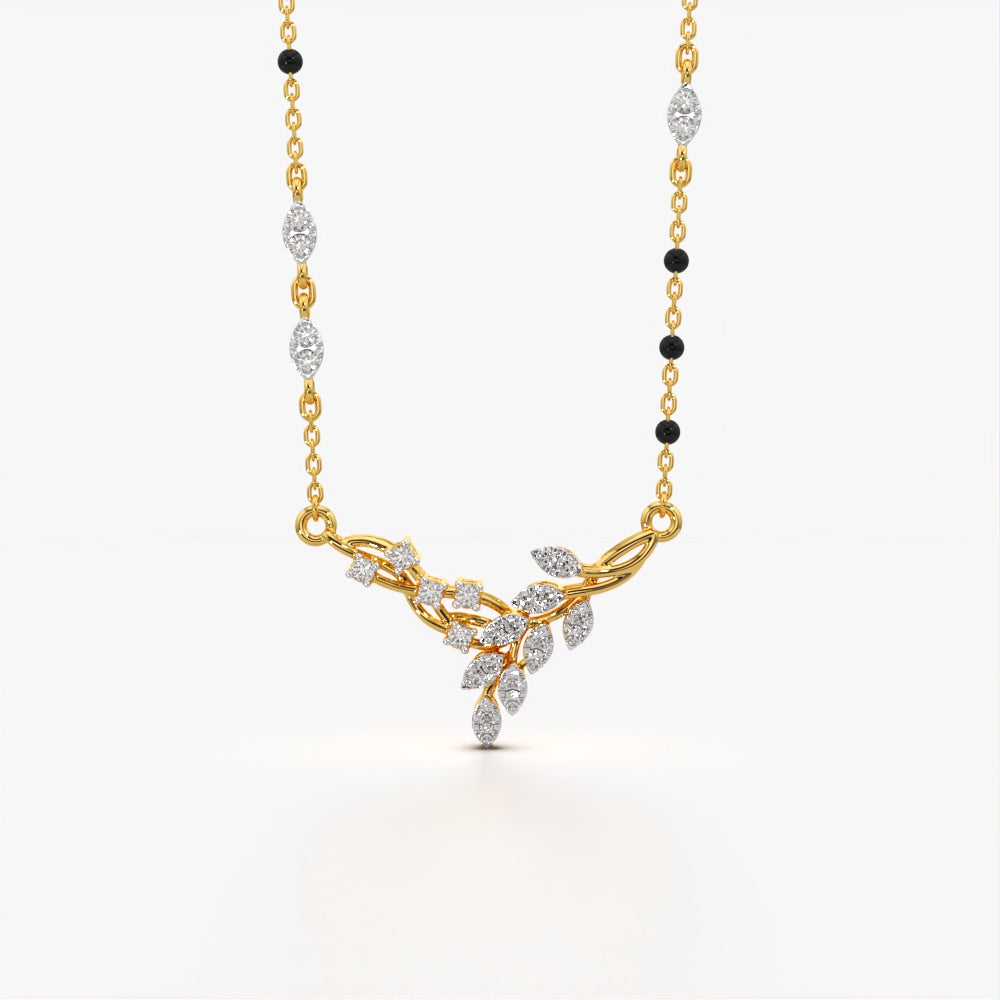
Crystal Leaf Vine Mangalsutra
Shop Now -
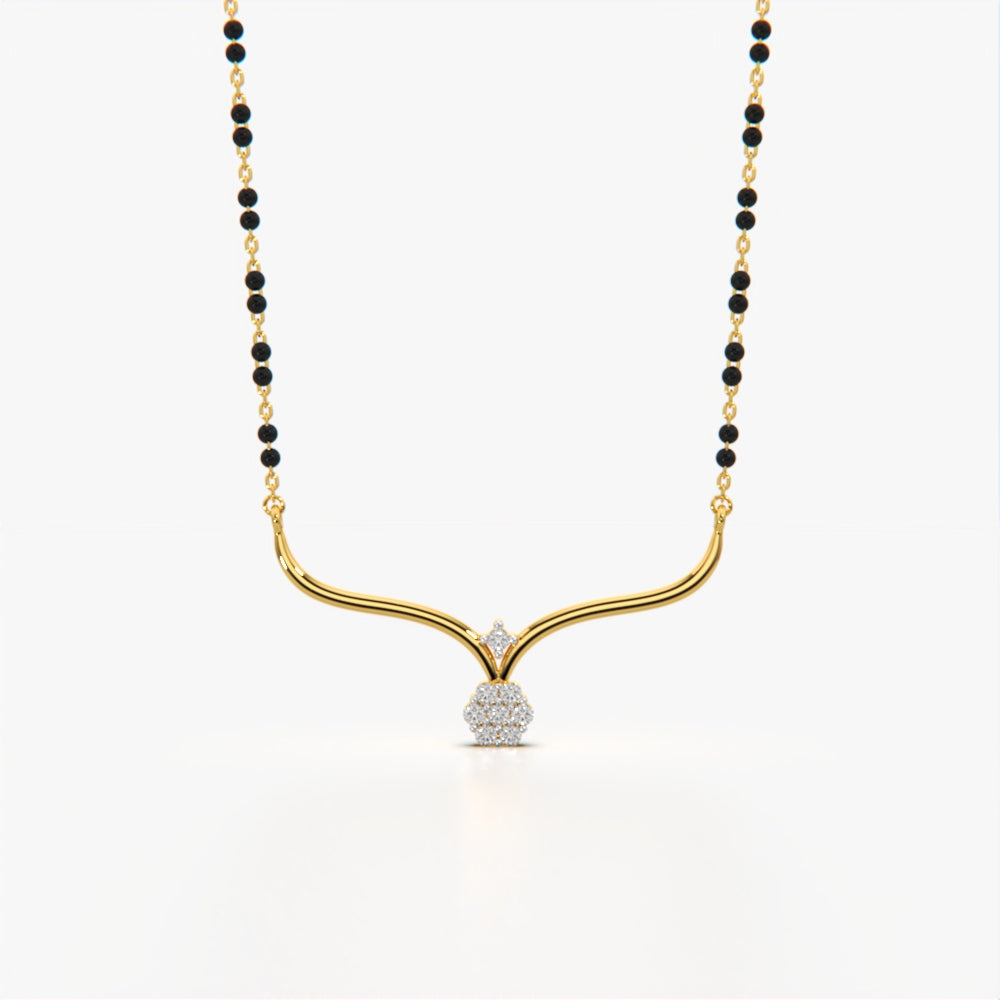
Floral Arc Mangalsutra
Shop Now -

Oval Halo Solitaire Mangalsutra
Shop Now
Three checks most mangalsutra guides skip
Before the list itself, there are three questions that materially affect whether a modern mangalsutra works in an Indian household. None of them appear in the standard trend roundup, and all three come up constantly in real buying conversations.
Does it actually keep the black beads?
A significant share of pieces sold as "modern mangalsutra" are, structurally, pendant necklaces. The pendant has been redesigned, and the mani, the black beads, have quietly been dropped in favour of a plain chain.
For some families, that is completely fine. For many, it is not. In several communities, the black beads are not decoration; they are the defining element, believed to absorb negativity and protect the marriage. A relative who glances at your neck is often looking for the beads, not the pendant.
This matters practically. If you buy a beadless piece and your mother-in-law reads it as "not a mangalsutra", you have bought a necklace at a mangalsutra price, and you will end up wearing the old one anyway.
KYMEE's mangalsutra chains carry black beads spaced along the chain rather than removing them, which is visible in the product photography and stated in the product descriptions. If you are buying anywhere, confirm on the individual product page rather than assuming from the category name. It is the single most common mismatch between what people think they ordered and what arrives.
What is the stone actually made of?
This is the least honest corner of the Indian jewellery market, and it is worth understanding before you spend.
Walk through any wholesale listing, and you will find "American Diamond Mangalsutra", "Diamond Mangalsutra", and "White Stone Diamond Mangalsutra" priced anywhere from ₹9 to ₹9,000. None of those are diamonds. "American diamond" is a trade name for cubic zirconia. Cubic zirconia is a synthetic zirconium dioxide crystal. It looks bright, it is inexpensive, and it is not remotely the same material as a diamond.
Moissanite is a separate material again, silicon carbide, considerably harder than cubic zirconia and with higher light dispersion, meaning it throws more coloured fire. It is also more expensive per unit of size, which is why almost nobody uses it for large centre stones at demi-fine prices.
This is worth knowing because hardness determines how a stone ages. Softer stones scratch on their table facets over years of wear, and a scratched stone goes cloudy, which is the real reason cheap sparkle looks dead after eighteen months, not the plating.
KYMEE's stated approach is to use moissanite specifically in the mini and accent stones, where hardness matters most for a piece rubbing against fabric daily, and cubic zirconia where a larger centre stone is needed, and moissanite at that scale would push the price out of the segment. Neither is described as a diamond. When you are comparing across brands, ask the same question directly, because the vocabulary is designed to blur it.
Where will it rub?
Think about your actual day before you think about your outfit.
If you wear a saree with a pinned pallu, the pin sits near the collarbone, and the fabric is under tension across exactly the zone a mangalsutra pendant occupies. If you carry a sling bag or a laptop bag, the strap crosses one side of the chain and grinds it against your neck for the whole commute. If you drive, the seatbelt does the same on the opposite side. If you have long hair worn loose, the chain sits under it and gets pulled through hair oil daily.
The wear point is almost never the pendant. It is the chain at the back of the neck and at the two shoulder crossings. This is why a piece can look perfect from the front and still show thinning after a few years.
The 10 mangalsutra designs, by shape
1. The flat cluster

Multiple small square-cut stones set into individual bezels across horizontal connectors, forming a compact block of light rather than one big stone.
This is the most practical shape on the list, and it is not a coincidence that it is the most reviewed piece in KYMEE's mangalsutra range. Bezel setting means each stone sits inside a metal rim rather than being held by raised prongs, so there are no sharp claw tips standing proud of the surface to catch on fabric. The cluster reads wide and low, so the drop is short and the pendant barely moves. At around 3.5 grams total, it is light enough to forget you are wearing it.
The trade-off is that a cluster of small stones reads as texture rather than as a statement. If you want people to notice the piece from across a room, this is not it. If you want something that disappears under a formal shirt on Monday and looks considered at a Sunday lunch, it is close to ideal.
Suits: office wear, western outfits, anyone who wants the piece to be present rather than prominent.
2. The single-focus halo

One larger centre stone encircled by a ring of smaller stones. The halo makes the centre read visually bigger than it is, which is the entire point of the setting.
This shape is the closest bridge between what younger buyers want and what older family members recognise. A round or oval pendant with a clear centre is legible as a mangalsutra to almost everyone, in a way that an abstract geometric shape is not. It sits at the entry end of the collection's price range, which makes it a reasonable first modern mangalsutra when you are not yet sure how much you will wear it.
The rounded outline is also mechanically forgiving. There are no corners to snag, and a circle looks correct at any rotation, so even if it turns slightly, it never looks wrong.
The trade-off is that halo designs are the most produced shape in the category. You are choosing familiarity over distinctiveness, which is a perfectly reasonable trade; just make it deliberately.
Suits: first modern mangalsutra, mixed-generation households, anyone who wants one piece to work everywhere.
3. The horizontal bar

A slim horizontal bar, stone-set along its length, sitting parallel to the collarbone.
Structurally, this is the flattest silhouette available, and the flattest silhouette is the one that behaves best under clothing. A bar has almost no vertical drop, so it cannot swing. It is close to symmetrical top to bottom, so a flip is barely noticeable. And its profile is thin enough that it sits under a shirt collar or inside a kurta placket without creating a visible bump in the fabric.
If your working life involves lanyards, stethoscopes, dupattas, aprons, or anything else that crosses the chest repeatedly, the bar is the shape that fights you least.
The honest limitation is that a bar carries no traditional visual vocabulary at all. There is nothing in a bar that says mangalsutra except the black beads on the chain. In households where the pendant itself is expected to look ceremonial, this shape can read as simply a necklace.
Suits: corporate wardrobes, medical and lab settings, layering under other necklaces, minimalists.
4. The open arc

A curved sweep of metal and stones that follows the natural line of the collarbone, usually with floral detailing worked into the curve.
The arc is an underrated shape because it solves a real problem: how to get visual width without visual weight. A curve occupies more horizontal space than a compact pendant, so it reads generous, but because it is a line rather than a mass, it stays light. It also sits naturally because it is echoing a curve your body already has.
Floral detailing on an arc is a genuine bridge between traditional and modern grammar. Florals are deeply embedded in Indian jewellery vocabulary, so the piece feels rooted, while the open arc structure keeps it from looking like your grandmother's set.
The trade-off is the outline complexity. An arc with floral piercing has more edges and gaps than a solid pendant, which means more places for a thread to find. Manageable, but worth knowing if you live in chiffon.
Suits: wide necklines, boat necks, sarees, and kurtas, for buyers who want a traditional feeling without traditional weight.
5. The symbol pendant

A recognisable symbol, most commonly the infinity loop, rendered horizontally and set with pavé stones.
Symbol pendants work on a different logic than the rest of the list. You are not choosing an aesthetic; you are choosing a meaning you want to carry. The infinity form reads as a bond without an end, which maps neatly onto what a mangalsutra is for, and it does so without needing anyone to explain it.
Mechanically, the horizontal infinity is well behaved. It is wide rather than tall, so low drop. It is close to symmetrical, so flipping is not obvious. Pavé setting, where many tiny stones sit close together in a bed of metal, keeps the surface relatively smooth.
The trade-off is that pavé has many small settings, and small settings are where dirt collects. This shape needs more frequent cleaning than a bezel-set design, particularly if you use powder, sunscreen, or perfume near the neckline.
Suits: anyone who wants meaning over ornament, gifting, and anniversary purchases.
6. The interlocking link

Two or more forms are physically threaded through one another, so the pendant is literally two joined pieces rather than one shape.
Of all the modern reinterpretations, this is the one with the strongest conceptual claim. The mangalsutra represents a union, and an interlocking pendant enacts that union structurally rather than depicting it. Two elements that cannot be separated without breaking one of them.
Links also have a quality no solid pendant has: internal movement. The elements shift slightly against each other as you move, which makes the light behave differently throughout the day. Some people love this. Some find the faint sound distracting in a quiet room.
The trade-off is at the joint. Any place where two metal parts move against each other is a friction point, and friction is where a gold layer wears first. This is a shape where the plating warranty genuinely matters over a long horizon.
Suits: anniversary and milestone gifting, buyers who want the symbolism to be structural, people who like a piece with some life in it.
7. The motif pendant

A defined figurative motif, the butterfly being the most popular, rendered in stone and metal.
Motif pendants are the personality option. Where a bar or cluster is deliberately neutral, a butterfly is a choice with a point of view, and for a lot of women, that is exactly right. It also photographs well, which matters more than people admit.
Motifs carry their own meanings that sit alongside the mangalsutra's. A butterfly reads as transformation, which is not an unreasonable thing to associate with marriage.
Two honest trade-offs. First, figurative motifs date faster than abstract shapes. A bar looks the same in ten years; a butterfly will look like it came from a particular moment. Second, wings mean a wide, irregular outline with tips, and tips catch. This is a shape to be more careful with around loose-weave fabric.
Suits: women who want the piece to have character, younger buyers, second mangalsutra when you already own something conservative.
8. The layered geometric

Overlapping planes set at slightly different depths, so the pendant has a genuine three-dimensional structure rather than being flat.
Layering solves the problem that flat pendants have in Indian light. Under harsh direct sun or a single overhead bulb, a flat pendant is lit uniformly and can look dull. A layered pendant always has one plane catching light and another in shadow, so it stays visually alive in conditions that flatten simpler designs.
It also reads as designed rather than decorated, which is the distinguishing quality of good contemporary jewellery.
The trade-off is thickness. Depth means the pendant stands further off the chest, which means it is less invisible under a fitted shirt and slightly more likely to press when you lie down or lean forward at a desk.
Suits: modern and western wardrobes, buyers who find florals too soft and bars too plain, anyone photographing themselves often.
9. The twin-stone drop

Two larger pear-shaped stones angled to meet, forming a heart or a paired silhouette.
Two-stone designs carry a specific idea: two distinct people, kept distinct, joined. It is the same logic as the toi et moi setting, and it is a more interesting proposition than a single stone for a piece that is explicitly about a partnership.
Pear shapes also produce the most concentrated light return of the shapes on this list, because the pointed end acts as a light funnel.
The trade-off is drops and points. Twin pears tip is a taller pendant than a cluster or a bar, so it moves more, and pear stones have a genuine point at one end, which is the single most snag-prone geometry in jewellery. This is a festive-leaning piece that can be worn daily rather than a daily piece that scales up.
Suits: festive wear, wedding-season events, buyers who want the piece to be visible.
10. The vine

Organic leaf and vine forms intertwine, with stones following the natural line of the growth rather than sitting in a geometric grid.
This is the most ornate architecture on the list and the most traditional in feeling, despite being contemporary in execution. Vine and leaf motifs sit deep in Indian decorative vocabulary, and a vine pendant will look correct with heavy silk in a way that a geometric bar simply will not.
It sits at the upper end of the collection's range, and it is the piece to pick if you want one mangalsutra that can carry a wedding.
The trade-offs are the ones you would expect from open organic metalwork. Maximum outline complexity, so maximum snag risk. Many small crevices, so more cleaning. Highest visual weight, so it dominates a simple outfit rather than complementing it.
Suits: festive and wedding season, silk and heavy fabric, buyers who want one piece that scales up rather than down.
Matching a design to your actual week
A useful way to decide is to count. Out of seven days, how many are office or errands, how many are social, and how many are festive or family events?
If five or more days are ordinary, buy for the ordinary days. The flat cluster, the bar, and the halo will serve you better than something that only comes alive at a function. Buying the festive piece and wearing it daily is how pieces get damaged and how people conclude that demi-fine jewellery does not last.
If you already own a heavy traditional mangalsutra from your wedding, which most married Indian women do, you are not replacing it. You are buying the second one, the rotation piece, and the second one should be chosen for the days the first one is impractical. That framing usually points at the flatter, lower-drop shapes.
If you genuinely have only one and it needs to do everything, the halo and the arc are the two shapes that stretch furthest in both directions.
For pairing beyond the mangalsutra itself, the pendant necklaces and layered necklaces collections are useful references for how a shorter mangalsutra sits alongside a longer chain, and there is a broader guide on styling a pendant against different necklines that applies directly.
Keeping a daily mangalsutra looking new in Indian conditions
Indian wearing conditions are harder on jewellery than most international care advice accounts for, and the mangalsutra takes the worst of it because it never comes off.
Humidity and sweat: Sweat is mildly acidic and salt-bearing. During the monsoon and through the summer months in coastal cities, the neck and upper chest stay damp for hours. Wipe the piece with a dry, soft cloth at the end of the day, particularly along the back of the chain. This one habit does more for longevity than anything else.
Haldi, sindoor, and kumkum: These are pigmented powders that lodge in stone settings and between beads, and turmeric, in particular, stains. If you are attending a haldi or doing daily pooja with kumkum, the sensible move is to take the piece off for the ritual and put it back after. If that is not culturally comfortable in your household, clean the settings the same evening with a soft dry brush before the powder sets.
Hard water: Much of northern and western India runs on hard groundwater with high calcium and magnesium. Repeated exposure leaves a dulling mineral film on stones and in crevices. Do not wear the piece in the shower. This is the single most commonly ignored piece of care advice and the most consequential one.
Hair oil and cosmetics: Oil migrates from hair onto the chain and holds dust. If you oil your hair weekly, tie it up rather than leaving it loose over the chain, and wipe the chain afterwards.
Order of operations: Jewellery goes on last, after perfume, moisturiser, and hair products, and comes off first. Perfume alcohol is not kind to plated finishes.
Storage: Store flat in a soft pouch, not tangled in a box with other pieces. Chains scratch each other. If you live somewhere humid, a small silica sachet in the pouch is worth the ten rupees.
KYMEE publishes a fuller Jewellery care page, and there is more detail on how the vermeil layer behaves in what is gold vermeil.
What a gold vermeil mangalsutra does and does not do
It is worth being direct about this, because the demi-fine category is often sold without the caveats.
Gold vermeil is a defined standard, not a marketing word. It means a thick layer of gold over a sterling silver base, as distinct from ordinary gold plating over brass or alloy. KYMEE's mangalsutras are 18K gold vermeil at a stated 2.5 micron thickness over 925 sterling silver. The sterling silver base is what makes the pieces nickel-free, which matters if you have reacted to costume jewellery before, and it matters more for a mangalsutra than for any other piece because of the constant skin contact.
What it does well: It gives you real 18K gold colour at roughly a tenth of what a comparable solid gold piece costs. It is light enough for genuine all-day wear. It is safe for sensitive skin. It lets you own more than one design without the purchase feeling reckless, which is the entire point of a rotation piece.
What it does not do: It is not an investment. A gold vermeil mangalsutra has no meaningful gold-weight resale value in the way a 22K piece does, and you should not think of it as a store of value. It is jewellery, not savings. The gold layer is a layer, and over a long enough horizon with daily wear, it will show thinning at friction points, most likely at the back of the chain rather than on the pendant. Care extends that considerably. It does not eliminate it.
If gold as an asset is part of what you want from the purchase, a solid gold piece is the correct answer, and no amount of good vermeil changes that. If what you want is something beautiful you can actually wear every day without anxiety, vermeil is a sound choice, and there is a stronger argument for the category in why lightweight jewellery works for modern women.
If none of the ten is quite right
Mangalsutra choices are frequently constrained by things a catalogue cannot anticipate. A family tradition about the number of beads. A specific vati shape from your mother's piece that you want echoed. A regional convention your in-laws expect. A length that works with your particular neckline.
Two routes are worth knowing about.
The first is talking to someone before buying. KYMEE offers a video call booking directly on the product pages, with slots throughout the afternoon, which is more useful than it sounds for a piece like this. Seeing the actual scale of a pendant held against a hand on video tells you more in thirty seconds than any product photograph will.
The second is having it made. KYMEE's create your own service covers custom mangalsutras in the same 18K gold vermeil standard, which is the route to take if you need a specific bead arrangement, a particular pendant form, or a length that catalogue pieces do not offer. There is more on how that process works in what is custom jewellery.
If you are still working out what style suits you before you get to specific pieces, the existing guides on types of mangalsutra and choosing a mangalsutra as a modern bride cover the ground before this one begins.
FAQs
Which mangalsutra design is best for daily office wear?
Flat, low-drop shapes. A bar pendant or a compact bezel-set cluster sits closest to the body, does not swing, and slips under a shirt collar or kurta placket without creating a bump. Avoid pendants with a long vertical drop or pointed stone ends if you spend the day at a desk, because they move more and catch more.
Can a modern mangalsutra replace a traditional one?
Culturally, this varies enormously by community and family, so the honest answer is that it depends on your household. What is more common in practice is that women keep the wedding mangalsutra for ceremonies and family occasions and wear a lighter, modern piece daily. If you are buying a modern piece as a genuine replacement rather than an addition, have the conversation with your family before you spend, particularly about whether the black beads are present.
Is cubic zirconia the same as an American diamond?
Yes. "American diamond", often shortened to AD in Indian listings, is a trade name for cubic zirconia, a synthetic zirconium dioxide crystal. It is not a diamond and has no gemmological relationship to one. The term is widely used across the Indian market and is a common source of confusion when comparing prices, so it is worth asking sellers directly what the stone material is.
How is moissanite different from cubic zirconia?
They are different materials. Moissanite is silicon carbide and is considerably harder than cubic zirconia, which means it resists surface scratching better over years of wear. It also has higher dispersion, so it throws more coloured flashes rather than white sparkles. Moissanite costs more per unit of size, which is why many demi-fine brands, including KYMEE, use it in smaller accent stones where hardness matters most for daily wear and use cubic zirconia for larger centre stones.
Does a mangalsutra need to have black beads?
Traditionally, yes, and in many communities, the black beads are the defining element rather than the pendant. Modern designs sometimes omit them, which turns the piece into a pendant necklace in everything but name. Whether that is acceptable is a family question rather than a design question, so check the product page rather than assuming, because the category label does not guarantee it.
What length works best with Western outfits?
Shorter lengths that sit at or just below the collarbone generally work best with shirts, dresses, and Western necklines, because they stay above the neckline rather than disappearing into it. Longer lengths sit better with sarees and traditional wear. If you wear both regularly, look for a piece with an extender so you can adjust, and check the specific length listed on the product page since it is not standardised across brands.
Will a gold vermeil mangalsutra tarnish?
Gold vermeil is more durable than standard gold plating because the gold layer is thicker and the base is sterling silver rather than brass. With basic care, it holds its finish well. It is still a plated finish, so over years of daily wear, the layer can thin at high-friction points, most commonly at the back of the chain rather than on the pendant. Keeping it out of water, wiping it dry after wear, and storing it in a pouch make a substantial difference.
Can you wear a mangalsutra in the shower?
Better not to. Beyond the water itself, most of India runs on hard groundwater with high mineral content that leaves a dulling film on stones and in settings, and shampoos and soaps accumulate in crevices. Taking it off before bathing is the single highest-value care habit for any daily-wear piece.
Is it acceptable to own more than one mangalsutra?
Yes, and it is increasingly common. Many women keep a heavier traditional piece for weddings, festivals, and family functions and a lighter modern piece for work and everyday wear. There is no rule against it, and rotating two pieces actually extends the life of both by halving the wear on each.
What should you check before buying a mangalsutra online?
Confirm four things on the product page rather than the category page: whether black beads are present, what the stone material actually is, the chain length in inches, and the pendant dimensions in millimetres. Product photography is shot to flatter scale, so millimetre dimensions tell you far more about how a piece will look on you than any image will. If the listing does not state them, ask before ordering.