


Types of Solitaire Rings: The Choices Hiding Inside One Word

Search "types of solitaire rings," and you get a list. Prong. Bezel. Oval. Split shank. Cathedral. Emerald cut. Tension. Twelve items, numbered, with a photo each.
That list is wrong, and it is wrong in a way that costs people money.
Those twelve items are not alternatives to each other. You do not choose bezel instead of oval. You do not choose a split shank instead of a prong. A bezel-set oval on a split-shank band is not one of the three types of rings. It is one ring, and every ranking page in India would file it under three different bullet points as though you had to pick.
A solitaire ring is four independent decisions stacked on top of each other. Once you see them as four dials rather than one menu, the category stops being confusing and starts being obvious. More usefully, you can then rank the four dials by how much each one actually changes your life, which is a very different ranking from how much each one changes the photograph.
This post does both. It separates the four axes, then tells you which order to decide them in.
What a Solitaire Ring Actually is
A solitaire ring carries one main stone and nothing competing with it. The word comes from the French for "alone."
That is the entire definition. It says nothing about diamonds, nothing about engagements, and nothing about price. All three of those got attached later, mostly by marketing, and in India they have attached so firmly that most people searching this term assume they are shopping for a proposal at a lakh and above.
They usually are not. A large share of solitaire buying in India today is self-purchase, birthday gifting, promise rings, anniversary markers, and plain everyday wear. The category has quietly detached from the engagement, but the content around it has not caught up.
One clarification matters before we go further because it is the single most common confusion in this category. A solitaire is a format, not a material. A ring with one CZ centre stone is a solitaire. A ring with one moissanite is a solitaire. A ring with one sapphire, one emerald, or one unfaceted cabochon is a solitaire. The stone being alone is the whole qualification.
-
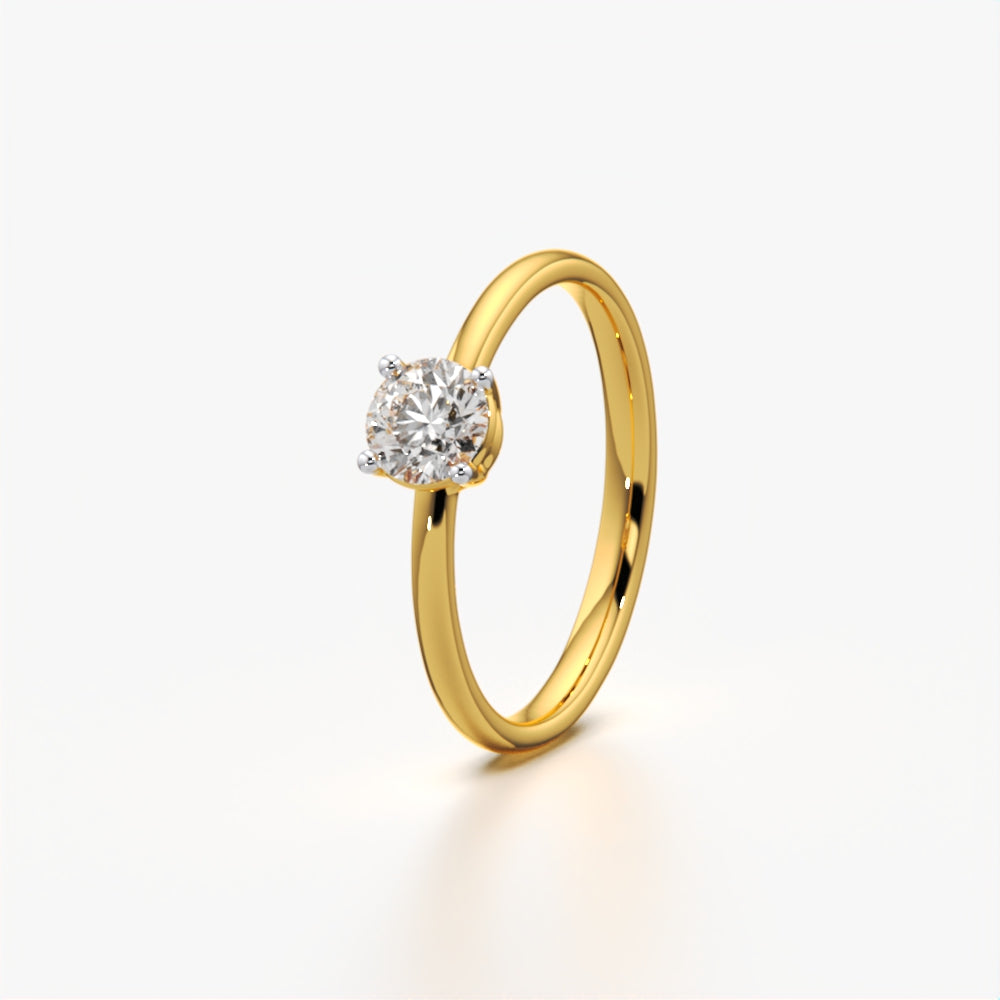
Classic Four-Prong Solitaire Ring
Shop Now -
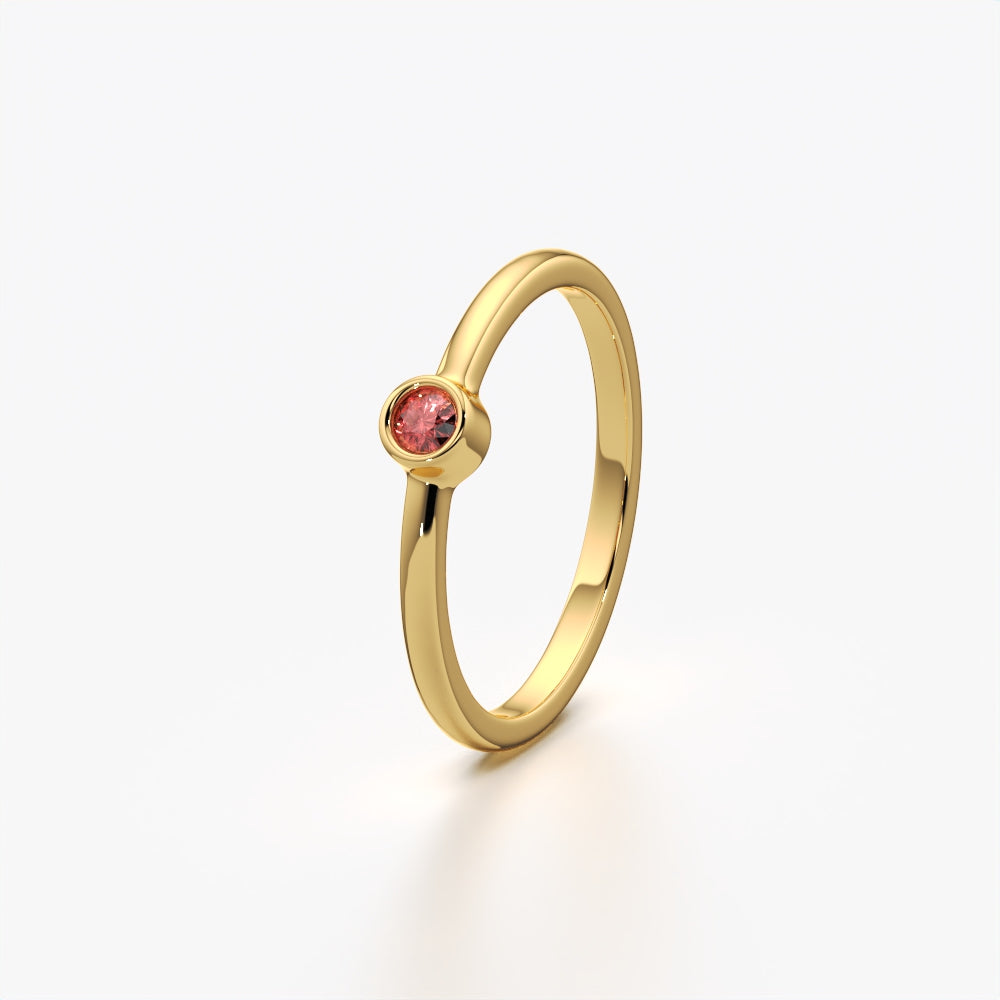
Dainty Bezel Solitaire Ring
Shop Now -
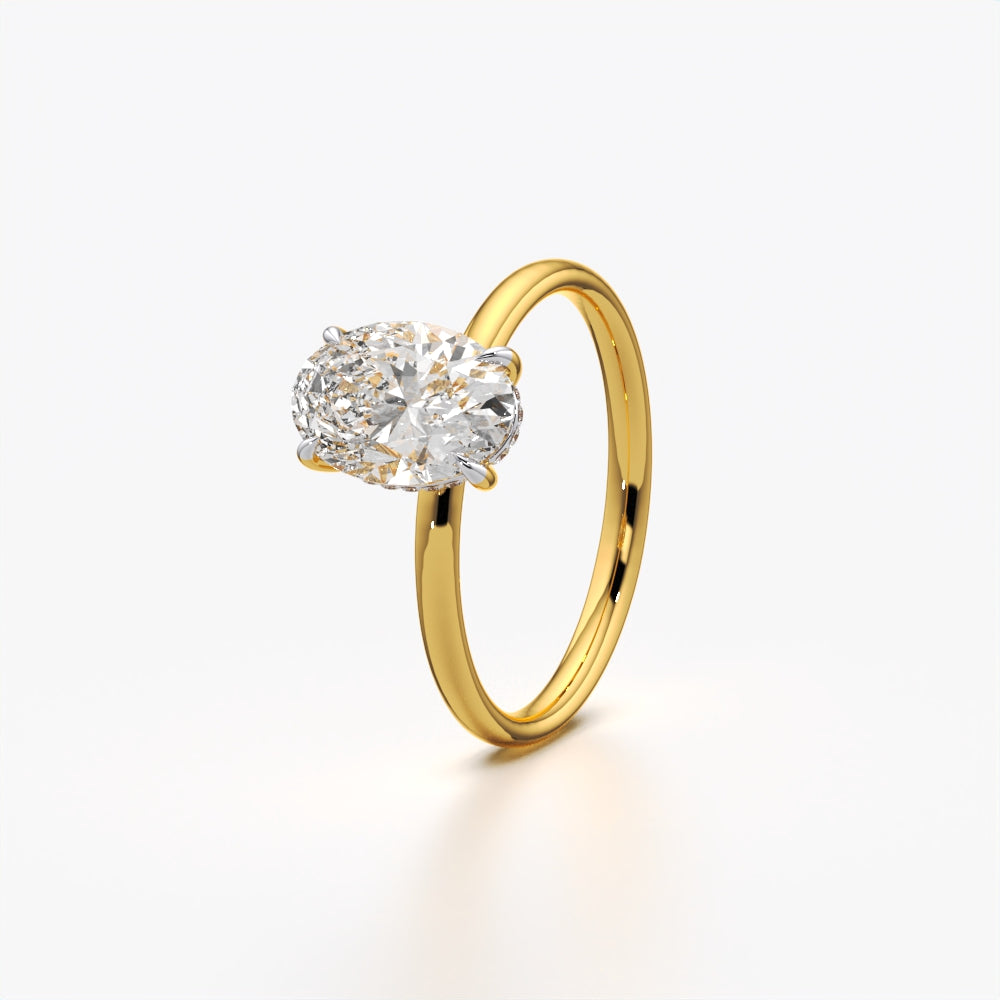
Classic Oval Solitaire Ring
Shop Now -
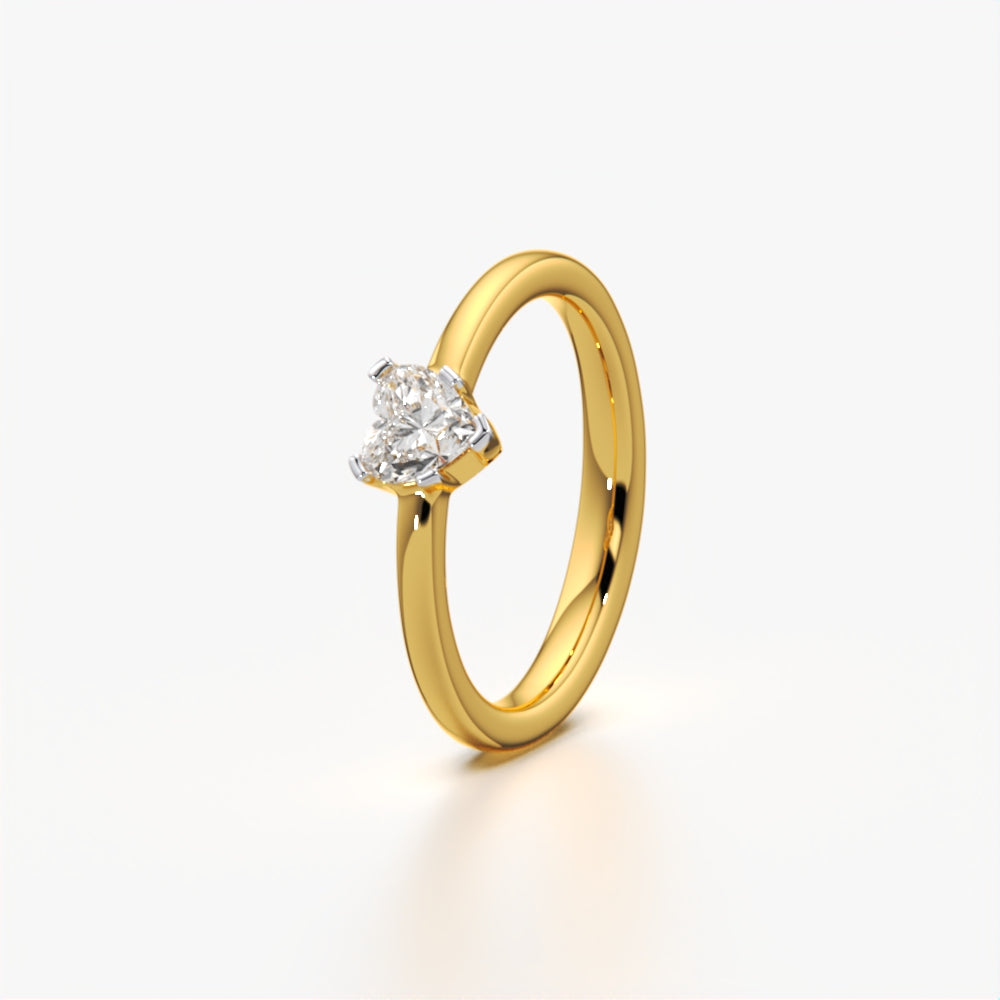
Heart-Cut Solitaire Ring
Shop Now
The Four Axes
Here is the structure the flat lists are hiding.
Axis one is profile height: How far the stone sits off the surface of your finger.
Axis two is the setting: How the metal physically grips the stone.
Axis three is the stone shape: Round, oval, pear, marquise, emerald, and so on.
Axis four is band architecture: What the metal does on its way around your finger.
Every solitaire ring in existence has a value on all four. Every "type" you have read about is one value on one axis. Now the useful part: they are not equally important, and the SERP has the order almost exactly backwards.
Axis One: Profile Height, the Type Nobody Lists
Not one page ranking for this term in India treats profile height as a category. It is the most consequential of the four.
Profile height is how tall the stone sits. It decides whether the ring is comfortable, whether it snags, whether it survives daily wear, and whether you are still wearing it in month four or it has migrated to a drawer.
Flush and near-flush
The stone sits level with or barely above the band. Almost nothing to catch on. It reads as texture rather than as a stone from a metre away. The most forgiving profile that exists.
Low profile
The stone sits just above the band, usually in a bezel or a low bezel-style cup. This is the sweet spot for continuous wear. Visible, catches light properly, and clears fabric without incident.
Mid profile
A short prong or basket lifts the stone clear of the band. More light gets underneath the stone, so it sparkles harder. Slight but real snag risk.
High profile
Tall prongs, cathedral shoulders, or a raised basket hold the stone well clear of the finger. Maximum brilliance, maximum presence, maximum snag. This is the classic engagement silhouette, and it is built for occasional wear with attention, not for wearing while you sleep.
The dupatta test
Here is a check no international guide will give you, because the gesture does not exist in their daily life.
Draw your dupatta or your saree pallu across the back of your hand, the way you do fifty times a day without thinking. Then pull your hand out of a pair of jeans' pocket. Then run your fingers through your hair.
A high-profile ring will catch on at least one of those three, and it will catch again tomorrow and the day after. Women on jewellery forums describe exactly this pattern over and over, and they describe the workaround they invent for it: turning the stone inward toward the palm before pulling on a sweater or a sleeve, then forgetting to turn it back. If your answer to a ring is a habit you have to remember, the profile is wrong for how you live.
None of this makes high profile bad. It makes it occasional. Decide honestly which one you are buying, and the other three axes get much easier.
-
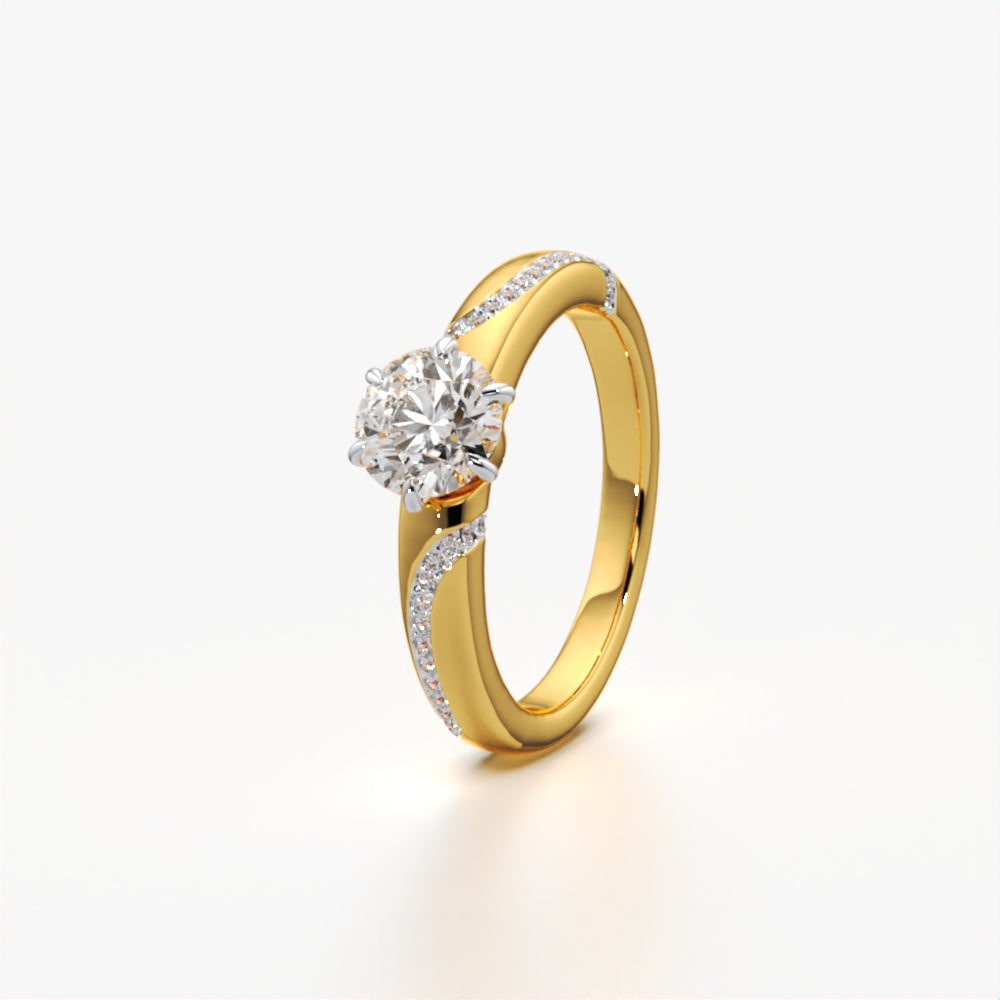
Swirl Pave Solitaire Ring
Shop Now -
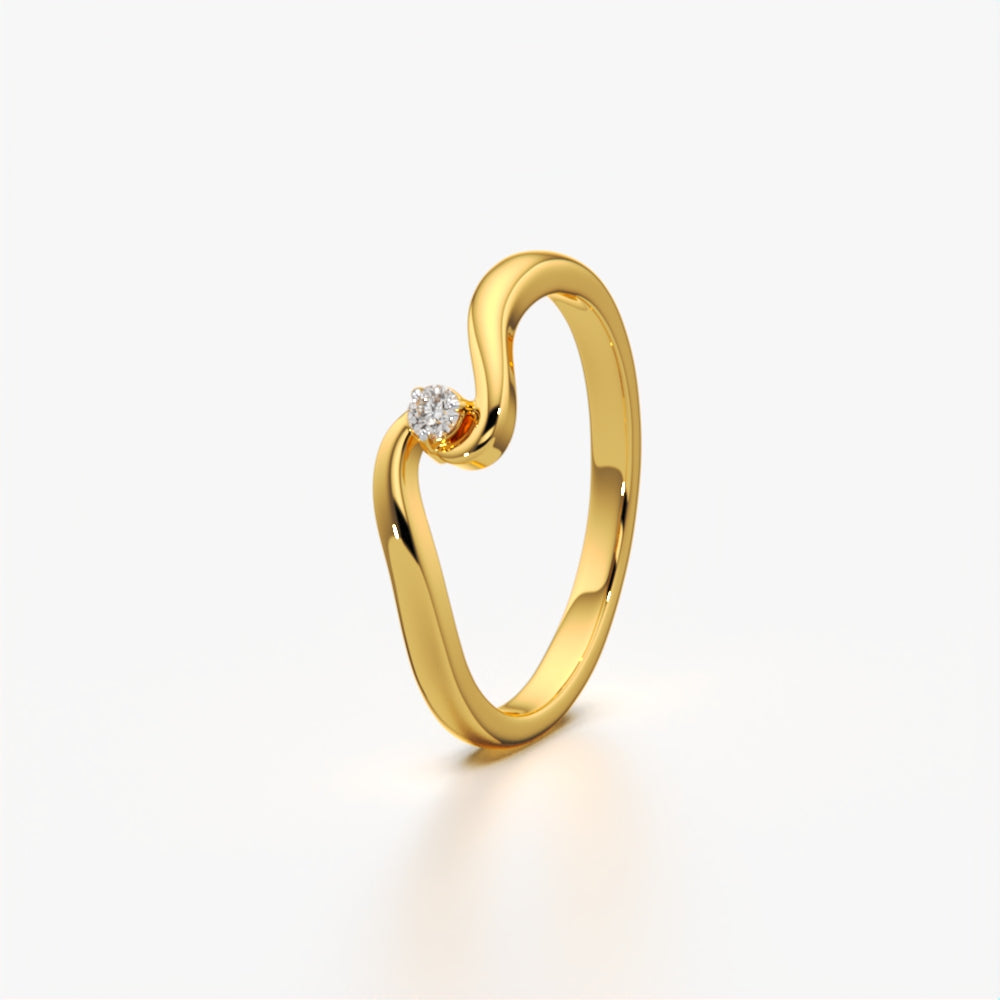
Wave Tension Solitaire Ring
Shop Now -
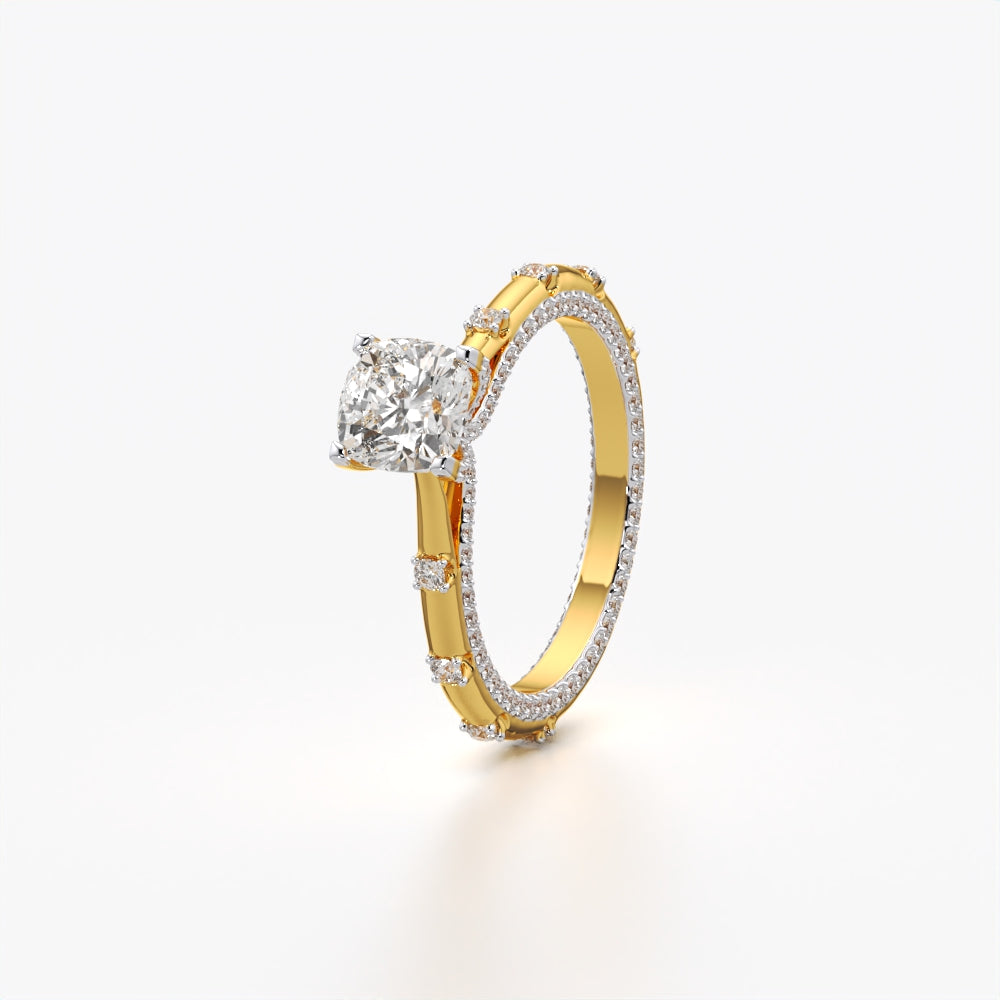
Cushion Solitaire Pave Crown Ring
Shop Now -
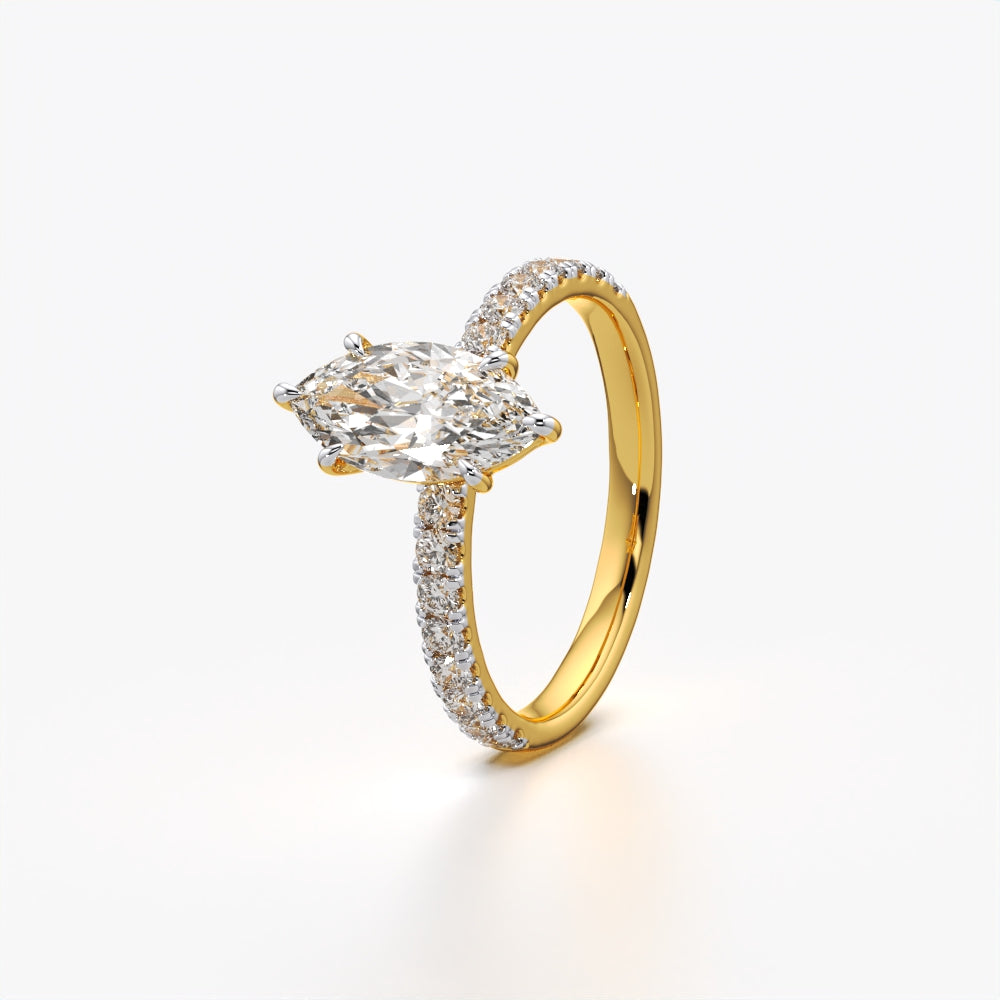
Marquise Cut Pave Solitaire Ring
Shop Now
Axis Two: Setting
The setting is how metal grips the stone. This is where most "types of solitaire" lists start, and it is genuinely the second most important axis.
Prong

Four or six metal claws hold the stone from the sides, leaving the rest of it open. Because so little metal touches the stone, light enters from almost every angle, which is why prongs are the sparkle default.
The trade is exposure. The claws are the highest point on the ring, so they are what catches. They also collect. Prongs create tiny sheltered gaps under and between the claws where things accumulate, and in Indian conditions, those gaps fill faster than most guides admit. Hard water leaves a mineral film. Haldi and kumkum lodge in the crevices during festivals and pujas. Hand cream and monsoon humidity together make a film that dulls the stone within weeks.
None of that is a defect. It is a maintenance schedule. A prong-set solitaire wants a gentle soft-brush clean every couple of weeks, not once a year.
Bezel

A continuous rim of metal wraps the stone's edge. The most protective setting was made.
Bezels are the quiet winner for anyone whose ring is going to be on their hand from morning till night. Nothing protrudes. The rim shields the girdle of the stone, which is the edge most likely to chip. Nothing accumulates in gaps because there are no gaps.
The cost is a small amount of brilliance, since the rim blocks light entering from the sides, and a slightly smaller apparent stone, since the rim covers the outer edge. Some people also read bezels as more modern and less traditional, which is a taste question, not a quality one.
Half bezel
Metal wraps two sides and leaves two open. A compromise that keeps most of the protection while letting light in from the open sides. Genuinely underrated and rarely listed as its own type.
Tension
The band's own spring pressure grips the stone from two sides, so it appears to float in a gap in the metal. Striking, architectural, and the setting are most likely to get a comment.
Two honest caveats. Tension settings are the hardest of these to resize because resizing changes the pressure that is doing the holding. And the effect depends on the stone being substantial enough to bridge the gap convincingly, so it is not a style that scales down to very small stones well.
Basket
A prong setting reinforced with a horizontal gallery bar near the base, offering extra side protection and a lower center of gravity than traditional open prongs.
Axis Three: Stone Shape
This is the axis the Indian SERP treats as the main one. It is actually the least consequential of the four for daily life and the most consequential for how the ring photographs.
That is not a criticism. Just be clear about which one you are optimising.
Round is the default. The most facets, the most light return, the most forgiving of a less-than-perfect angle. Nothing about it is a compromise except that it is the expected answer.
Oval covers more of your finger for the same stone weight, and the long axis pulls the eye lengthwise, which makes fingers read as longer. The most flattering shape for shorter or wider fingers.
Pear does what oval does, but asymmetrically, with the point directed at your fingertip. More distinctive. Worth noting, the point is the most vulnerable part of the stone and benefits from a protective setting.
Marquise is the most elongating shape available. Two points instead of one, and maximum surface for its weight. Currently having a strong revival.
An emerald cut is a rectangle with stepped facets. It does not sparkle in the scattered way a round does. Instead, you get broad flashes and a glassy, mirror-like clarity. This is a completely different visual effect, and people either love it or find it insufficiently sparkly.
A cushion is a square or rectangle with rounded corners. Softer than princess, warmer than emerald, no sharp corners to chip.
Radiant is emerald's outline with brilliant faceting inside. Rectangle shape, round-cut sparkle.
The heart is unambiguous about what it means. Needs to be well-cut, or it reads as a lumpy pear, so it is worth looking at closely rather than buying from a thumbnail.
Cabochon is a shape almost no list includes. An unfaceted, smoothly domed stone with no sparkle at all, just deep saturated colour and a soft glow. Historically, the oldest way stones were set was long before faceting was invented. Reads as jewellery rather than as sparkle.
East-west orientation
An elongated stone can be set the long way along your finger, which is standard, or turned ninety degrees to sit across it. That second option is called east-west, and it changes the ring completely without changing a single component. It also lowers the effective profile, because a stone lying across the finger sits closer to it.
It is one of the few genuinely modern moves in this category, and almost nobody in India lists it as a type.
Axis Four: Band Architecture
The band is the part touching you for sixteen hours a day, and it is the axis people think about last.
Plain shank: Smooth, undecorated. Maximum contrast against the stone. Easiest to size, easiest to stack, easiest to live with.
Pavé shoulders: Small stones set into the band on either side of the centre. Considerably more sparkle. Also, more places to trap residue, and a band that is harder to resize because you cannot cut through set stones.
Twisted or rope: The metal is twisted into a cord. Adds texture and a slightly vintage warmth. It reads well against ethnic wear because the texture picks up the same visual language as traditional gold work.
Split shank and bypass: The band divides as it approaches the stone, or the two ends pass each other rather than meeting. Creates negative space around the centre stone, which makes it appear larger. Bypass, in particular, gives an open, unfinished-on-purpose look.
Double band: Two parallel bands supporting a single stone. Looks like a stack, but is actually one ring.
Vine, leaf, and organic: The band is shaped into botanical forms. The most decorative option. Best paired with a simple stone so the two are not competing.
Wishbone and curved: The band dips or curves rather than running straight. It sits well against other rings, which matters if you plan to stack.
Cathedral and trellis: The band rises up in arches to meet the stone, the way cathedral arches meet a vault. Trellis is the version where the prongs cross over each other on the way up. Both are architectural, both add height, and both look considerably more expensive than a plain shank.
Both are also high-profile by definition. Beautiful, but not built for wearing through a working day of typing.
The Order You Should Actually Decide In
Here is the sequence, ranked by how much each choice changes your daily experience.
Decide profile height first: This is a lifestyle question, not a taste question. Answer it honestly, and half the catalogue disqualifies itself immediately.
Decide setting second: This is mostly determined by the first answer. Low profile points you toward bezel and half-bezel. High profile points you toward prong, cathedral, and tension.
Decide band architecture third: This is comfort plus stackability. Plain if you want to layer other rings. Decorated if the ring is standing alone.
Decide stone shape last: This is pure aesthetics, which is exactly why it should be last, and exactly why it should be yours. By this point, the first three decisions have narrowed the field enough that you are choosing between things that all genuinely work for you.
Doing it in the reverse order, which is how the flat lists encourage you to shop, means falling in love with a pear-cut photograph and discovering four months later that the point catches on everything you own.
Combinations That Fight Each Other
Some pairings are technically possible but work against themselves. No list tells you this.
A decorated band with an ornate setting is two things competing for the same attention. Cathedral shoulders plus a vine band plus pavé are three focal points and no hierarchy. Pick one place for the detail.
Pointed stones in bare prong settings leave the most fragile part of the stone most exposed. Pear and marquise both benefit from a V-shaped prong or a bezel at the point specifically.
Tension settings with very small stones lose their effect. The floating illusion needs enough stone to span the gap visibly.
A high profile with a heavily stacked hand means the tall setting scrapes against neighbouring rings all day. Both pieces wear. If you stack, stay low.
Emerald cut, expecting sparkle, is the most common disappointment in this category. It is a genuinely beautiful cut that does something different from sparkling. Look at one in motion before committing.
What Changes at the Demi-Fine Price Point
Almost every guide ranking for this term assumes you are spending upwards of seventy-five thousand rupees on a certified stone. If you are not, three things shift.
Cut quality matters more than shape: At high budgets, you are choosing between well-cut stones. Lower down, the gap between a well-cut and a poorly-cut stone of the same shape is far wider than the gap between two shapes. A well-cut CZ outperforms a badly-cut anything.
Setting quality becomes the durability question: With a precious stone, the stone is indestructible, and the setting is the weak point. With any stone, honestly, the setting is still the weak point. Ask how the stone is held, not just what it is.
Metal construction outranks everything: This is where most affordable jewellery fails, and it fails at the base metal, not the stone. Thin gold plating over brass discolours within months in Indian humidity, and the discolouration is permanent because there is nothing underneath worth re-plating.
Vermeil is a different construction. It is a defined standard requiring a thick layer of gold over solid sterling silver, not over brass. When the surface eventually needs attention, there is real silver beneath it. This is the specification worth checking before anything about the stone.
For readers weighing this segment, KYMEE works exclusively in 18K gold vermeil over nickel-free 925 sterling silver, and the brand is transparent about its stones in a way this category often is not: cubic zirconia for the larger centre stones, moissanite reserved for the smaller accent and pavé work. If you want the construction explained properly, the brand's own guide to gold vermeil covers what the term actually requires.
The Coloured Stone Solitaire
There is a fifth axis, and no Indian guide lists it at all, because the entire category has been defined as colourless by default.
A solitaire with a coloured centre stone is still a solitaire. One stone, alone, nothing competing. Sapphire blue, emerald green, garnet red, or any of the soft pastels are currently everywhere on Pinterest.
What colour changes, practically: it reads as jewellery rather than as an engagement signal, which solves a real problem for anyone who wants the silhouette without the question at every family gathering. It also coordinates with an outfit in a way a colourless stone cannot, and it pairs naturally with Indian ethnic wear, where coloured stones have been standard for centuries.
Colour also works beautifully in bezels, because the metal rim frames the colour like a border rather than interrupting the sparkle.
This is one area where the demi-fine segment genuinely outperforms fine jewellery in choice. A coloured centre stone in fine jewellery is a significant cost decision. In vermeil, it is simply a variant, which is why KYMEE's solitaire range offers several designs in more than a dozen colourways on the same setting, alongside a separate coloured stone rings collection. Choosing the setting and the colour independently is a freedom the fine jewellery end of the market does not really offer.
The India Layer
Four conditions that change which type works, and that no international guide accounts for.
Continuous wear: Indian ring-wearing patterns skew toward never taking it off. Not evenings-and-occasions, but sleeping, cooking, commuting, showering. That pattern punishes high profiles and rewards bezels far more heavily than the American guides assume.
Hard water: Much of urban India has hard water. It leaves mineral deposits, and the deposit collects wherever there is a sheltered gap. Prong undersides are exactly such a gap. This is the single biggest cause of a stone "losing its sparkle" in the first year, and it is entirely reversible with a soft brush and mild soap.
Festival exposure: Haldi, kumkum, sindoor, oils. All of these lodge in crevices and some stain. Prong gaps and pavé channels are the vulnerable geometry. A bezel with a smooth band has almost nowhere for any of it to sit.
Monsoon humidity: Humidity accelerates every plating problem. This is a metal-construction question rather than a setting question, and it is the argument for vermeil over plated brass in one sentence.
Ethnic wear pairing: Gold-toned solitaires sit naturally alongside traditional gold jewellery in a way that silver-toned ones fight against. Twisted rope and vine bands read as continuous with traditional Indian metalwork. A stark modern bezel reads as deliberately contrasting. Both are valid. Know what you are doing.
Choosing by How You Will Actually Wear It
For all-day, everyday wear: Low profile, bezel or half-bezel, plain or lightly textured band, any shape. This is the configuration that survives.
For work in a conservative office: Low to mid profile, small stone, plain band. Bezel again. The goal is polished rather than announced.
For a promise or milestone ring that is not an engagement: This is where coloured stones and unusual shapes earn their place. A pear or marquise in a colour reads as personal rather than as a proposal, which is often exactly the point.
For occasional and festive wear: Now, high profile is available to you. Cathedral shoulders, tall prongs, pavé bands, larger stones. You are wearing it for hours, not days, and it will spend the rest of its time in a box.
For stacking: Choose a high-profile or peg-head setting if you want traditional straight bands to sit flush beneath the stone. Low-profile settings sit directly on the finger and usually require a curved or contour band to fit around the setting basket.
For gifting when you do not know their taste: Round stone, bezel setting, plain band, low profile. It is the least likely configuration to be wrong. Sizing is the real risk with rings as gifts, so the second-best option is something adjustable or something bought alongside a size you have confirmed.
When None of the Four Axes Give You What You Want
Occasionally, the combination you want does not exist in anyone's catalogue. A specific shape, in a specific setting, on a specific band, in a specific colour.
This is what customisation is for, and it is more accessible in the demi-fine segment than most people realise, precisely because the materials cost less than fine jewellery. KYMEE runs a custom design service that lets you specify the elements individually rather than picking from finished pieces. If you have read this far and found yourself wanting axis one from one ring and axis four from another, that is the route.
The Short Version
A solitaire ring is four decisions, not one type.
Profile height decides whether you wear it. Setting decides how long it survives. Band decides how it feels. The stone's shape decides how it looks.
Every flat list you have read scrambles those four into a single menu and puts the least consequential one first. Decide them in the right order, and the ring you end up with is one you are still wearing in a year, which is the only test that has ever mattered.
FAQs
How many types of solitaire rings are there?
There is no fixed number, and any list claiming one is combining categories. Solitaire rings vary across four independent axes: profile height, setting style, stone shape, and band architecture. Because those combine, the practical number of distinct configurations runs into the hundreds. The useful question is not how many exist, but which value on each of the four axes suits you.
Which solitaire setting is best?
For daily wear, bezel. For maximum sparkle, prong. That is the entire trade, and neither answer is universally correct. Prong settings let more light into the stone because less metal touches it. Bezel settings protect the stone's edge completely and have no gaps to snag or collect residue. Choose based on how many hours a day the ring will be on your hand.
What is the difference between a solitaire and a halo ring?
A solitaire has one stone and nothing else. A halo has a centre stone encircled by a ring of smaller stones. The halo makes the centre stone appear noticeably larger and adds considerable sparkle, at the cost of the clean single-stone silhouette that defines a solitaire.
Does a solitaire ring have to be a diamond?
No. Solitaire describes the arrangement, not the material. Any single centre stone qualifies, including cubic zirconia, moissanite, sapphire, emerald, or an unfaceted cabochon. The word means "alone," and it refers to the stone standing by itself.
Can you wear a solitaire ring every day?
Yes, with the right profile. A low-profile bezel-set solitaire is one of the most wearable rings that exist. A high-profile prong setting is not really a daily-wear piece, regardless of what the marketing says, because the height that creates the sparkle is the same height that catches on fabric and hair.
Which solitaire shape makes fingers look longer?
Elongated shapes set lengthwise along the finger. Marquise is the strongest, followed by oval and pear. All three cover more finger area than a round stone of the same weight, and the long axis draws the eye vertically. An east-west orientation does the opposite, so avoid it if lengthening is your goal.
Which finger should a solitaire ring go on?
If it marks an engagement, the ring finger is on the left hand in most traditions and the right hand in many Indian families. If it is a fashion or self-purchase piece, any finger works, and the middle and index fingers are both popular. One practical note: a high-profile solitaire is most secure on the ring finger, which naturally curls inward and shelters the setting. On the index or little finger, which moves more independently, the same ring catches on more things.
Are solitaire rings only for engagements?
No, and increasingly not in India. A large share of solitaire buying now consists of self-purchase, birthday and anniversary gifting, promise rings, and plain everyday jewellery. The engagement association is a marketing legacy, not a rule.
Do bezel-set solitaires look smaller?
Slightly, yes. The metal rim covers the outer edge of the stone, so a bezel-set stone reads a fraction smaller than the same stone in prongs. In exchange, you get complete edge protection and no snagging. If apparent size matters more than security, prongs are the answer.
Why does my solitaire ring stop sparkling?
Almost always film, not damage. Skin oils, hand cream, hard-water minerals, and dust collect underneath the stone where you cannot see them, and they block the light that has to enter from below for the stone to return its brilliance. A soak in warm water with a little mild soap and a gentle brush around the setting restores most of it. Prong settings need this more often than bezels because they have more places for residue to hide.