


How Do You Find a Mangalsutra That is Comfortable for Daily Wear

Most guides to buying a daily-wear mangalsutra give you the same five instructions: go lightweight, go short, pick a strong chain, choose a minimal pendant, check the gold purity. All of that is true. None of it explains why so many women follow the advice, buy the piece, and stop wearing it within a year.
The reason is that the advice is written for the moment of purchase. A mangalsutra worn every day is not a purchase decision. It is an endurance test, and the thing being tested is not the design.
This guide is built around the test.
The variable nobody measures: contact hours

Ask any jeweller in a busy Indian market which repair walks in most often, and the answer is a snapped mangalsutra chain. Not a lost stone, not a bent pendant. The chain, usually at or near the clasp.
That happens because of a number almost no listing shows you.
A festive mangalsutra worn twenty times a year spends roughly 160 hours against skin. A daily-wear mangalsutra worn from morning to night spends about 5,800. One that never comes off spends 8,760. The heavy ceremonial piece is doing a fraction of the work, and it is usually built more robustly.
So the everyday piece is simultaneously the lightest built and the hardest worked object in your jewellery box. That inversion is the whole problem, and grams are a poor way to think about it. Two grams worn continuously is a harder job than twelve grams worn occasionally.
Once you switch from asking "how light is it" to "how many hours will it be on, and what happens during those hours", the right choices stop being a matter of taste.
-
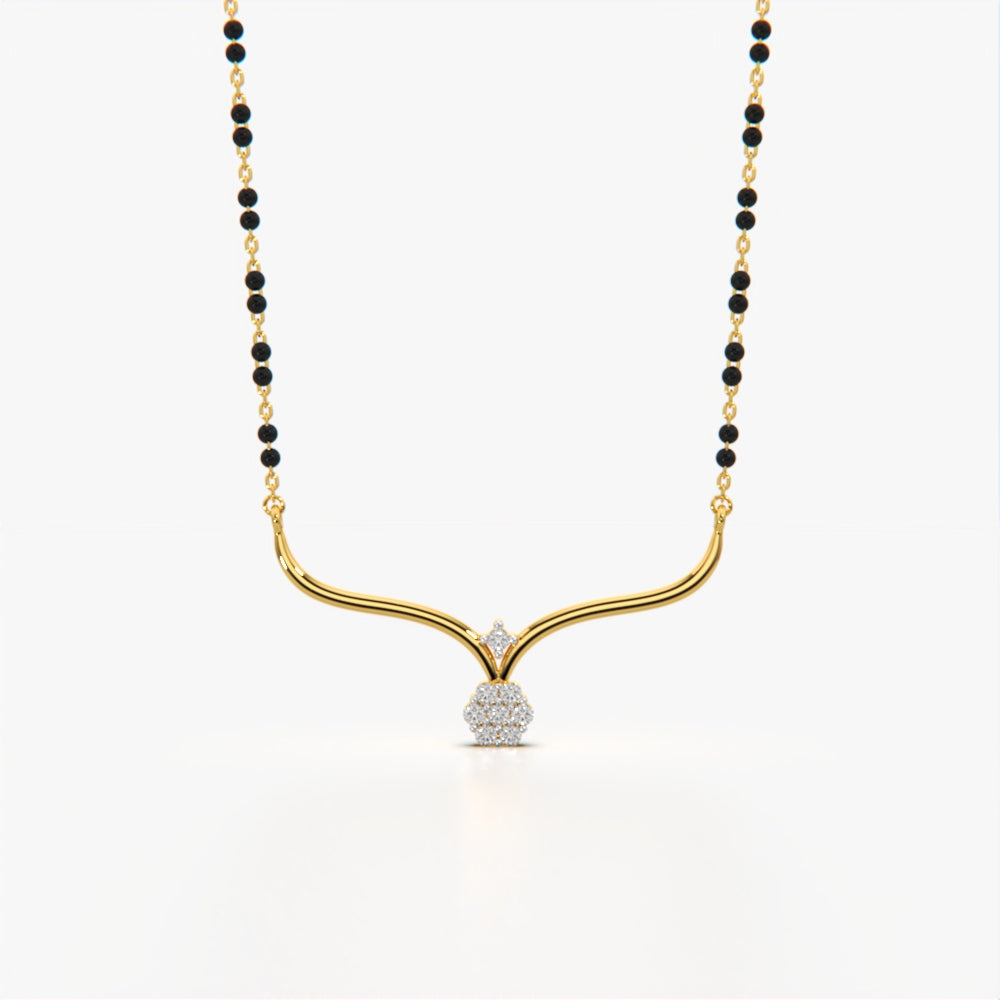
Floral Arc Mangalsutra
Shop Now -

Infinity Pavé Diamond Mangalsutra
Shop Now -
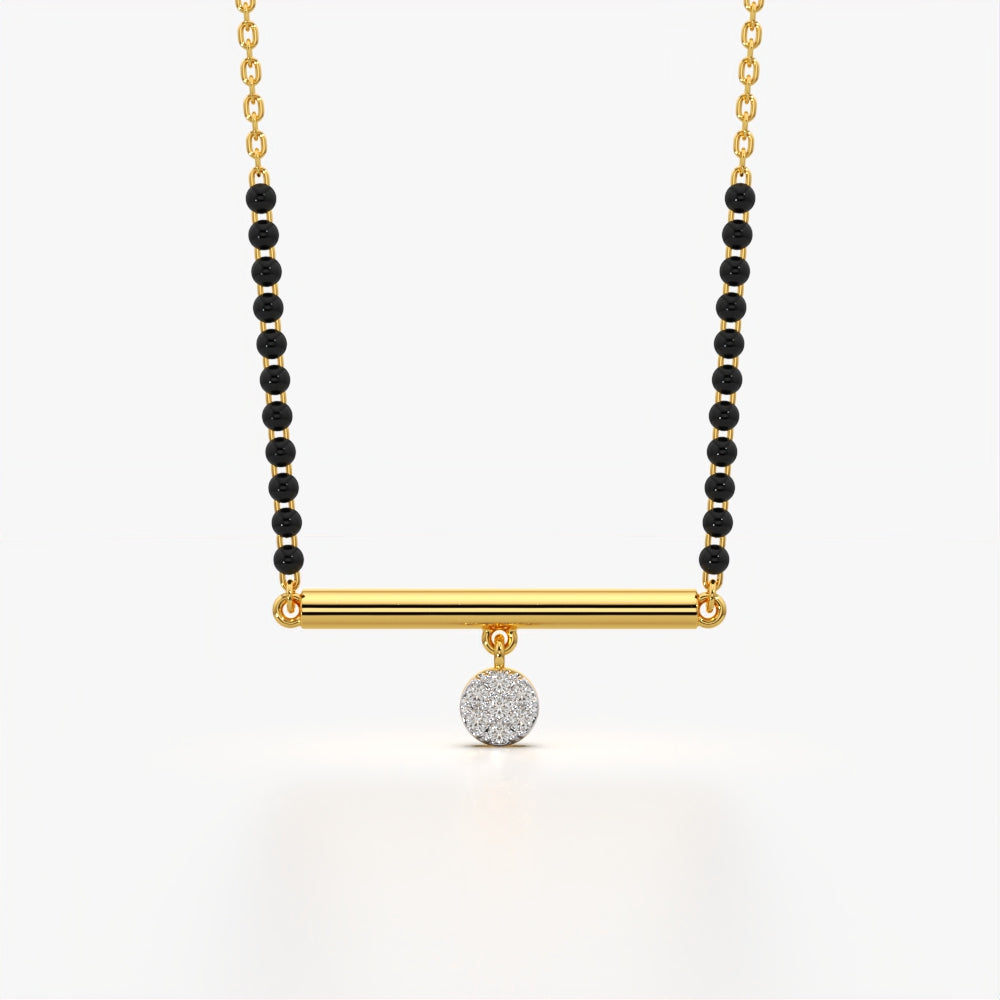
Sleek Bar Charm Mangalsutra
Shop Now -
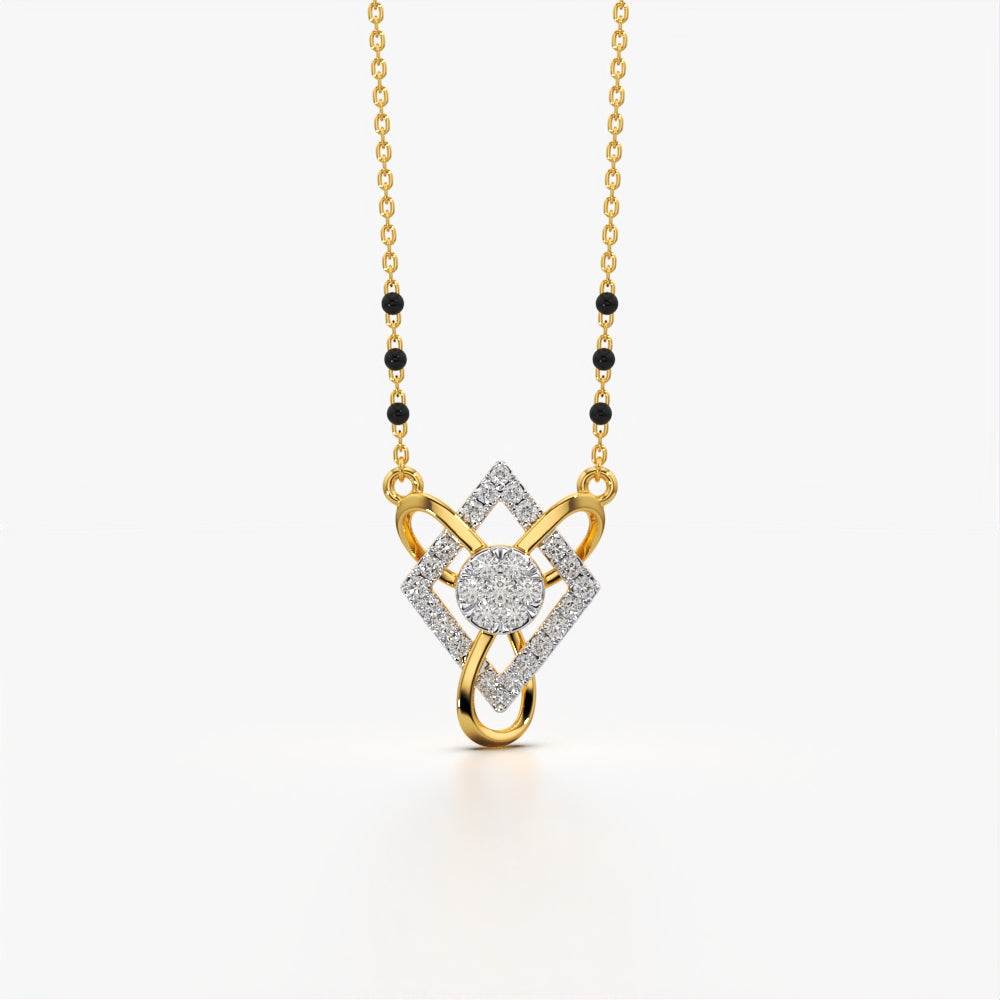
Geometric Diamond Cluster Mangalsutra
Shop Now
Four questions that actually decide it
Work through these before you look at a single design.
1. How many hours a day will it be on?
There are two genuinely different products hiding inside "daily wear".
If it never comes off, including through sleep, bathing, and cooking, then your governing constraints are metal against damp skin, clasp fatigue, and the back of the neck. Design is close to irrelevant. Prioritise a base metal that will not react, a clasp you can trust, and settings with nothing exposed. Assume the piece will need the beads restrung before you think it does.
If it comes off nightly, you have bought yourself an enormous amount of durability, roughly a third of the annual contact hours, plus a daily chance to wipe it dry. You can afford a slightly more delicate construction and a slightly more decorative pendant. You have also introduced a new failure mode: a clasp opened and closed 700 times a year, and a piece that spends nights on a bathroom shelf where it can be knocked into a drain.
Neither is better. But they need different pieces, and no listing will ask you which one you are.
2. What else lives at your collarbone?

This is the question that decides length and pendant shape, and it is almost never asked.
The Indian collarbone is a crowded place. On any given day, it may also hold a dupatta and its safety pin, a saree pallu and its pleat pin, an office ID card on a lanyard, a laptop bag strap, a seat belt, a religious pendant that has been there since childhood, a stethoscope, and, for a few years of many women's lives, a baby's hand.
Every one of those is a snag risk or a competitor for the same visual line. Two rules follow.
Separate the lines: If you already wear a religious pendant or a longer chain you will not remove, the mangalsutra needs its own vertical space. Two pieces sitting at nearly the same length will tangle daily and abrade each other. A gap of at least two inches keeps them independent.
Read the profile, not the size: A pendant is not risky because it is large. It is risky because of what sticks out. A flat, enclosed pendant with the stonework contained inside the outline will slide past a dupatta pin. An open, prong-set or filigree pendant of exactly the same width will catch on it. When you look at a product photo, look at the piece side-on if any image allows it, and ask what a loose thread would hook onto.
3. Does it need to be seen?
This is a real decision, and treating it as one is the fastest way to a piece you actually keep wearing.
For some women, the mangalsutra is meant to be visible, and a short chain at the collarbone is right because it reads clearly above most necklines.
For others, visibility is the problem. Women in some professional settings, women working abroad, women in mixed workplaces, and women who simply do not want a marital marker to be the first thing a stranger reads about them all have a legitimate reason to want the meaning without the announcement. That is not a modern erosion of tradition. Long mangalsutras, historically the default across much of India, were worn tucked under the pallu precisely because they were not meant to be on display.
If discretion matters, you have three good routes: a longer chain worn under clothing, a bracelet format that moves the black beads to the wrist, or a pendant so minimal that it reads as a necklace to anyone who does not know what they are looking at.
4. What happens the day it breaks?
Assume it will. A chain worn continuously for years is a consumable in one specific place, and the piece you buy should come with an answer to this.
Three things worth establishing before you pay:
- Can the black beads be restrung, and by whom? Thread fails without warning, and a piece that cannot be restrung is a piece with an expiry date.
- What does the seller cover when the gold layer wears at the back of the neck, which is where sweat pools and the clasp rubs? This is the single most predictable form of wear on a plated or vermeil piece.
- Is there a buyback or trade-in route, so that outgrowing the piece is not the same as losing the money?
A brand that has answers here is worth more than one with a nicer pendant.
-

Interlocking Pave Link Mangalsutra
Shop Now -

Oval Halo Solitaire Mangalsutra
Shop Now -
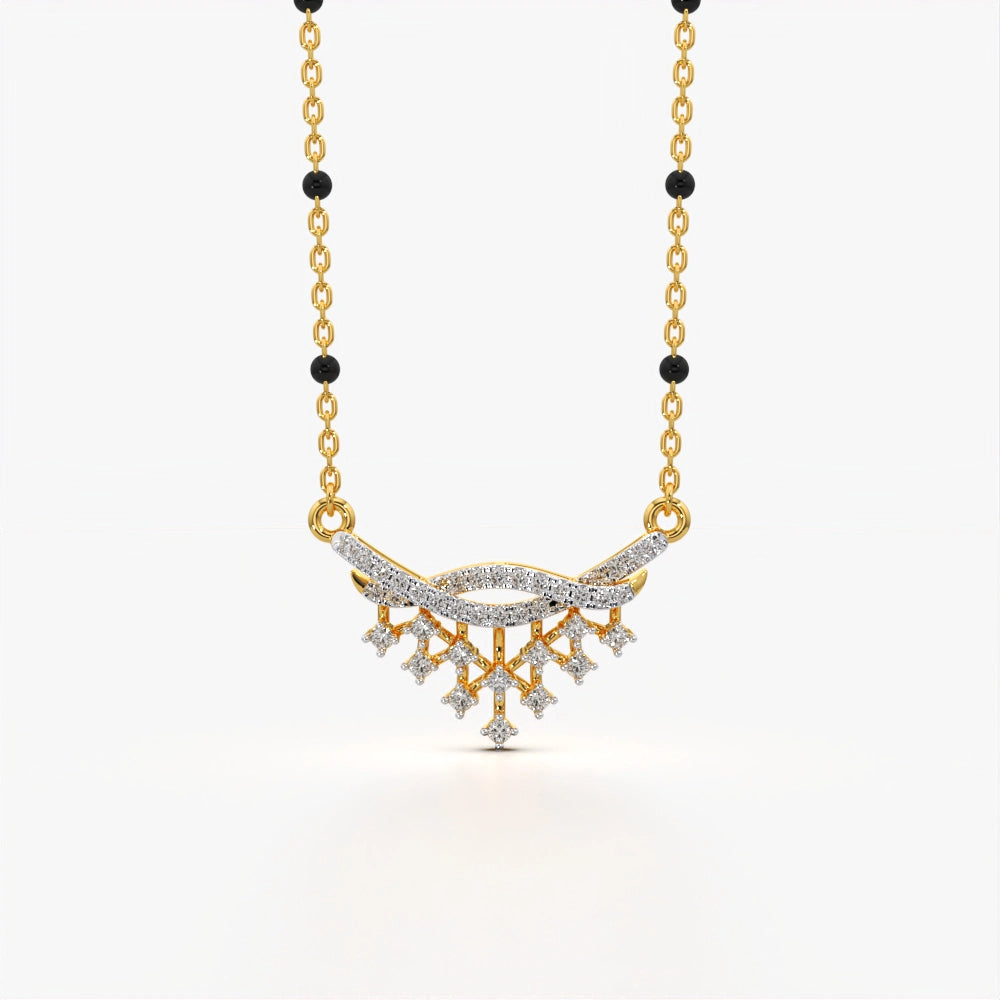
Chandelier Arc Mangalsutra
Shop Now -

Layered Triangle Mangalsutra
Shop Now
The specification checklist
Once the four questions are answered, the specification follows almost mechanically.
Length: Sixteen to eighteen inches if you want it visible at the collarbone, out of the way of a bag strap, and stable when you move. Twenty inches and above if you wear it under clothing or your family expects a traditional drop. The awkward zone is roughly nineteen inches, long enough to swing and to sit under a seat belt, short enough to still be visible. Avoid it.
Pendant footprint: Under about 1.5 cm across for continuous wear. Above that, a pendant starts to flip face-down, and a piece that spends its day upside down is a piece you stop enjoying.
Setting type: Bezel settings, where the metal wraps the stone edge, and pavé, where small stones sit flush in the surface, both survive continuous wear far better than exposed prongs. Prongs are the trade-off you accept for light reaching a stone from underneath, which matters on a solitaire ring and matters very little on a small pendant worn under a kurta all day.
Clasp and jump ring: Ask specifically. A lobster clasp with a soldered or solid jump ring will outlast a spring ring, which is the component that fails most often. If a seller cannot tell you which clasp is fitted, that is information too.
Chain gauge: The finest chains photograph beautifully and are the first thing to go. For continuous wear, slightly heavier is genuinely better, and the difference in how it looks is smaller than the difference in how long it lasts.
Bead arrangement: Worth knowing that this has names. A nirgun arrangement runs black beads continuously along the chain. A shagun arrangement breaks them with gold beads at intervals. If the black beads on a modern piece look purely decorative, the protective layer has been reduced. That may be an acceptable trade for you, but make it knowingly rather than by accident.
Metal, and specifically what sits against skin: This decides more than anything else on this list.
What a day in India actually does to it
Here is the part that separates a piece that lasts from one that does not, mapped to an ordinary day rather than to a care leaflet.
Morning: Hair oil, perfume, talc and attar are all applied at the neck and throat, directly onto the chain. Anything applied after the jewellery goes on will sit in the settings.
Commute: Seat belt friction across the chest on one diagonal. Bag strap on the other. Heat and perspiration for the whole journey.
The kitchen: Turmeric, oil, steam and chilli, plus constant hand-to-neck contact. Haldi in particular stains porous settings and lodges in pavé work, and it is very difficult to remove once it has.
Washing up and cleaning: Detergent, and in much of Gujarat, Rajasthan, Tamil Nadu and the Deccan, hard water that leaves a mineral film. That film dulls both metal and stones, and no amount of polishing fixes it if the piece is never dried.
All day: Damp skin. This is the one that matters most and is discussed least. Metal held against perspiring skin for years will provoke a reaction if it contains nickel. The itching, small eruptions, and green marks that women quietly put down to "gold does not suit my skin" are very often nickel dermatitis from a plated base metal, not from gold at all. It is the most common reason a daily mangalsutra ends up in a drawer.
Night: If you sleep in it, that is roughly 2,900 hours a year of a clasp pressed between skin and a pillow.
Monsoon: Months of ambient humidity, and a jewellery box that never fully dries out.
You cannot design most of this away. You can choose a piece built for it, and one habit fixes a surprising amount: wipe it with a dry cloth at the end of every day, before the sweat sits on it overnight. KYMEE's jewellery care guide covers the rest, and the short version is that jewellery goes on last and comes off before water.
The two-piece rotation
Here is a counterintuitive piece of arithmetic.
Two everyday mangalsutras at ₹6,000 each will almost always outlast one at ₹12,000, because each spends half as many hours in contact. Rest is a real maintenance strategy for a chain, a clasp, and a plated surface, and it is free.
It also solves a practical problem. A single daily piece has to work with a saree at a family function on Sunday and a video call on Monday morning, and pieces that try to do both usually do neither well. Two pieces, one plain and one with a little more presence, are a more honest split.
This is also why the second mangalsutra is such a common purchase. Ask most married women how many they own and the honest answer is two: the one tied at the wedding, often chosen by the family and usually too formal or too heavy for a Tuesday, and the one she actually wears, bought later, usually by herself. If you are shopping for the second one, you are doing something entirely ordinary.
How the right piece changes across life stages
Newly married: The strongest pull is towards something that looks like the wedding piece. Resist it slightly. The everyday piece has a different job and should be allowed to look different.
Full-time work: Visibility, snag risk against ID lanyards and bag straps, and neckline compatibility do most of the deciding. A short, flat, enclosed pendant is the safe answer.
Clinical, laboratory, kitchen, factory, or childcare work: A neck chain is a genuine hygiene or safety issue in several of these. This is the clearest case for a bracelet or ring format, and it is a practical choice rather than a fashion one.
Pregnancy and the infant years: Two things change at once. Skin becomes more reactive for many women, which brings the metal question forward. And a baby will grab a chain, repeatedly, with more force than you expect. This is a genuinely common reason women stop wearing a neck mangalsutra for two or three years, and almost no buying guide mentions it. If you are in this phase, a bracelet format or a shorter, higher-sitting chain is worth considering before you conclude that you have simply gone off wearing one.
Travel and living abroad: Theft anxiety and loss anxiety are real costs of wearing solid gold daily, and they are the reason many women who own beautiful gold mangalsutras leave them in a locker and wear nothing. A lower-anxiety piece worn every day serves the purpose better than an expensive one worn never.
Questions to ask before you buy anything
Most product listings, across the whole category, answer perhaps three of these. That is worth knowing, because the gaps are usually where the compromises are.
- What is the total chain length in inches?
- What is the finished weight?
- What is the base metal underneath any plating or gold layer, and does it contain nickel?
- What is the thickness of the gold layer, in microns?
- What type of clasp is fitted?
- Are the stones set in bezel, pavé, or prongs?
- What are the stones, named accurately? Cubic zirconia, moissanite, and diamond are three different things, and a listing that says "diamond" when it means something else is telling you about the seller as much as the stone.
- Can the beads be restrung, and can the piece be repaired?
One honest note. Chain length is the specification most often missing across the category, and it is missing from many KYMEE mangalsutra listings too. If a length is not published, ask before ordering rather than after, since it is the single measurement that decides whether a daily piece works for you.
Where KYMEE's mangalsutras fit

KYMEE builds only for the second job, the everyday piece. Nothing in the range attempts to be a ceremonial thaali, a family vati, or a regional inherited form, and that is deliberate rather than an oversight.
The construction is 18K gold vermeil over nickel-free 925 sterling silver, with a minimum 2.5-micron gold layer, which is several times the thickness of standard gold plating. The nickel-free sterling base is the specification that speaks directly to the skin-contact problem described above, and it is the reason a vermeil piece behaves differently from a gold-plated brass one over an Indian summer. Every piece carries a lifetime plating warranty, which addresses the one wear pattern you can predict: the back of the neck.
On stones, the labelling is precise where the category generally is not. Larger stones are cubic zirconia. Moissanite is used only in mini and accent form. Neither is called a diamond, which is worth holding in mind when you compare listings elsewhere and see the word used loosely.
The mangalsutra collection currently runs to 37 designs, all on black-bead chains, sitting roughly between ₹5,000 and ₹10,000. Mapped against the decisions above:
If you want the lowest visual commitment, the North Star Black Bead Mangalsutra is about as minimal as the category gets. The pendant is fixed rather than sliding, which matters more than it sounds: a sliding pendant migrates off-centre a dozen times a day. It is listed at roughly 2.1 grams, with mini round moissanites paved into a small star. The Sleek Bar Charm Mangalsutra and the Half Pave Chevron Bar Mangalsutra are the flattest silhouettes, which is the right property for anyone who pins a dupatta daily.
If your work makes a neck chain impractical, the Tilted Square Black Bead Mangalsutra Bracelet moves the black beads and pendant to the wrist. This is the answer for clinical, laboratory, kitchen, and childcare work, and for the infant years.
If you want a little more presence without more weight, the Layered Triangle Mangalsutra and the Scrollwork Double Arc Mangalsutra use a double-strand construction, which reads fuller while keeping the individual chains fine.
If you want a symbol rather than a stone, the Interlocking Rope Twist Infinity Mangalsutra, the Toi et Moi Two Stone Mangalsutra and the Tiny Four Petal Cluster Pendant Mangalsutra each carry a small enclosed motif rather than a raised setting.
If you already wear a religious pendant or a chain you will not remove, the length separation rule applies. The pendant necklaces and layered necklaces collections are the two that sit most cleanly alongside a short mangalsutra, and the guide to daily wear necklaces goes into the layering maths.
If you want the broader picture of what exists before narrowing down, the guide to types of mangalsutra covers regional and construction forms, and what a mangalsutra means covers the tradition itself.
When nothing off the shelf matches your family's design
This is the honest limit of every modern mangalsutra brand, including this one.
If your family's mangalsutra carries a specific deity engraving, a Coorgi pathak, a thaali form tied to your kuladevata, or a motif that survives only in one photograph of your grandmother, you will not find it in any direct-to-consumer catalogue. Minimal pendants get made because minimal pendants scale. Inherited motifs do not.
For that, KYMEE's custom service is the route. You can bring a reference photograph or a description of an existing family piece and have a wearable everyday version made in gold vermeil. It is the practical answer to the very common situation where the original is too heavy, too fragile, or sitting in a bank locker while you wear nothing.
FAQs
Which mangalsutra is best for daily wear?
A short chain of sixteen to eighteen inches, a pendant under about 1.5 cm with a flat enclosed profile, bezel or pavé settings rather than exposed prongs, a lobster clasp with a solid jump ring, and a base metal that contains no nickel. Format matters less than fit. A bracelet mangalsutra is the better everyday choice for anyone whose work makes a neck chain impractical.
Can you wear a mangalsutra twenty-four hours a day?
Many women do, and there is no rule against it. Understand what you are asking of the piece: continuous contact with damp skin, a clasp bearing weight against a pillow every night, and no daily opportunity to dry it. If that is your intention, spend the budget on the base metal and the clasp rather than the pendant, and have the beads restrung on a schedule rather than waiting for them to look worn.
Is gold vermeil suitable for a mangalsutra worn every day?
It works well provided the base is sterling silver rather than brass, since that is what keeps nickel out of continuous skin contact. Gold layer thickness matters too. Vermeil requires a minimum of 2.5 microns, which is many times the thickness of standard gold plating. For a piece worn continuously through Indian humidity, that difference is the entire point.
Short or long for daily wear?
Short, roughly sixteen to eighteen inches, if you want it visible and out of the way of bag straps and dupatta pins. Long, twenty inches and above, only if you deliberately wear it under clothing or your family expects a traditional drop. Nineteen inches is the length to avoid, because it swings and sits under a seat belt while still being visible.
Can you wear a mangalsutra bracelet instead of a necklace?
Yes, and it is a growing choice for practical reasons rather than fashion ones. Clinical, laboratory, manufacturing, kitchen, and childcare work all make a neck chain a hygiene or safety problem. It is also a sensible option during the infant years, when a baby will pull on anything at the neck.
How often should the black beads be restrung?
Before they look worn rather than after. Thread fails without warning and usually at an inconvenient moment. For a piece worn continuously, having it checked once a year is reasonable.
Can you wear a second mangalsutra instead of your wedding one?
Yes, and most married women in India do exactly this. The ceremonial piece stays for occasions, and a lighter second piece handles daily life. Some families have a preference about which is worn and when, so it is worth asking rather than assuming, but the practice itself is entirely ordinary.
Will a daily-wear mangalsutra turn your skin green?
Not if the metal in contact with your skin is right. Green marks and itching are usually a reaction to nickel in a base metal underneath thin plating, not a reaction to gold. A nickel-free sterling silver base with a substantial gold layer over it avoids the problem for almost everyone.
How much should a daily mangalsutra weigh?
Lighter is generally more comfortable, but weight is a poor proxy for durability. Chain gauge, clasp quality, and setting type predict how long a piece survives far better than grams do. Something in the region of two to four grams is comfortable for continuous wear, provided the chain and clasp are not the thinnest available.
Is it acceptable to wear a mangalsutra with barely any black beads?
It is common, and it is a design trade rather than a rule being broken. The black beads carry the protective function in the tradition, so a piece that reduces them to a decorative touch has reduced that layer. Make the trade knowingly. If the beads matter to you, look for a chain where they are structural rather than an accent at either side of the pendant.