


Leaf Necklace: Meaning, What Each Leaf Says, and Why India Already Treats Leaves Like Gold

A leaf necklace stands for growth, renewal, and life moving forward. Leaves are how a plant grows and renews itself every season, so wearing one says you are still growing. The exact meaning depends on the leaf. A peepal leaf stands for wisdom, a banyan leaf for long life, a mango leaf for an auspicious start, an olive leaf for peace, a laurel leaf for victory, a ginkgo leaf for resilience, and a vine of leaves for growing together.
In India, a leaf is rarely just a leaf. On Dussehra, families in Maharashtra hand each other apta leaves and call them sona, gold. Mango leaves hang over the door for every good beginning. A Bengali bride hides her face behind betel leaves until the moment she first looks at her groom. Kerala's traditional ela thali is shaped like a leaf. Even the heart suit in your deck of cards is called paan, after the betel leaf.
So what your leaf necklace says depends on four things: which leaf it is, how many leaves there are, which way they point, and what they're paired with. This guide covers all four, plus what a leaf means as a gift, which leaves carry the most meaning in India, what leaf necklaces cost right now, and how to choose one that won't snag on your dupatta.
-
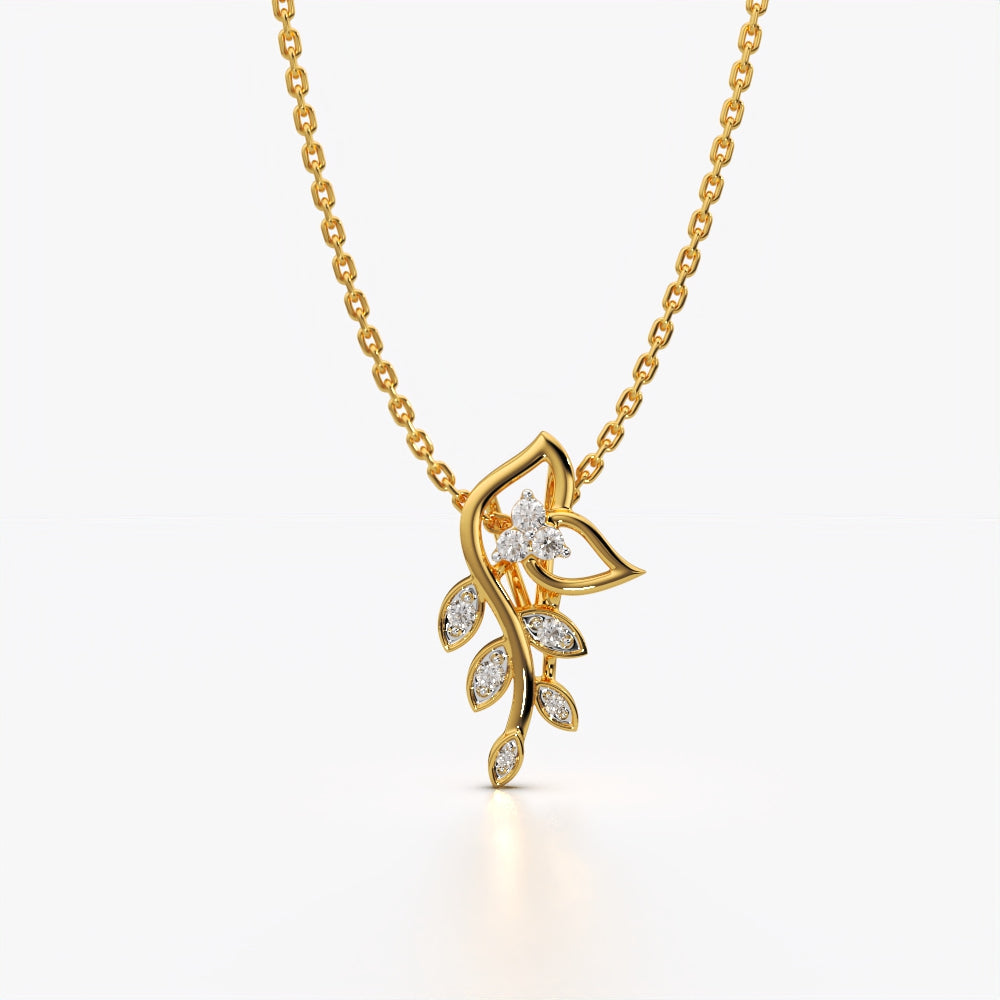
Leaf Vine Cascade Pendant Necklace
Shop Now -
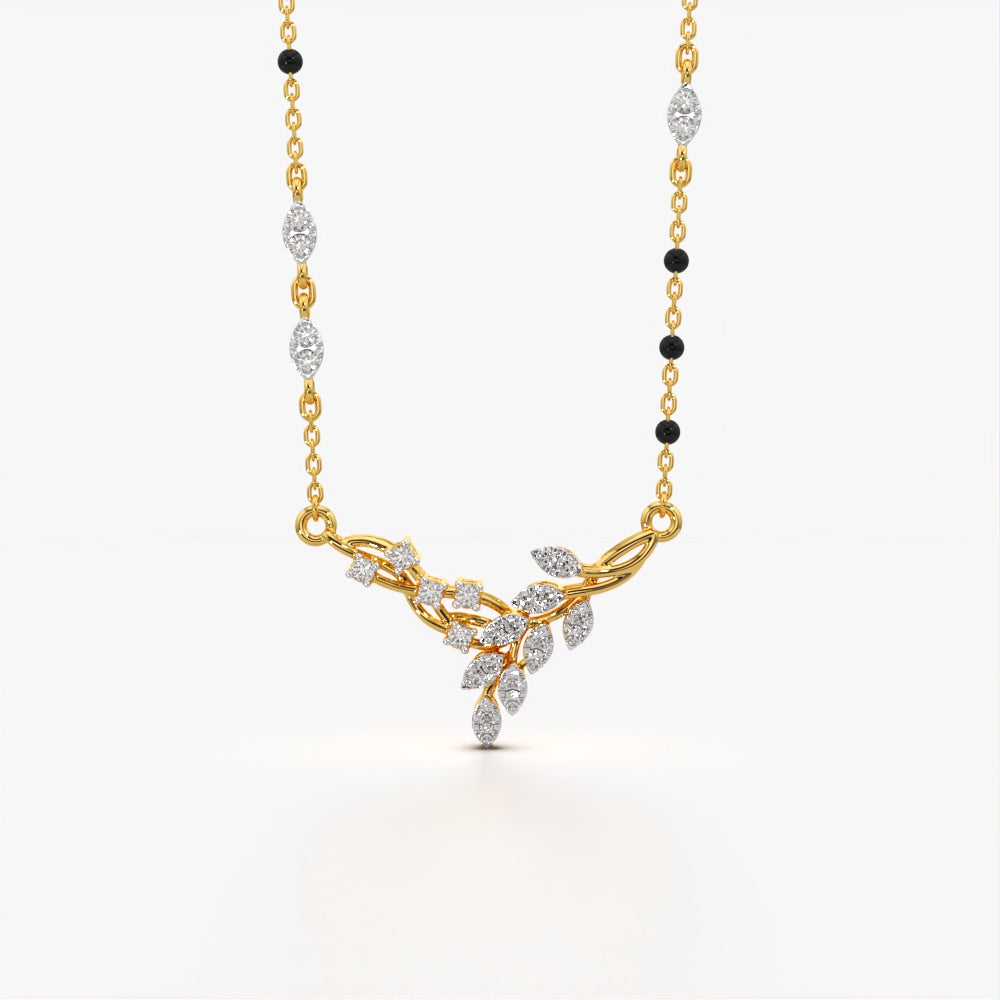
Crystal Leaf Vine Mangalsutra
Shop Now -
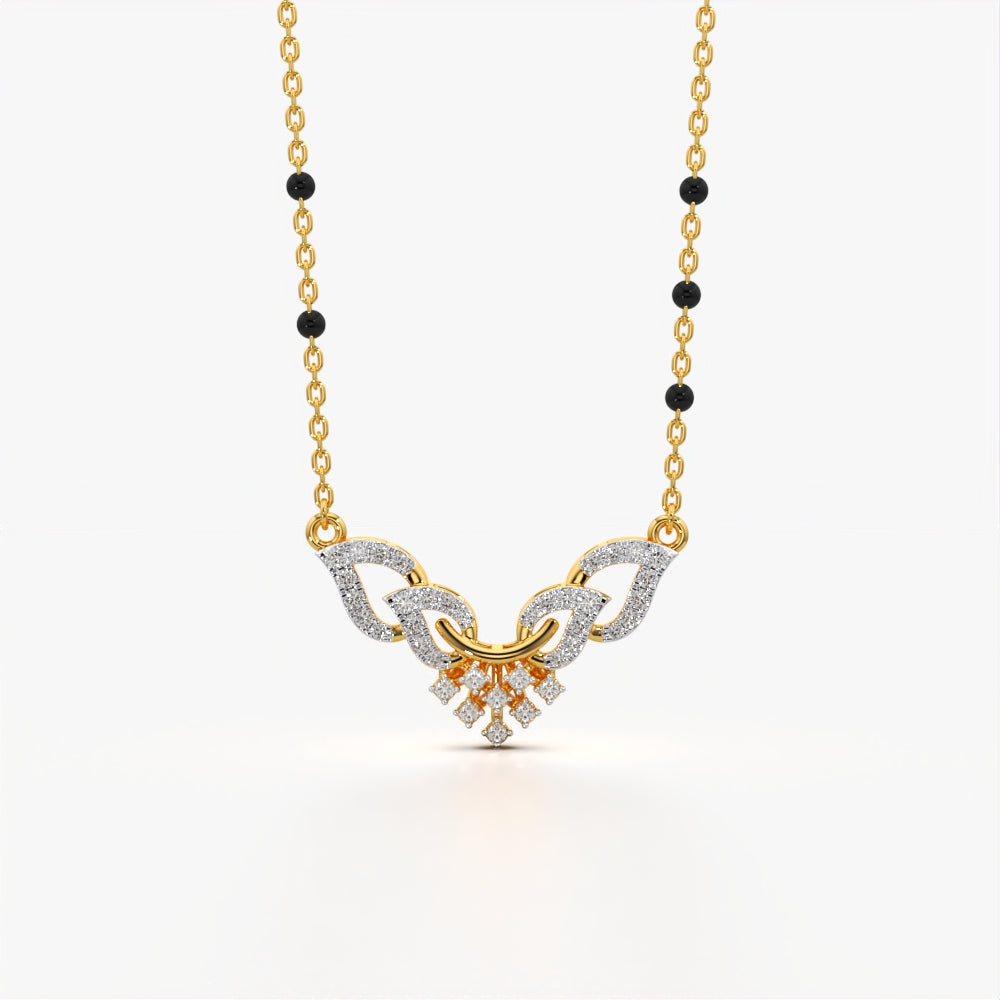
Elegant Leaf Wing Modern Mangalsutra
Shop Now -
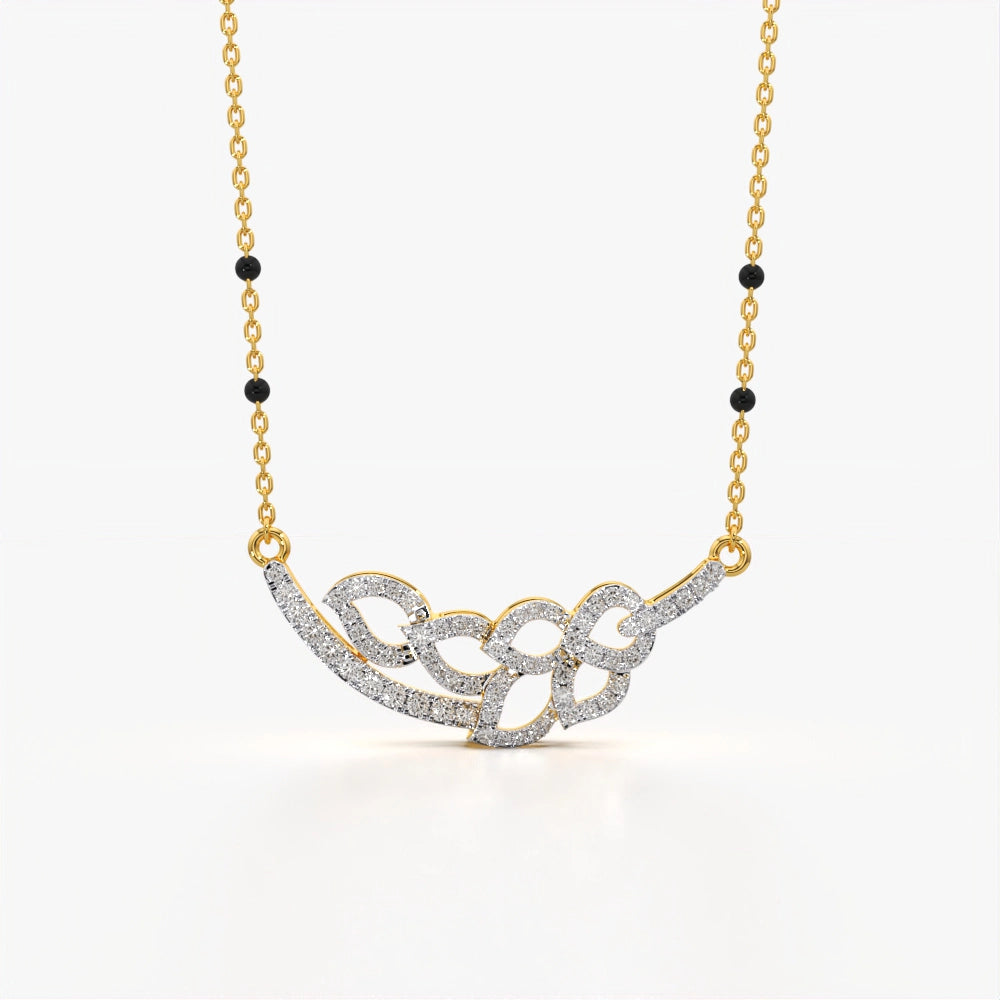
Intertwined Leaf Moissanite Mangalsutra Necklace
Shop Now
The short answer
- Any leaf: growth, renewal, fresh starts, and a connection to nature.
- Peepal leaf: wisdom and spiritual awakening. The Buddha found enlightenment under a peepal tree, and in the Bhagavad Gita, Krishna says, "Among trees, I am the peepal."
- Banyan leaf: long life and continuity. It's India's national tree.
- Mango leaf: auspicious beginnings and welcome. It's the leaf in every toran and kalash.
- Betel (paan) leaf: respect, welcome, and marriage.
- Olive leaf: peace. Laurel leaf: victory. Ginkgo leaf: resilience and lasting love. Fern: new life.
- A vine or branch of leaves: growing together, family, continuity.
- A falling leaf: letting go and accepting change.
- A gold leaf: a leaf that never wilts. In India, it also echoes the Dussehra custom of calling leaves gold.
How to read a leaf necklace: four clues
Most leaf necklaces don't come with a label.
Here's how to read one.
| Clue | What to look at | What it changes |
| 1. The leaf | Its shape: heart, oval, fan, lance, lobed | Which tradition the meaning comes from |
| 2. The count | One leaf, two, three, or a whole vine | Whether it's about you, a couple, or a family |
| 3. The direction | Rising, falling, or trailing sideways | Growth, letting go, or a journey |
| 4. The company | A flower, a stone, a heart, black beads | What kind of growth: love, marriage, a fresh start |
Let's take them one at a time.
Clue 1: Which leaf is it?
Jewellers draw leaves in a handful of recognisable shapes. Use this table to identify yours.
| Leaf | How to spot it on a pendant | What it usually means | Where the meaning comes from |
| Peepal (sacred fig) | Heart shape with a long, thin tail at the tip | Wisdom, awakening, spiritual grounding | Bodhi tree, Bhagavad Gita, Hindu, Buddhist and Jain reverence |
| Banyan | Thick oval with a rounded tip | Long life, shelter, continuity | India's national tree; Vat Purnima |
| Mango | Long, narrow and pointed, like a lance | Auspicious beginnings, welcome, fertility | Torans and the kalash |
| Betel (paan) | Heart-shaped with a short point | Respect, welcome, marriage | Weddings, pujas, hospitality |
| Lotus leaf | Round, flat, with the stem at the centre | Staying untouched by negativity | Bhagavad Gita 5.10 |
| Chinar | Five-pointed, hand-like, often in red or amber | Heritage, Kashmir, the beauty of change | Kashmir's autumn |
| Olive | Slim, pointed leaves in pairs along a stem | Peace | The dove's olive leaf, ancient Greece |
| Laurel | Like olive but slightly broader, often in a wreath | Victory, achievement | Apollo, the Pythian Games |
| Ginkgo | A fan with a notch in the middle | Resilience, long life, two hearts as one | Hiroshima's survivor trees, Goethe |
| Fern | Rows of tiny leaflets, or a curled spiral | New life, growth | The Māori koru |
| Monstera | A large leaf with splits and holes | Modern, tropical style | A design trend more than a tradition |
| Four-leaf clover | Four rounded leaflets meeting at a centre | Luck | See our clover necklace meaning guide |
Peepal or paan? The heart-shaped leaves people mix up
Both leaves are heart-shaped, which is why they're easy to confuse in jewellery. The giveaway is the tip. A peepal leaf ends in a long, thin tail. Botanists call it a drip tip: it helps rain run off the leaf quickly. A betel leaf has only a short point.
Here's a detail most people never notice: the heart symbol on playing cards is called paan in Hindi. Indian card players looked at the "heart" and saw a betel leaf. So in India, a heart and a leaf have long been the same shape with two names.
If you can't tell which leaf it is
That's normal. Most modern leaf jewellery isn't a specific plant. It's a stylised leaf, usually a pointed oval. In stone-set pieces, that shape is often a marquise, which is also called a navette, French for "little boat", and which jewellers love for leaves and petals.
A generic leaf carries the general leaf meaning: growth, renewal, and nature. The other three clues then do most of the talking.
Clue 2: Count the leaves
These are common readings, not rules. But they help explain why one pendant feels personal, and another feels like a family piece.
| Leaves | Common reading | A good fit for |
| One leaf | You: your growth, your fresh start, your next chapter | A new job, a move, a self-gift |
| Two leaves | Two people growing from one stem | Partners, best friends, sisters |
| Three leaves | Past, present and future, or a family of three | A new parent, a family milestone |
| A vine or branch | Continuity: a family tree, a marriage that keeps growing | Anniversaries, mangalsutras, mothers |
| A wreath or circle | Victory, completion, a full cycle | Graduations, promotions, a goal reached |
Two leaves have a lovely literary backing. In September 1815, the German poet Goethe pressed ginkgo leaves into a poem for Marianne von Willemer. He wondered whether the two-lobed ginkgo leaf was one being that had divided, or two that had chosen to become one, and decided he was the same: "one and also two". It's one of the most romantic readings any leaf has.
Clue 3: Which way does it point?
Direction changes the mood of a leaf.
- Rising leaf (tip pointing up): growth, ambition, reaching for something.
- Falling leaf (tip pointing down): letting go, acceptance, a season ending so another can start. Some people choose a falling leaf after a loss or a hard year.
- Trailing leaves (a vine running sideways or cascading): a journey, continuity, life moving on.
A practical catch: many single-leaf pendants hang tip-down, because of where the bail (the loop the chain passes through) sits. If direction matters to you, look for a photo or video of the necklace being worn, not just lying flat. A leaf that looks upright in a flat photo may hang the other way on your neck.
Clue 4: What's it paired with?
| Leaf paired with | Common reading |
| A flower | Growth that has bloomed: a goal reached, a relationship that has flowered |
| A small stone at the tip | A dewdrop: freshness, a new morning, a new beginning |
| A heart | Love that keeps growing |
| Black beads (a mangalsutra) | A marriage that grows with time |
| An initial | Your own growth, or someone you're growing with |
| Another symbol (moon, evil eye, butterfly) | Growth plus that symbol's meaning. See our moon necklace, evil eye and butterfly necklace guides |
Leaf colours
| Colour | Common reading |
| Green | Fresh growth, health, nature |
| Gold | Permanence. A gold leaf never wilts, which is a small, quiet idea: growth that lasts |
| Red, amber or orange | Autumn, change, maturity. Think of Kashmir's chinar trees in October |
| White or silver | Calm, clarity, a fresh start |
| Blue | Peace, trust. Often used for enamel leaves |
What leaves mean in India
Most leaf-meaning guides online stop at oak, maple, olive, and perhaps peepal. India has a far richer leaf culture, and much of it is still part of daily life.
Peepal: the leaf of wisdom
The peepal (Ficus religiosa) is sacred in Hinduism, Buddhism, and Jainism. The Buddha attained enlightenment while meditating under a peepal at Bodh Gaya in Bihar. A branch of that tree was planted in Sri Lanka around 288 BCE, and the Jaya Sri Maha Bodhi that grew from it is the oldest living human-planted flowering plant in the world.
In the Bhagavad Gita (10.26), Krishna says: aśhvatthaḥ sarva-vṛikṣhāṇāṁ, "Among all trees, I am the peepal." The leaf itself is heart-shaped, 10 to 17 cm long, with that distinctive drip tip.
A plain peepal leaf pendant is usually worn as a symbol of wisdom and calm. A peepal leaf with a deity or Om on it is a devotional piece, and many people treat it with the same care they'd give a puja item.
Krishna on a leaf: it's a banyan, not a peepal
You've probably seen baby Krishna lying on a leaf, sucking his toe, in paintings, brass wall hangings and pendants. Many of these are sold today as "Krishna on a peepal leaf".
In the old stories, the leaf is a banyan leaf. The form is called Vatapatrashayi, "the one who lies on a banyan leaf". In the legend told in the Mahabharata, the Matsya Purana, and the Bhagavata Purana, the sage Markandeya sees the whole world drowned in a great flood. Floating on the water is an infant on a banyan leaf. When Markandeya comes close, he's drawn inside the child and finds the entire universe there, safe. The image stands for renewal: the world kept safe, ready to begin again.
Banyan: the leaf of long life
The banyan is India's national tree, and it's famous for living for centuries. On Vat Purnima, also called Vat Savitri, married women in Maharashtra, Goa, Gujarat, Uttarakhand and parts of North India fast and wind a white thread around a banyan tree seven times, praying for their husband's long life. It recalls Savitri, who argued with Yama, the god of death, until he returned her husband Satyavan's life.
That's why a banyan or vine motif sits so naturally on a mangalsutra.
Mango leaves: the leaf of every good beginning
A string of mango leaves over the door (a toran, or maavilai thoranam in Tamil Nadu) marks a festival, a wedding, a griha pravesh or a new venture. In a puja kalash, a crown of five, seven, or eleven mango leaves sits in the water under the coconut. Mango leaves are linked with Kama, the god of love, and stand for fertility and abundance.
A mango leaf necklace says what the toran says: welcome, and may this beginning go well. With Diwali on Sunday, 8 November, torans will soon be going up on doors across the country.
Betel leaf: the leaf of respect and weddings
The betel leaf, paan, is offered in pujas and at weddings across India. In a Bengali wedding, the bride circles the groom seven times (Saat Paak) with her face hidden behind betel leaves. At Shubho Drishti, she lowers them and looks at the groom for the first time. The leaf literally frames the first look of the marriage.
Paan has also given Hindi one of its most useful idioms: beeda uthana, to take up the paan. In old royal courts, a platter of paan beedas was passed around, and whoever picked one up first took on the dangerous task. Today it simply means to take responsibility for something. That makes a paan-shaped leaf a quietly clever gift for someone starting a big new role.
Apta leaves: the day leaves become gold
On Dussehra, which falls on Tuesday, 20 October this year, families in Maharashtra and parts of Karnataka exchange leaves of the apta tree (Bauhinia racemosa). They call them sona, gold, and say: Sona ghya, sonya sarkha raha. "Take this gold, and stay like gold."
The custom comes from a legend about Kautsa, a student who owed his guru a huge fee in gold coins. King Raghu wanted to help, and Kubera, the god of wealth, rained gold onto the apta trees of his kingdom. In other regions, the shami tree (banni in Karnataka) is worshipped on the same day, remembering the Pandavas, who hid their weapons in a shami tree during their exile.
A gold leaf necklace is the literal version of this custom: a leaf that really is gold, or gold-finished, to wish someone a life that shines.
Kerala's leaf-shaped thali
Kerala's traditional thali, the ela thali, is a leaf. Ela means leaf in Malayalam, and Hindu families in Kerala often wear a leaf-shaped gold pendant with an Om on it as the marriage symbol. Maharashtra's Kolhapuri saaj traditionally carries 21 pendants, often described as leaves. Leaves have been part of Indian bridal jewellery for a long time. Our guide to the types of mangalsutra covers these regional styles.
Lotus leaf: the leaf nothing sticks to
The Bhagavad Gita (5.10) describes a person who works without attachment as being "like a lotus leaf untouched by water": padma-patram ivāmbhasā. Water beads up and rolls off a lotus leaf without wetting it.
It's a surprisingly modern meaning for a work necklace: do the work, don't let the drama stick.
Chinar: Kashmir's autumn leaf
The chinar (Platanus orientalis), called buen in Kashmiri, has long been the state tree of Jammu and Kashmir. In autumn, its five-pointed leaves turn from blood red to mauve, amber and yellow. A popular legend says the Mughal emperor Jahangir named it after seeing that colour: che naar ast, "what a flame this is". The chinar leaf appears across Kashmiri crafts, from papier-mâché to shawl embroidery and carpets.
A chinar leaf, especially in red or amber, stands for heritage and the beauty of change. The trees are at their most colourful from late October into November.
More leaves with meaning in India
| Leaf | What it means | Where you see it |
| Tulsi | Devotion, purity, home | Courtyards, Tulsi Vivah (Saturday, 21 November), which opens the wedding season |
| Bel patra | Devotion to Shiva. Three leaflets, often read as Brahma, Vishnu and Mahesh | Shiva puja; see our clover guide for how it compares with a clover |
| Neem | Accepting life's bitter moments with the sweet | Ugadi pachadi, where neem's bitterness stands for life's hard times |
| Banana leaf | Abundance, hospitality | Festive meals, especially in South India |
Leaves around the world
| Leaf | Meaning | The story behind it |
| Olive | Peace | In Genesis, a dove returns to Noah's ark with an olive leaf. In ancient Greece, olive wreaths were worn by brides and given to Olympic victors. Two olive branches frame the United Nations emblem |
| Laurel | Victory, achievement | Sacred to Apollo, laurel wreaths crowned winners at the Pythian Games. It gives us the word "laureate" and the phrase "resting on your laurels" |
| Ginkgo | Resilience, long life, love | Ginkgo's family dates back over 290 million years. Six ginkgo trees between 1 and 2 km from the Hiroshima bomb survived and grew again. It's also the symbol of Tokyo |
| Fern (koru) | New life, growth, strength, peace | The Māori koru is a fern frond uncurling |
| Oak | Strength, endurance | A common reading in European folklore |
| Maple | Balance, home (and Canada) | On Canada's flag since 1965 |
| Ivy | Fidelity, friendship | It clings and stays green all year |
| Monstera | Style, a love of plants | A modern favourite with no old tradition behind it, which is fine |
Leaves are also part of a bigger 2026 trend. Pinterest's 2026 trend report named "Wilderkind", a nature-led style, and noted searches for bug jewellery up 60%. Botanical pieces, from leaves to dragonflies, sit right in that mood.
What a leaf necklace means as a gift
The same leaf says different things depending on who gives it.
| From | To | What it usually says | Leaf that fits |
| Partner | Partner | "We're growing together" | Two leaves, or a vine |
| Husband | Wife, on Karwa Chauth (Thursday, 29 October) | "Our life together keeps growing" | A leaf mangalsutra or a vine pendant |
| Parent | Child leaving for college or a new city | "Keep growing" | A single rising leaf |
| Child | Mother | "Our family grew from you" | A branch or vine |
| Friend | Friend after a hard year | "This season will pass" | A falling leaf |
| Colleague or manager | Promotion, farewell, new role | "Well done" or "Go take it on" | Laurel, or a paan-shaped leaf for beeda uthana |
| Anyone | Anyone on Dussehra (Tuesday, 20 October) | "Stay like gold" | Any gold leaf |
| Brother | Sister, on Bhai Dooj (Wednesday, 11 November) | Growth and good things for the year ahead | A small single leaf she'll wear daily |
| You | Yourself | A reminder of how far you've come | Whatever you'll actually wear |
For more ideas, see our first Karwa Chauth gift guide and Diwali gift ideas for women.
What does it mean when someone gives you a leaf necklace?
Usually, that they see you growing, or want you to. From a partner, it often means "we're growing together", especially if there are two leaves or a vine. From a parent or friend, it's a wish for a fresh start. A leaf is gentler than a heart and more personal than a plain chain, which is why people choose it when they want to say something without saying too much.
Is a leaf necklace religious?
Not by default. A generic leaf is a nature symbol, and anyone can wear it. Some leaves carry religious meaning in India, especially peepal, tulsi, and bel, and a leaf with a deity or Om on it is devotional. If you're gifting one of those, think about the wearer's faith and traditions first. A plain olive, laurel, or vine leaf is the easiest choice across families and faiths.
Why leaves suit a mangalsutra
A mangalsutra is meant to be worn every day for years, and a leaf is about growth over time. That's why so many modern mangalsutras use leaves and vines. India already has precedents: Kerala's leaf-shaped ela thali, and the banyan tree of Vat Purnima, where wives pray for a long married life.
A leaf mangalsutra also solves a practical problem for many women. It looks less like bridal jewellery and more like a pendant, so it fits office wear and western outfits while still being a mangalsutra. KYMEE's leaf mangalsutras are below, and you can see every design in the mangalsutra collection.
How to choose a leaf necklace you'll actually wear
A leaf has points, edges, and length, which a round pendant doesn't. These checks matter more than usual.
- Do the dupatta test: Leaf tips and pavé edges can catch on chiffon dupattas, lace, knits, and long hair. Before you buy, look at the tips: rounded or close-set leaves snag less than sharp, open ones. If you buy in a store, run the pendant gently across a soft fabric.
- Check how it hangs: As covered above, the bail decides whether your leaf rises or falls. Look for an on-neck photo or video.
- Ask for the size in millimetres: Leaves are long shapes, so they look bigger than a round pendant of the same weight. One large silver brand lists its leaf pendant at 3.1 cm tall and 1.1 cm wide. That's a noticeable, statement-size leaf. For daily wear, many people prefer something shorter.
- Pick the chain length for the shape: At 16 inches (40 cm), a pendant sits just above the collarbone. At 18 inches (45 cm), it falls at the collarbone, which suits most leaf and vine pendants because a long leaf has room to hang straight. Our necklace size chart shows every length.
- Wear asymmetric vines with an open neckline: A vine that trails to one side looks best with a V-neck, a wider kurta neckline, or a collared shirt left open, where the whole line shows.
- Read the stone name: Leaf pieces use moissanite, cubic zirconia (CZ), lab-grown or natural diamonds, enamel, and semi-precious stones. The listing and invoice should say which.
- Treat enamel leaves gently: Enamel is coloured glass fused onto metal. It gives the brightest greens and blues, but a hard knock can chip it.
- Check what's under the gold: Alloy or stainless steel with gold-tone plating is fine for a trend piece. For daily wear and skin that reacts easily, nickel-free 925 sterling silver or solid gold is the safer base.
- For gold vermeil, ask for the micron figure: Vermeil has a much thicker gold layer than ordinary plating: at least 2.5 microns. Here's the full gold vermeil vs gold plated comparison.
What a leaf necklace costs in India 2026
Leaf necklaces come at every price.
| Type | What you get | Price we saw | Choose it if |
| Alloy, gold-tone | Fashion jewellery | About ₹399 at one youth fashion brand | You want a trend piece for a season |
| Stainless steel, gold-tone, with CZ | Fashion jewellery | About ₹3,009 at one D2C brand | You want the look at a low price |
| Rhodium-plated 925 silver with enamel | White silver look | About ₹4,999 at one large silver brand | You prefer white metal |
| 18K gold vermeil | 925 sterling silver with a thick 18K gold layer | ₹6,599 for KYMEE's leaf vine pendant; ₹7,699 to ₹9,199 for its leaf mangalsutras | You want the gold look for daily wear and don't need resale value |
| Solid 14K or 18K gold, often with diamonds | Hallmarked gold | Leaf pendants from about ₹15,000 at one online jeweller; peepal designs from about ₹21,900 | You want metal value, resale or an heirloom |
A Dhanteras thought. Dhanteras falls on Friday, 6 November. If your goal is value, hallmarked gold is the right Dhanteras buy. A leaf necklace in vermeil or silver is something else: a symbol you'll wear every day, not an investment.
KYMEE's leaf necklaces
KYMEE makes its leaf necklaces in 18K gold vermeil over nickel-free 925 sterling silver, with a gold layer of at least 2.5 microns. Each reads the leaf a little differently.
1. Leaf Vine Cascade Pendant Necklace

A small flower cluster with a vine of marquise-shaped leaves cascading to one side, on a fine cable chain. It's the most botanical piece in the range, and the listing says it pairs with bridal, festive, and everyday looks.
- Meaning it leans towards: growth that has bloomed and keeps going (leaf, flower, and vine together)
- Shape: asymmetric trailing vine
- Best for: daily wear with open necklines, a self-gift for a new chapter, a gift for a mother or partner
- Skip it if: you want a single, centred leaf
2. Intertwined Leaf Moissanite Mangalsutra Necklace

An intertwined leaf and petal pendant, pavé-set with small moissanite stones, on a traditional black bead mangalsutra chain.
- Meaning: it leans towards two lives intertwined and growing together
- Stones: pavé moissanite (small accent stones)
- Best for: a first Karwa Chauth, an anniversary, a newly married woman who wants a mangalsutra that sparkles a little
- Skip it if: you prefer plain gold with no stones
3. Crystal Leaf Vine Mangalsutra

A leaf vine mangalsutra with a nature-inspired design, listed as lightweight and suited to office and daily wear.
- Meaning it leans towards: continuity, a marriage that keeps growing
- Best for: daily office wear; someone who wants a mangalsutra that reads as a modern pendant
- Skip it if: you want a traditional, heavier mangalsutra
4. Elegant Leaf Wing Modern Mangalsutra

A lightweight modern mangalsutra built around a leaf-wing motif, designed for everyday wear.
- Meaning it leans towards: leaves for growth, wings for freedom. A mangalsutra for someone who wants both
- Best for: the lowest-priced leaf mangalsutra in the range; daily wear; a minimal look
- Skip it if: you want a lot of sparkle
Four leaf necklaces at a glance
| Necklace | Leaf meaning | Type |
| Leaf Vine Cascade Pendant | Growth that blooms and keeps going | Pendant necklace |
| Intertwined Leaf Moissanite Mangalsutra | Two lives growing together | Mangalsutra, black beads |
| Crystal Leaf Vine Mangalsutra | Continuity | Mangalsutra |
| Elegant Leaf Wing Modern Mangalsutra | Growth and freedom | Mangalsutra |
Looking for luck rather than growth? The four-leaf clover is a leaf too. KYMEE's Open Clover Outline Necklace and Four Leaf Clover Heart Pendant Necklace are covered in our clover necklace meaning guide.
You'll find the leaf pendant in pendant necklaces, the leaf mangalsutras in mangalsutra, and everything in the wider necklaces range.
Leaf earrings and rings to pair them with
- Leaf Branch Threader Earrings: sculpted leaf branches with tiny moissanite stones at the tips and a fine chain that trails down the back, about 1.28 g. More on sui dhaga (threader) earrings, and here's how to wear threader earrings.
- Trailing Vine Leaf Drop Studs: a polished open leaf at the top and a cascading branch of marquise-shaped leaves in pavé moissanite, with a push-back closure. The closest match to the Leaf Vine Cascade Pendant.
- Pavé Leaf Branch Climber Stud Earrings: five leaf-shaped moissanite pavé outlines climbing up the earlobe along a polished stem, about 2.00 g. A good match for a rising-leaf look.
- Laurel Leaf Huggie Hoop Earrings: pairs of marquise-shaped laurel leaves pavé-set with mini round moissanite, with a hinged click closure. The victory leaf, in a small hoop.
- Whispering Vine Ring: a band sculpted into a budding leaf branch, set with moissanite, about 1.32 g. Stackable.
- Olive Leaf Vine Solitaire Ring: an olive leaf vine that wraps all the way around the finger, with a prong-set round CZ centre stone. Peace, in a ring.
More earrings are in stud earrings.
Leaf designs we don't make, and your options
You'll see these across Pinterest and Instagram.
None of them are in our collection today:
- Peepal leaf pendants
- Banyan, mango or betel leaf pendants
- Ginkgo leaf necklaces
- Chinar or maple leaves in red or amber enamel
- Monstera leaves
- Solid gold leaf pendants that hold metal value. For these, a hallmarked piece from a jeweller you trust is the better route
If you'd like a leaf we don't make, such as a peepal leaf, a ginkgo leaf for a couple, or a single leaf with an initial, you can have one made. Fill in KYMEE's create-your-own form with the piece type, your budget, and a sketch or photo, and the team replies within 24 hours with ideas and a quote. KYMEE uses moissanite only as small accent stones, so any larger stone in a custom piece is cubic zirconia (CZ).
Caring for a leaf necklace
- Put it on after you dress. Leaf tips and vines catch on fabric when you pull a kurta or sweater over your head.
- Put it on after perfume, lotion, and sunscreen. They leave a film that dulls pavé stones.
- Take it off for water. Remove it before showering or swimming. Pool and sea water slowly reduce the shine.
- Store it flat and on its own. Keep each piece in a soft pouch, with vines laid flat so the leaves don't bend or tangle.
- Clean it simply. Wipe with a soft, dry, lint-free cloth. For more, use a slightly damp cloth with mild soap, then dry completely. Here's more on how to clean gold vermeil and how to clean moissanite.
KYMEE's jewellery care guide covers the rest.
FAQs
What does a leaf necklace mean?
A leaf necklace symbolises growth, renewal and fresh starts, because a leaf is the newest part of a plant. The exact meaning depends on the leaf: peepal for wisdom, banyan for long life, mango for auspicious beginnings, olive for peace, laurel for victory and ginkgo for resilience. A vine of leaves stands for growing together.
What does a leaf symbolise spiritually?
Spiritually, a leaf stands for life's cycles: growing, changing, letting go, and growing again. In India, the peepal leaf is linked with wisdom and the Buddha's enlightenment, and the Bhagavad Gita compares a person free of attachment to a lotus leaf that water cannot wet.
What does a peepal leaf pendant mean?
A peepal leaf pendant stands for wisdom, calm, and spiritual grounding. The peepal is sacred in Hinduism, Buddhism, and Jainism: the Buddha attained enlightenment under one at Bodh Gaya, and in the Bhagavad Gita, Krishna says, "Among trees, I am the peepal." A peepal leaf with a deity or Om is a devotional piece.
Is baby Krishna on a peepal leaf or a banyan leaf?
In the scriptures, it's a banyan leaf. The form is called Vatapatrashayi, "the one who lies on a banyan leaf". In the legend, the sage Markandeya sees the infant floating on a banyan leaf during a great flood. Many modern idols and pendants call it a peepal leaf, but the traditional leaf is the banyan.
What does it mean when someone gives you a leaf necklace?
It usually means they see you growing, or want you to. From a partner, a vine or two leaves often means "we're growing together". From a parent or friend, it's a wish for a fresh start. A falling leaf can be a gentle way of saying a hard season will pass.
What does a leaf mangalsutra mean?
A leaf mangalsutra stands for a marriage that grows over time. Leaves already have a place in Indian bridal jewellery: Kerala's traditional ela thali is leaf-shaped, and on Vat Purnima married women pray at the banyan tree for a long married life. Vines add the idea of two lives intertwined.
What does an olive leaf necklace mean?
An olive leaf necklace means peace. The idea comes from Genesis, where a dove returns to Noah's ark with an olive leaf, and from ancient Greece, where olive wreaths were worn by brides and given to Olympic victors. Two olive branches also frame the United Nations emblem.
What does a ginkgo leaf necklace mean?
A ginkgo leaf means resilience and long life. Ginkgo's family is over 290 million years old, and six ginkgo trees survived the 1945 Hiroshima bombing. Because Goethe wrote a love poem about its two-lobed leaf being "one and also two", it's also a popular gift between couples.
Which leaf is lucky in India?
Several. Mango leaves hang over doors for every auspicious beginning. On Dussehra, Maharashtrians exchange apta leaves as "gold" (sona), saying "take this gold and stay like gold". And the four-leaf clover, though not Indian in origin, is now one of the most popular luck symbols in Indian jewellery.
Why is the hearts suit called paan in Hindi?
Because the heart symbol looks like a betel leaf, which is called paan. Indian players named the suit after the leaf it resembles. The other suits are hukum (spades), eent (diamonds), and chidi (clubs). So in India, the heart on a playing card has long been a leaf.
What does a falling leaf necklace mean?
A falling leaf, one that points downward, stands for letting go, acceptance, and change. It's often chosen after a loss, a breakup, or a hard year, as a reminder that seasons end so new ones can begin. Many single-leaf pendants hang tip-down, so check how a pendant hangs if direction matters to you.
Is a leaf necklace good for daily wear?
Yes, if you choose one that sits close and doesn't snag. Look for rounded or close-set leaf tips, a pendant in a length you're comfortable with, an 18-inch chain so a long leaf hangs straight, and a nickel-free base such as 925 sterling silver or solid gold. Put it on after you dress.
Can men wear a leaf necklace?
Yes. Leaf pendants such as olive, oak, laurel, and ginkgo are worn by men too, usually as a flat metal leaf on a slightly heavier chain. The meaning stays the same: growth, peace, strength, or achievement, depending on the leaf.