


 All Rings
 Toi Et Moi Rings
 Wedding Bands
 Solitaire Rings
 Stackable Rings
 Dainty Rings
 Personalized Rings
 Daily Wear Rings
 Halo Rings
 Ring Set
 For Daily Wear
 For Party
 For Work
 For Gifting
 For College
 For Festive Days
 All Earrings
 Hoop Earrings
 Drop Earrings
 Stud Earrings
 Name Earrings
 Threader Earrings
 All Necklaces
 Charm Pendants
 Pendant & Necklaces
 Station Necklaces
 Personalized Necklaces
 Layered Necklaces
 Drop Necklaces
 All Bracelets
 Name Bracelets
 Chain Link Bracelets
 Bangle Bracelets
 Charm Bracelets
 Tennis Bracelets
How to Measure Ring Size: String, Chart, Tape and More Methods

Getting a ring is exciting. Getting the wrong size is not.
Whether you're buying one for yourself, surprising a partner, or finally treating yourself to that piece you've been eyeing, the fit is everything. A ring that's too tight cuts off circulation. One that's too loose spins, slips, and eventually disappears down a drain.
This post covers every reliable method to measure ring size at home, including the string, the paper strip, the existing ring, the printable chart, and even how to do it secretly for someone else. We've also mapped out ring size conversions for India, the US, the UK, Europe, Japan, and more.
Let's get it right the first time.
Why Getting Your Ring Size Right Matters More Than You Think
Ring sizing sounds simple, until it isn't. Rings made in rigid materials like tungsten, ceramic, or even hardened gold vermeil cannot be resized easily. And if you're shopping online (which most of us are, honestly), there's no jeweller to check the fit before you buy.
The Indian ring size system runs on a numeric scale from 1 to 30, based on the inner circumference of the ring in millimetres. The US system uses half-number increments (Size 5, 5.5, 6...), while the UK uses letters (J, K, L, M...). Europe goes by the circumference in millimetres directly. Japan has its own numeric scale, too. It can feel overwhelming, but all of it converts cleanly; you just need one accurate base measurement.
The Best Time to Measure Your Ring Size
Before picking up a string or ruler, know this: finger size changes throughout the day and with the seasons.
Fingers swell slightly in warm weather, after exercise, and toward evening. They shrink in cold weather and early in the morning.
For the most accurate measurement:
- Measure at the end of the day, when fingers are at their natural largest.
- Avoid measuring after a workout, after drinking alcohol, or after eating salty food; all of these cause temporary swelling.
- Measure at room temperature, not in air conditioning or in the cold.
- Take the measurement 2–3 times and average the results.
- If your knuckle is noticeably wider than the base of your finger, size up slightly so the ring can pass over the knuckle comfortably.
Method 1: The String or Thread Method (Most Widely Used)
This is the most widely used technique globally, simple and accurate, and requires nothing more than a piece of string or thread and a ruler.
What you need: A thin piece of string, thread, or even a strip of dental floss. A ruler. A pen.
Steps:
- Wrap the string around the base of the finger you want the ring to sit on. This is usually the ring finger of your right hand (more common for Indian women) or left hand.
- Make sure the string sits snugly but not tightly; it should feel the way you'd want your ring to feel.
- Mark the exact point where the string meets itself with a pen.
- Lay the string flat on a ruler and measure the length in millimetres. This is your finger circumference.
- Match your measurement to the ring size chart below.
Pro tip: If your knuckle is larger than the base of your finger, measure both and choose a size in between, so the ring slides over the knuckle but doesn't spin at the base.
To accurately determine your ring size, gather one or more of the following items:
- A string or a strip of paper
- Ruler or measuring tape
- Ring sizer (plastic or metal)
- Online ring size chart
Method 2: The Paper Strip Method

Works exactly like the string method, but with a thin strip of paper, which tends to hold the measurement more cleanly.
Steps:
- Cut a thin strip of paper roughly 10cm long and about 0.5cm wide.
- Wrap it around the base of your finger.
- Mark where the paper overlaps with a pencil or pen.
- Flatten the paper and measure the marked length in millimetres, that's your circumference.
- Use the chart below to find your size.
This method is popular for measuring ring size for kids, where fingers are smaller, and strings can slip more easily.
-
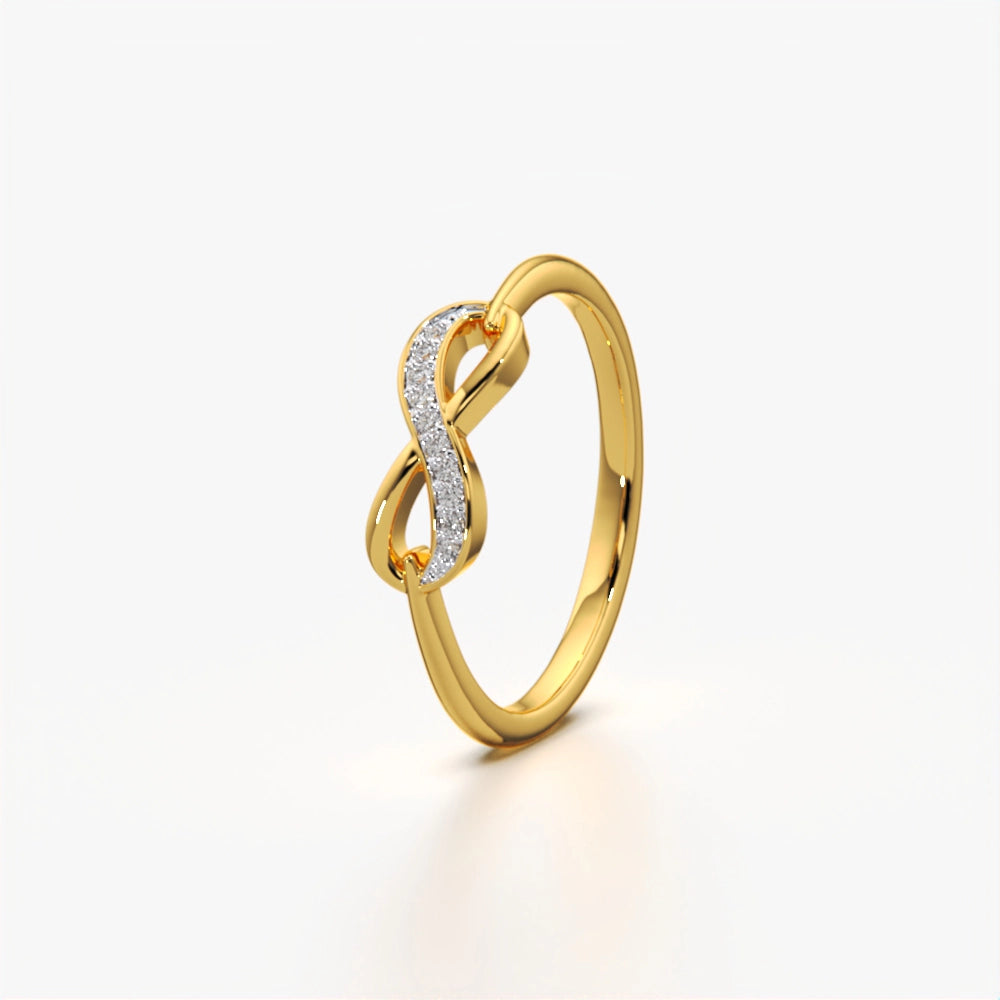
Diamond Encrusted Infinity Ring
Show Now -
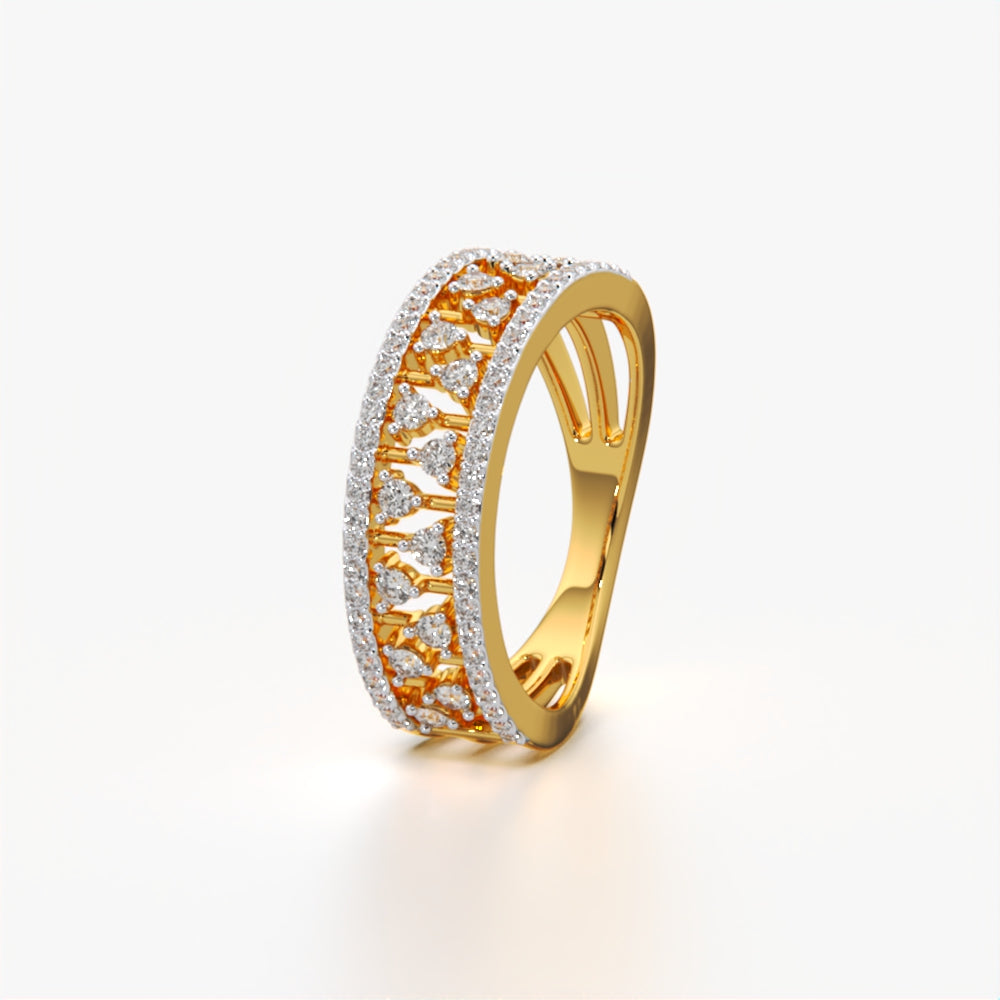
Geometric Openwork Band
Show Now -

Round Halo Stack Ring
Show Now -

Minimal Triple Solitaire Band
Show Now
Method 3: The Existing Ring Method (Best for Surprises)
If you already own a ring that fits perfectly on the finger in question, this is your fastest and most accurate option. It's also the go-to method when you're buying a ring as a gift without the person knowing.
What you need: A well-fitting ring, a ruler or vernier calliper, and good lighting.
Steps:
- Place the ring on a flat, white surface.
- Using a ruler, measure the inner diameter, the distance across the inside of the ring from one inner edge to the other, in millimetres.
- Match the diameter to the chart below.
If you don't have a ruler handy: Trace the inside circle of the ring on paper and measure that circle's diameter.
A vernier calliper gives the most precise reading, but a good ruler works perfectly well for everyday purposes.
Method 4: The Printable Ring Size Chart Method
This method is ideal if you have access to a printer.
Steps:
- Download or find a printable ring size chart online.
- Before printing, ensure page scaling is set to "None" or "100%" in your print settings, this is critical. If the page scales even slightly, the circles will be inaccurate.
- Once printed, place your existing ring over each circle on the chart.
- Find the circle that aligns exactly with the inner edge of your ring. That's your size.
- Alternatively, trace your finger directly on the chart and match it to the closest circle.
Method 5: Using a Measuring Tape

If you have a flexible tailor's measuring tape at home, this is even easier than the string method.
Steps:
- Wrap the measuring tape directly around your finger.
- Note the measurement at the point where it meets the start, in millimetres.
- This is your circumference. Cross-check with the chart below.
The measuring tape method is common in India because most homes that stitch clothes have one handy.
From a Ring
Determine Your Ring Size Using an Existing Ring

- Find a Well-Fitting Ring: Take a ring that you know fits comfortably.
- Measure the Diameter: Position it on a ruler or measuring tape and measure the diameter across its centre.
- Consult a Size Chart: Compare the diameter measurement to a ring size chart to identify the corresponding ring size.
Discover the different types of rings to find the perfect style for any occasion.
Method 6: Use a Ring Sizer Tool
Ring sizers are small plastic or metal tools, either a set of mandrel rings in different sizes or a looped belt-style sizer, that jewellers use professionally. Some jewellery brands include a complimentary plastic ring sizer when you request one, or you can order one online for a nominal cost.
This is the most accurate DIY method and is particularly recommended for anyone who is between two sizes or buying a ring for the first time.
Method 7: Use a Ring Size App (Measure With Your Phone)
Several apps and online tools now allow you to hold your finger against the phone screen or place a ring on the screen for an approximate size read. While these are not 100% precise due to differences in screen sizes and calibrations across devices, they work well as a quick estimate.
Popular options include Ring Sizer by Tawny and similar apps on Android and iOS. These are particularly useful when you're shopping from your phone and need a quick sanity check.
Ring Size Conversion Chart, India, US, UK, Europe & Japan
Here is a consolidated global ring size conversion table. All circumference values are in millimetres.
| Circumference (mm) | India Size | US Size | UK Size | Europe Size | Japan Size |
| 44.2 | 1 | 3 | F | 44 | 3 |
| 45.5 | 2 | 3.5 | G | 45.5 | 4 |
| 46.8 | 3 | , | G½ | 47 | 5 |
| 48.0 | 4 | 4 | H | 48 | 6 |
| 49.3 | 5 | 4.5 | I | 49 | 7 |
| 50.6 | 6 | 5 | J | 50.5 | 8 |
| 51.9 | 7 | 5.5 | K | 52 | 9 |
| 53.1 | 8 | , | K½ | 53 | 10 |
| 54.4 | 9 | 6 | L | 54.5 | 11 |
| 55.7 | 10 | 6.5 | M | 55.5 | 12 |
| 57.0 | 11 | , | M½ | 57 | 13 |
| 58.3 | 12 | 7 | N | 58 | 14 |
| 59.5 | 13 | 7.5 | O | 59.5 | 15 |
| 60.8 | 14 | , | O½ | 60.5 | 16 |
| 62.1 | 15 | 8 | P | 62 | 17 |
| 63.4 | 16 | 8.5 | Q | 63.5 | 18 |
| 64.6 | 17 | 9 | R | 64.5 | 19 |
| 65.9 | 18 | , | R½ | 66 | 20 |
| 67.2 | 19 | 9.5 | S | 67 | 21 |
| 68.5 | 20 | 10 | T | 68.5 | 22 |
| 69.7 | 21 | 10.5 | T½ | 70 | 23 |
| 71.0 | 22 | 11 | U | 71 | 24 |
Quick reference for Indian shoppers:
- Average women's ring size in India: 9 to 14
- Average men's ring size in India: 17 to 22
- If you're unsure, size 11–12 (India) is a safe starting point for women, and size 19–20 for men.
Indian Ring Size by Finger
Not all rings go on the same finger, and different fingers on the same hand can vary by 1–2 Indian sizes.
Here's what to generally expect:
- Index finger (Pointer): One of the thicker fingers, typically India size 14–18 for women.
- Middle finger: Usually the largest, India size 15–19 for women.
- Ring finger: The classic ring finger, India size 9–14 for women, 17–22 for men.
- Pinky finger: The smallest, India size 5–9 for women.
- Thumb: Often the widest, India size 16–22 for women.
Your dominant hand's fingers tend to be very slightly larger than your non-dominant hand. If you primarily wear rings on your right hand, measure that hand.
-
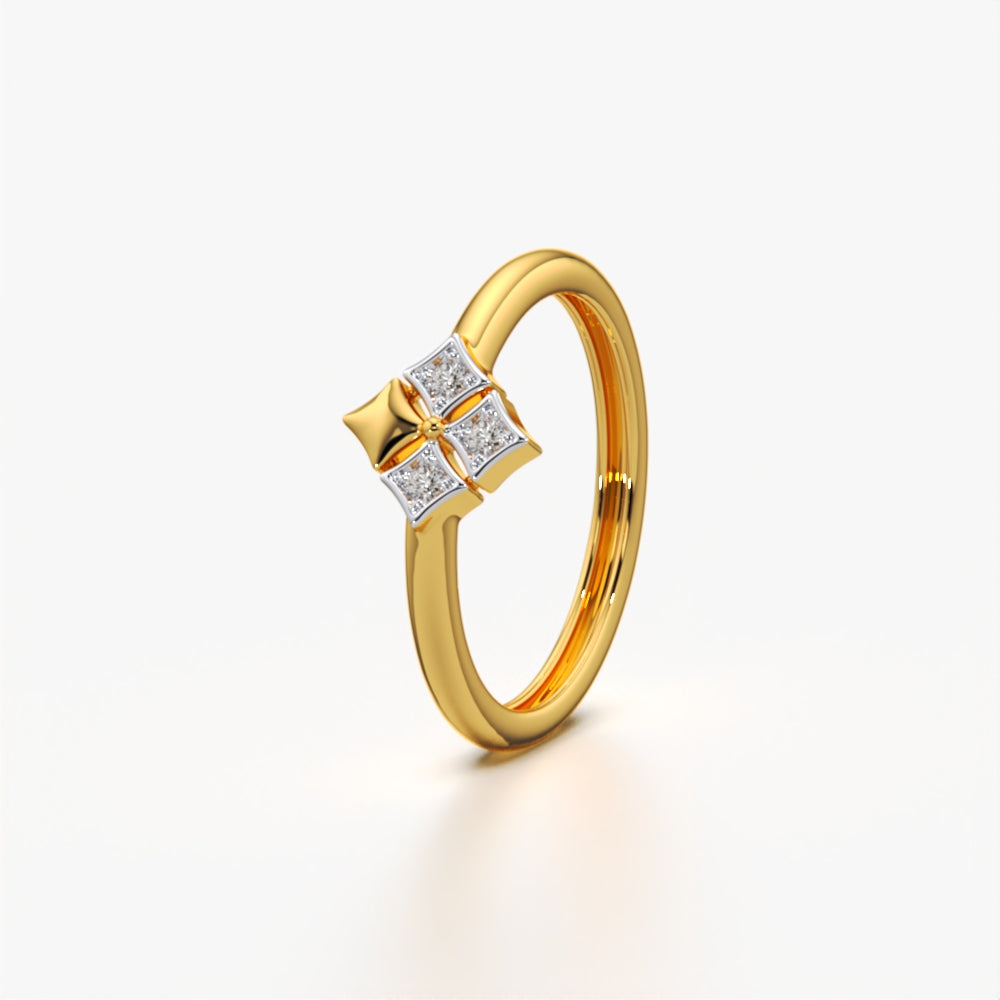
Kite Diamond Cluster Ring
Show Now -

Classic Full Eternity Ring
Show Now -
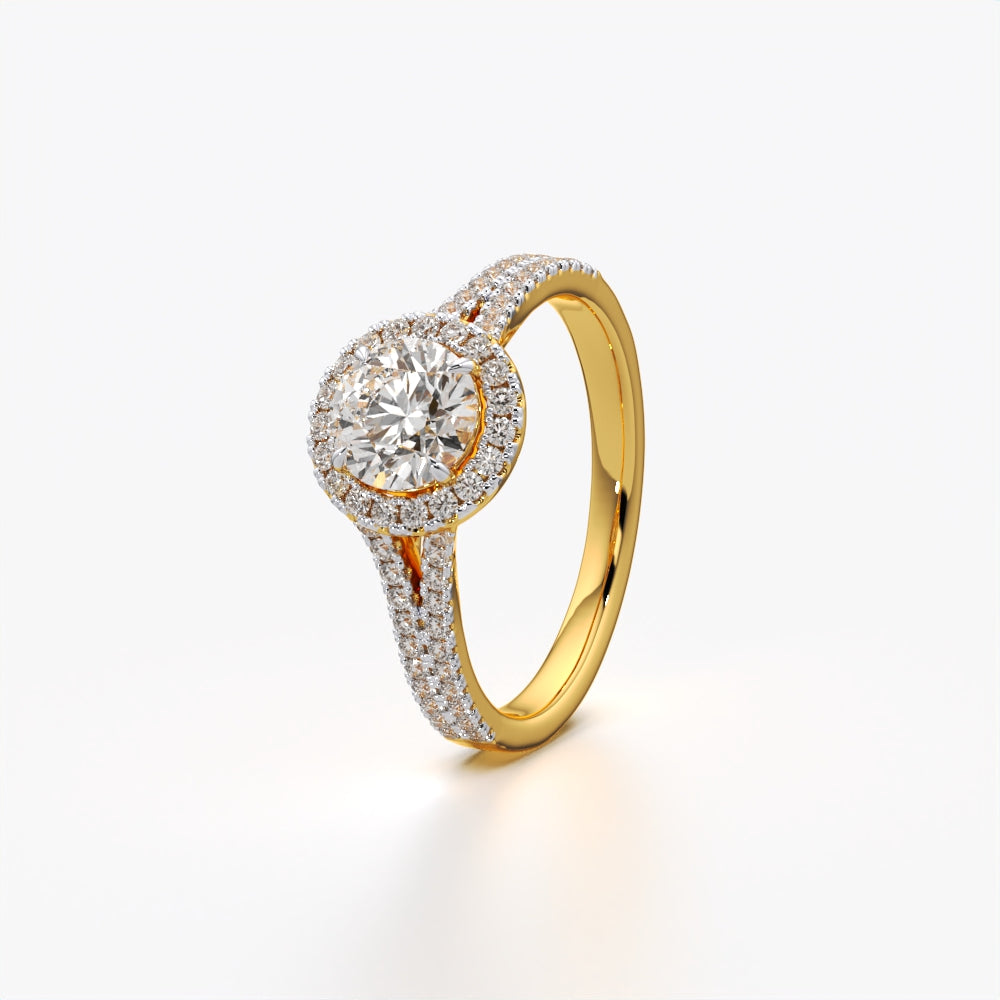
Classic Round Halo Split Shank Ring
Show Now -
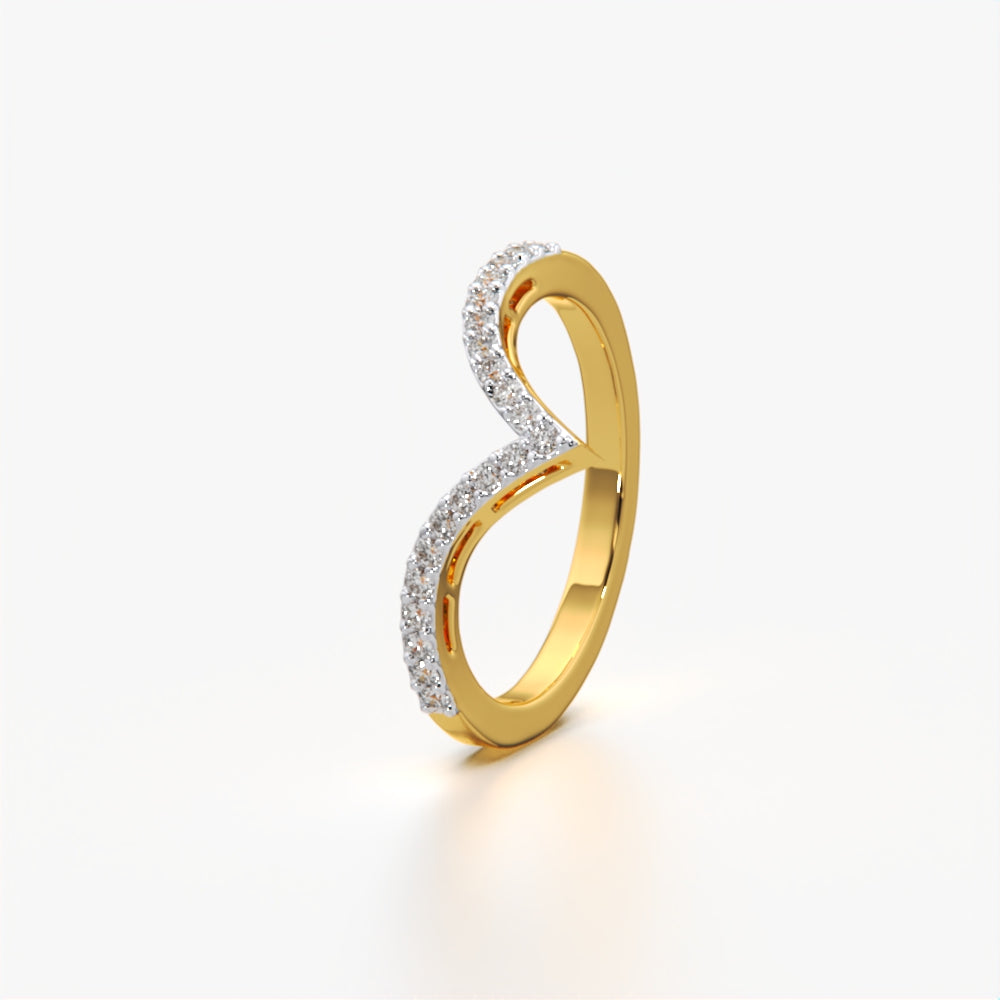
Pave Chevron Stacking Ring
Show Now
How to Measure Ring Size for Someone Else (Without Them Knowing)
If you're buying a ring as a surprise gift, here are the cleanest methods:
Borrow an existing ring: When they're not looking, borrow a ring they wear on the specific finger. Trace the inside on paper or measure the inner diameter. Return it before they notice.
Check their ring box: Most people have a few rings lying around. Pick one that sits on the relevant finger and measure it quickly.
Ask a friend or family member: Someone close to them likely knows their size, or has helped them buy jewellery before.
Estimate from hand size: As a general rule, slender hands start with Indian size 9–11. Average hands, India size 12–14. Larger hands, Indian size 15+. This is a rough estimate, but it helps narrow things down.
Buy from a brand with easy exchanges: This is often the smartest move, choose a jeweller that offers hassle-free sizing exchanges so you're covered even if you're slightly off.
Now That You Know Your Size, Here's a Brand Worth Knowing: KYMEE
Getting your size right is only half the equation. The ring itself has to be worth wearing every day.
KYMEE is a BIS-registered Indian jewellery brand handcrafting 18K Gold Vermeil rings, that's a thick layer of 18K gold (minimum 2.5 microns) over a solid 925 Sterling Silver base. The result is jewellery that looks and feels like solid gold, without the price tag that comes with it.
What makes 18K Gold Vermeil different from regular gold plating?
Standard gold-plated jewellery uses a thin flash of gold over base metal like brass or copper, which wears off within weeks and often turns skin green. Vermeil is a globally recognised higher standard; it must use sterling silver as the base and a meaningfully thick layer of gold. KYMEE's pieces are built to this standard and go further with an anti-tarnish finish that holds up to daily wear.
Why KYMEE specifically:
- Hypoallergenic and skin-safe, the 925 Sterling Silver base means zero irritation, even for sensitive skin
- Anti-tarnish finish, wear them daily without fuss, polishing, or airtight storage
- BIS-registered, certified quality you can trust
- Affordable than Gold
The best part for anyone reading this post: every KYMEE product page includes a ring size chart using Indian sizing and circumference-based measurement. Once you've used any of the methods above to find your circumference in millimetres, ordering is completely straightforward.
If you've always wanted gold jewellery but balked at the price, KYMEE's 18K Gold Vermeil rings are the answer. The gold is real. The sterling silver is real. The craftsmanship is real. The only thing that isn't is the eye-watering price tag.
Special Sizing Notes: Ring Styles That Fit Differently
Not all ring styles wear the same, even at the same size.
Keep these in mind when ordering:
Comfort fit bands: These have a rounded interior edge that sits gently against the finger. They feel slightly looser than standard rings. If you prefer a snug fit, size down by half.
Wide bands (6mm or more): A wider ring applies more pressure across the finger and feels tighter than a narrow ring at the same nominal size. Size up by half to a full size when buying wide bands.
Stackable rings: If you plan to wear multiple rings together on one finger, the rings collectively tighten the fit. Consider sizing up by half.
Statement rings: Large, face-heavy rings with big stones tend to rotate on the finger. A slightly snugger fit (half size down) can help keep them centred.
Eternity bands: Because the ring has stones all the way around, there's no flexible portion; it must slide over the knuckle exactly right. Sizing is more critical here. Measure carefully and, if in doubt, consult the brand.
Common Ring Sizing Mistakes to Avoid
Measuring in the morning: Fingers are smallest in the morning. You'll end up ordering too small.
Measuring in the cold: Cold causes fingers to contract. Measure at room temperature.
Pulling the string too tight: The string should be snug, not cutting into the skin. If it leaves a mark, you've gone too tight.
Measuring the wrong finger: A ring for the ring finger of your right hand won't fit the same as a ring for your left ring finger or your index finger. Measure the specific finger the ring will sit on.
Ignoring knuckle size: Many people have knuckles that are wider than the base of their fingers, especially as we get older. If the ring can't slide over your knuckle, the size is useless. Always size for the knuckle if this applies to you, and choose adjustable or open-band styles if possible.
Measuring after alcohol, salt, or exercise: Sodium and activity temporarily swell your fingers. Wait a couple of hours after eating, drinking, or working out before measuring.
Final Words
Ring sizing is one of those things that feels complicated the first time and completely obvious the second. The string method takes under two minutes. The existing ring method takes under thirty seconds. And once you know your ring size, buying online becomes simple and confident.
The most important rules: measure at the right time of day, measure the right finger, and always check the brand's size chart.
And when you're ready to shop, KYMEE's 18K Gold Vermeil rings are some of the finest quality-to-price pieces available right now. Real gold. Real silver. Real craftsmanship. Designed for modern women who want jewellery that works every day, not just on special occasions, and gathering dust in a box.
FAQs
1. What is the ring size 7 in India?
US size 7 is approximately India size 14, with an inner circumference of around 58.3mm.
2. What is a 6 cm circumference in ring size?
6 cm = 60 mm, which corresponds to approximately US size 9 and India size 19.
3. Can you measure ring size with your phone?
Yes, app-based ring sizers work reasonably well as estimates. For precise sizing, the string method or existing ring method is more reliable.
4. What is the average ring size for women in India?
Between India sizes 9 and 14, with sizes 11–12 being the most common.
5. What is the average ring size for men in India?
Between India sizes 17 and 22, with sizes 19–20 being the most common.
6. Does ring size differ between hands?
Yes, the dominant hand is often very slightly larger. Always measure the specific hand and finger the ring will be worn on.
7. When is the best time to measure ring size?
Late afternoon or evening, at room temperature, when the body is in its normal resting state.
8. How do you convert ring size from cm to mm?
Multiply by 10. A 5.7 cm circumference = 57 mm = Indian size 11.